
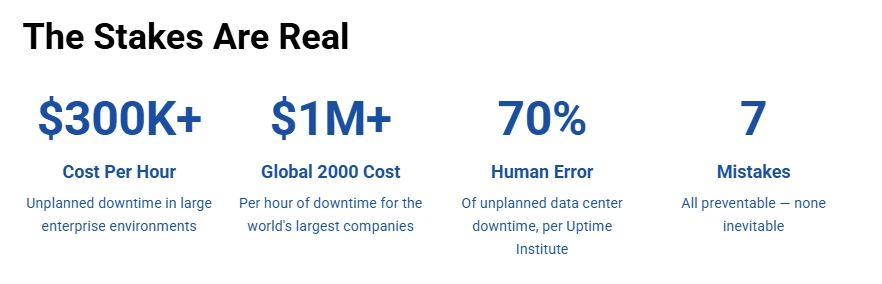
Mistakes can take down server rooms and be costly anytime, but this is especially true during HVAC upgrades. An HVAC upgrade is supposed to improve your facility. For a live server room, it can just as easily destroy it. The same work that modernizes your cooling infrastructure, including cutting ductwork, pulling air handlers, and drilling floor penetrations, releases the exact contaminants and thermal disruptions that server equipment cannot tolerate. One unplanned hour of downtime in a large enterprise environment costs over $300,000. For Global 2000 companies, that number climbs past $1 million. The good news is that none of these failures are inevitable. Every one of them starts with a preventable mistake.
Here are 7 mistakes that take down server rooms during HVAC upgrades, and what to do instead.
Mistake 1: Using Poly Sheeting as Your Containment Barrier
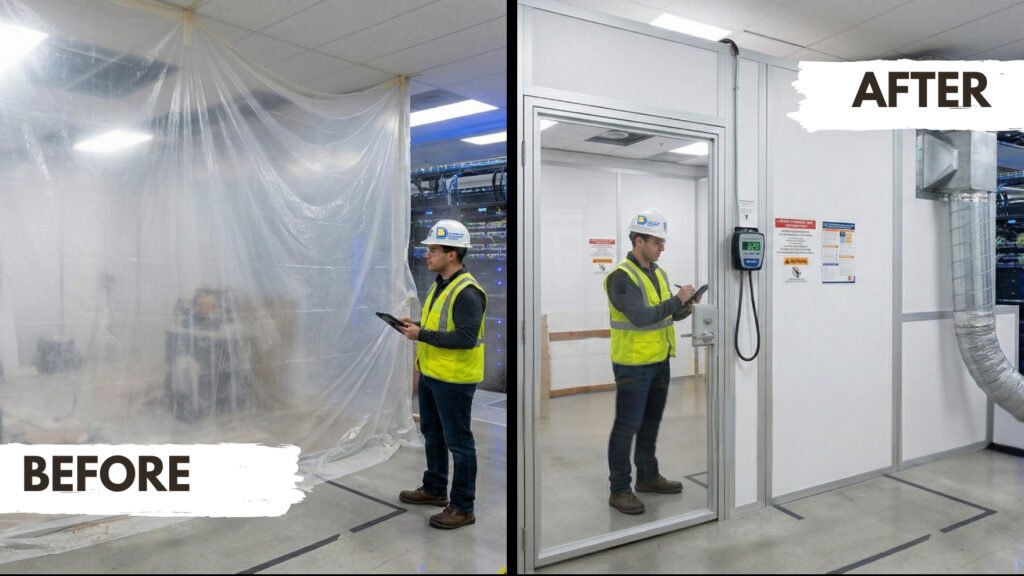
Polyethylene sheeting has been the default containment material on construction sites for decades. In a server room, it is the wrong tool for the job. Poly tears. It cannot maintain an airtight seal when primary HVAC systems are being dismantled and pressure dynamics in the space are shifting. It offers no fire resistance, no sound attenuation, and no structural rigidity to hold a negative pressure differential.
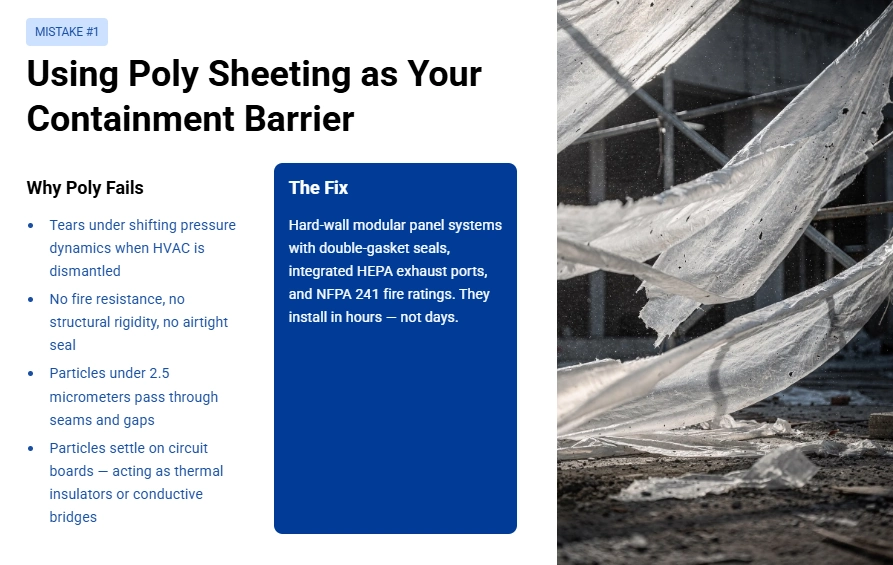
When construction generates fine gypsum dust, metallic particles, or concrete particulates, all common byproducts of HVAC work, poly sheeting fails to contain them. Particles smaller than 2.5 micrometers pass through gaps at seams, anchor points, and floor transitions. Once those particles enter a server chassis through high-velocity cooling fans, they settle on circuit boards and act as thermal insulators. In humid conditions, they create conductive bridges that lead to short circuits.
The fix is hard-wall modular panel systems designed for mission-critical environments. These systems provide rigid, airtight barriers with double-gasket seals at all joints, integrated duct ports for HEPA exhaust, and fire ratings that satisfy NFPA 241 requirements. They install in hours rather than days, which matters when every hour the construction zone is not fully contained is an hour of exposure for your equipment. [NFPA 241 Standard for Safeguarding Construction: https://www.nfpa.org/codes-and-standards/nfpa-241-standard-development/241]
Mistake 2: Skipping Negative Air Pressure in the Work Zone
A containment barrier without negative air pressure is a wall with holes in it. The pressure relationship between your construction zone and your active server environment determines which way contaminants travel. If you do not actively depressurize the work zone, dust and particulates migrate outward toward your equipment whenever a door opens, a panel shifts, or a technician moves through the space.
HEPA-filtered negative air machines must be verified at 99.97% efficiency at 0.3 microns. That threshold is not arbitrary. It is the particle size at which fine gypsum dust, masonry particles, and metallic shavings are captured before the air is exhausted. The negative pressure differential within the work zone must be maintained at a minimum of -0.02 inches of water column, verified by a recording manometer checked at least every two hours during active work. [Cal/OSHA Title 8 Safety Orders: https://www.dir.ca.gov/title8/index/T8index.asp]
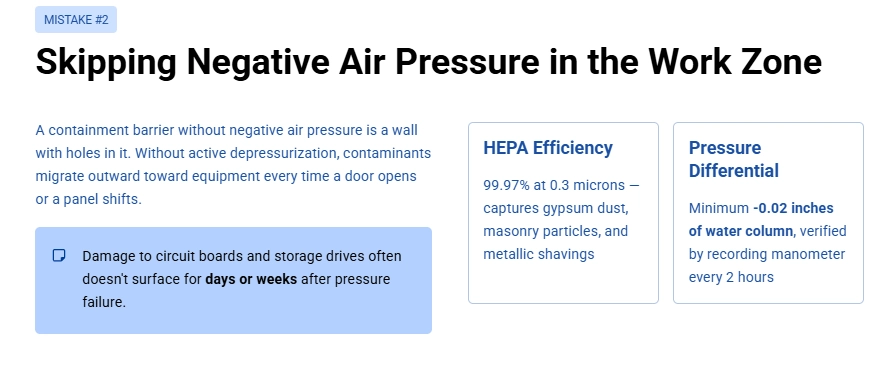
If negative pressure drops and no one catches it, your containment has already failed. The server room may look clean. The damage to circuit boards and storage drives often does not surface for days or weeks.
Mistake 3: Disrupting Hot Aisle / Cold Aisle Airflow Without a Plan
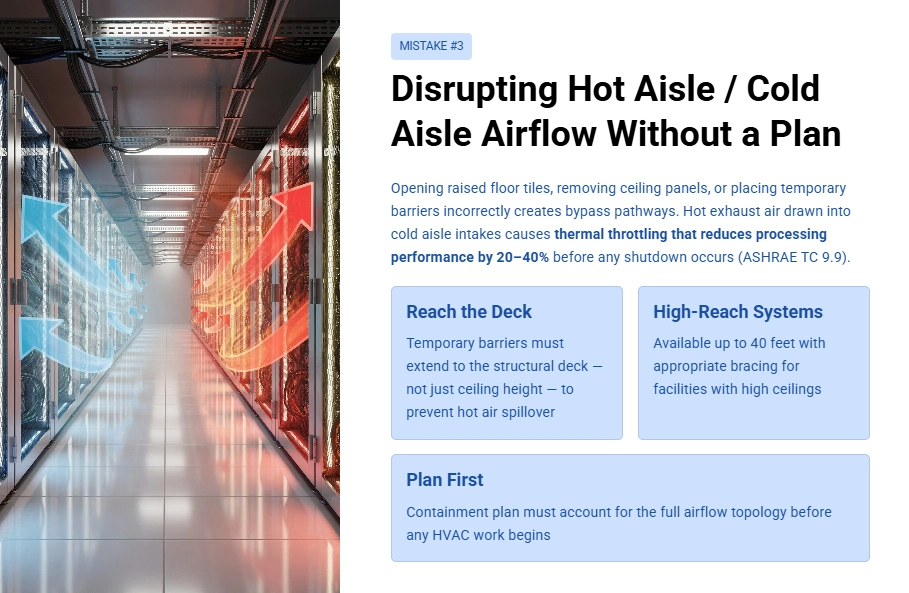
Modern data centers are organized around hot aisle and cold aisle configurations. Cold supply air enters the front of server racks. Hot exhaust exits the rear. Physical containment systems, including ceiling panels, vertical walls, and doors, keep those air streams separated. The entire thermal design of the facility depends on that separation remaining intact.
HVAC work disrupts this in ways that are not always obvious. Opening raised floor tiles in the plenum, removing ceiling panels to access ductwork, or installing temporary barriers in the wrong configuration all create new bypass pathways. Hot exhaust air from the construction zone can be drawn into cold aisle intakes. When that happens, servers experience thermal throttling that can reduce processing performance by 20% to 40% before an actual shutdown occurs. [ASHRAE TC 9.9 Thermal Guidelines: https://www.ashrae.org/technical-resources/bookstore/datacom-series]
Before any HVAC work begins, the containment plan must account for the airflow topology of the affected area. Temporary barriers need to reach the deck, not just ceiling height, to prevent hot air from spilling over the top. In facilities with high ceilings, high-reach containment systems are available that extend up to 40 feet with appropriate bracing, providing total vertical isolation of the work zone without compromising the return air path of active cooling units.
Mistake 4: Exceeding ASHRAE Thermal Rate-of-Change Limits
Most facility managers know ASHRAE TC 9.9 recommends a server room temperature between 18°C and 27°C (64.4°F to 80.6°F). What fewer people track during an HVAC upgrade is the rate at which temperature is allowed to change.
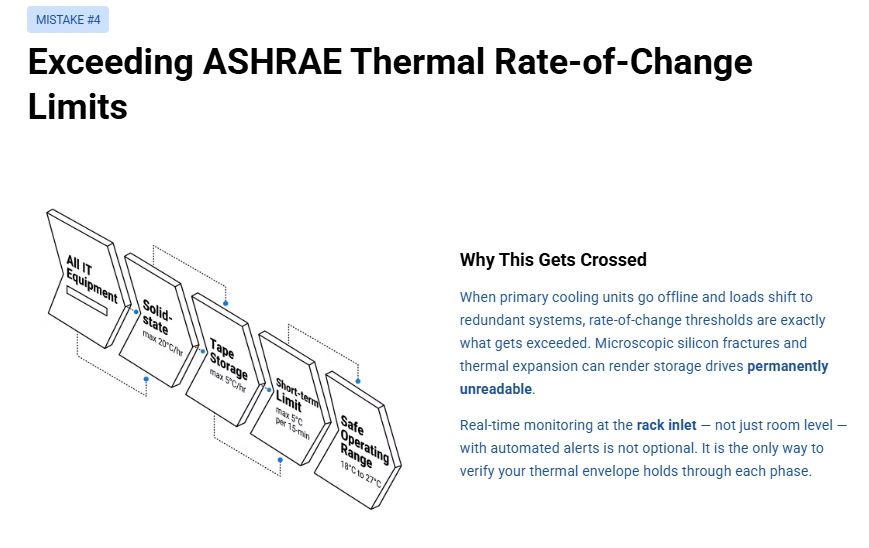
ASHRAE sets strict limits on thermal rate of change to prevent thermal shock to equipment. For solid-state IT equipment, the limit is no more than 20°C per hour. For tape storage, the limit drops to 5°C per hour. Neither type of equipment should experience more than 5°C of change within any 15-minute window. Exceeding these limits causes microscopic fractures in silicon components and thermal expansion issues that can render high-density storage drives permanently unreadable.
During an HVAC upgrade, when primary cooling units are taken offline and loads are redistributed to redundant systems, these rate-of-change thresholds are exactly what gets crossed. Without continuous temperature monitoring at the server rack inlet and not just at the room level, you will not know a threshold was exceeded until the damage is done. Real-time environmental monitoring with automated alerts is not optional in a live upgrade scenario. It is the only way to verify that your thermal envelope is holding throughout each phase of the work. [ASHRAE TC 9.9: https://www.ashrae.org/technical-resources/bookstore/datacom-series]
Mistake 5: No Formal Method of Procedure (MOP) Before Work Begins
Human error drives approximately 70% of unplanned data center downtime according to the Uptime Institute. Not hardware failure. Not power events. People following unclear instructions, skipping steps under time pressure, or making judgment calls that introduce single points of failure into a redundant system.
A Method of Procedure is the operational document that prevents this. For an HVAC upgrade, a proper MOP defines the exact sequence for isolating a cooling unit, the steps to transition the load to redundant N+1 systems, the temperature and humidity thresholds that trigger a work pause or rollback, and the responsible parties for each decision point. It is reviewed and approved by the data center operations team before any work starts, not written the morning of.
For Tier III and IV facilities, this is not a best practice. It is a requirement for maintaining Uptime Institute Tier Certification of Operational Sustainability (TCOS). Any HVAC upgrade that bypasses formal change management risks a compliance gap that can affect the facility’s certified status. [Uptime Institute Tier Standards: https://uptimeinstitute.com/tier-certification]
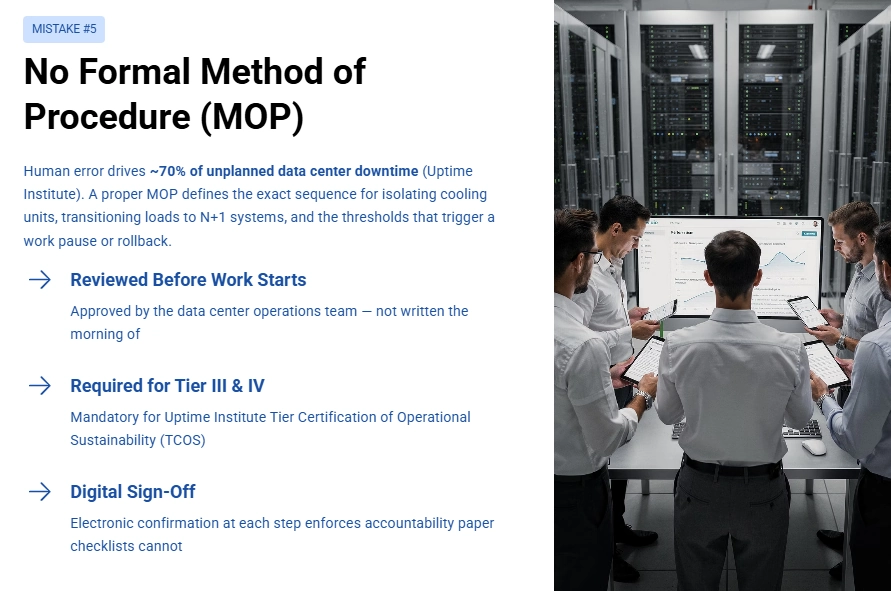
Digital MOP platforms that require electronic sign-off at each step significantly reduce the probability of errors. When a technician must confirm a sensor reading before proceeding to the next step, the system enforces accountability that paper checklists cannot.
Mistake 6: Ignoring Cal/OSHA Silica and Dust Requirements
California contractors working in occupied facilities have a specific set of regulatory obligations that apply directly to HVAC work in server rooms. Cal/OSHA Title 8, Section 1530.1 governs dust-generating operations, including cutting concrete for new HVAC conduits, drilling through slabs, and demolishing existing ductwork. It requires employers to implement local exhaust ventilation or physical isolation to protect building occupants.
The Respirable Crystalline Silica standard (Title 8, Section 1532.3) establishes a Permissible Exposure Limit of 50 micrograms per cubic meter as an 8-hour time-weighted average. Any activity that exceeds the action level of 25 micrograms per cubic meter triggers mandatory air monitoring and the implementation of engineering controls, including HEPA-filtered containment. These requirements apply to any occupied California facility where dust-generating construction occurs, not only healthcare or abatement work.
Failure to comply does not just risk fines. It can trigger a stop-work order. In a phased HVAC upgrade where each phase builds on the last, a stop-work order during Phase 2 does not just delay Phase 2. It extends the window of vulnerability for every server in the affected area. [Cal/OSHA Title 8: https://www.dir.ca.gov/title8/index/T8index.asp]
Proper containment with verified negative air pressure is simultaneously your environmental protection strategy and your Cal/OSHA compliance documentation.
Mistake 7: Treating Containment as a Commodity Decision
The final and most consequential mistake is selecting containment based on lowest cost rather than performance specification. In a standard commercial renovation, a lower-cost containment option may save money with minimal consequences. In a live server room, the wrong containment system is not a cost savings. It is a liability.
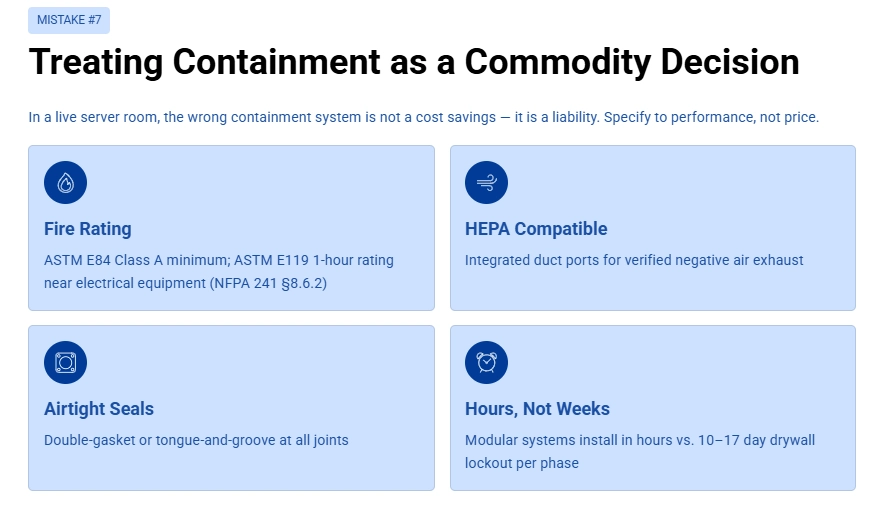
The containment system you deploy needs to meet a specific set of performance criteria: fire resistance rated at minimum ASTM E84 Class A, with ASTM E119 one-hour ratings for the highest-risk zones near electrical equipment; HEPA exhaust compatibility with integrated duct ports; double-gasket or tongue-and-groove seals at all joints; and the structural integrity to maintain negative pressure through multiple work shifts and technician entries. NFPA 241, Section 8.6.2 mandates 1-hour fire-rated temporary separation walls between occupied spaces and construction zones with higher hazard levels. A data center with high concentrations of electrical equipment and flammable packing materials in the construction zone qualifies. [NFPA 241: https://www.nfpa.org/codes-and-standards/nfpa-241-standard-development/241]
Modular hard-wall systems also install in hours rather than the 10 to 17-day lockout window that traditional drywall containment creates per project phase. During that drywall window, adjacent racks may need to remain offline to avoid dust ingress, and each day adds directly to the downtime cost that the upgrade was never supposed to create.
When you specify containment for a live server room HVAC project, you are making a decision that affects uptime, regulatory compliance, and equipment protection simultaneously. That decision belongs in the project specification, not in a last-minute field conversation.
Protect Your Server Room Before the First Tool Hits the Floor
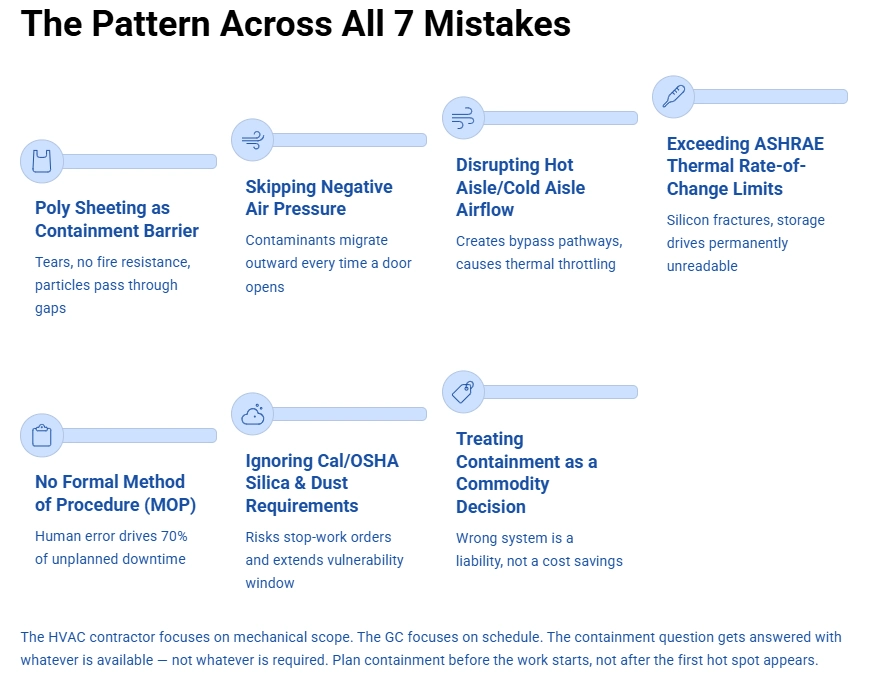
The pattern across all seven of these mistakes is the same: containment and operational planning are treated as afterthoughts rather than primary specifications. The HVAC contractor focuses on the mechanical scope. The GC focuses on schedule. And the containment question gets answered with whatever is available, not whatever is required.
For data center facility managers and general contractors working in the Bay Area and Northern California, Construction Containment Services (5DCCS) provides full-service modular containment for live server room and data center projects. Our systems meet NFPA 241 fire rating requirements, maintain verified negative air pressure, and install in hours so your HVAC upgrade timeline stays on track and your servers stay online.
Contact us before your next HVAC upgrade scope is finalized. The time to plan containment is before the work starts, not after the first hot spot appears.
Contact 5DCCS: 5dccs.com/contact | (855) 684-3752 | info@5dccs.com