
Data Center Row
Why Data Centers Need Modular Containment During Live Operations
One hour of unplanned data center downtime costs between $100,000 and $500,000, depending on facility size and criticality. Yet most infrastructure upgrades—cooling system replacements, electrical work, fire suppression installations—require weeks of construction activity in live environments where servers must remain operational 24/7.
At Construction Containment Services (5DCCS), we’ve helped Bay Area data center operators solve this challenge repeatedly: how do you perform dusty, disruptive construction work where even minor particulate contamination can cause equipment failure, and maintaining precise thermal zones is non-negotiable?
Traditional barriers like drywall and plastic sheeting create more problems than they solve. Drywall is slow, messy, and generates dust. Plastic sheeting can’t maintain thermal separation and poses fire risks.
Based on our experience serving data centers across the Bay Area, we’ve learned that these facilities need a fundamentally different approach—one that protects critical infrastructure without forcing costly shutdowns.
The Hidden Risks of Traditional Containment Methods
Dust Contamination Equals Equipment Failure
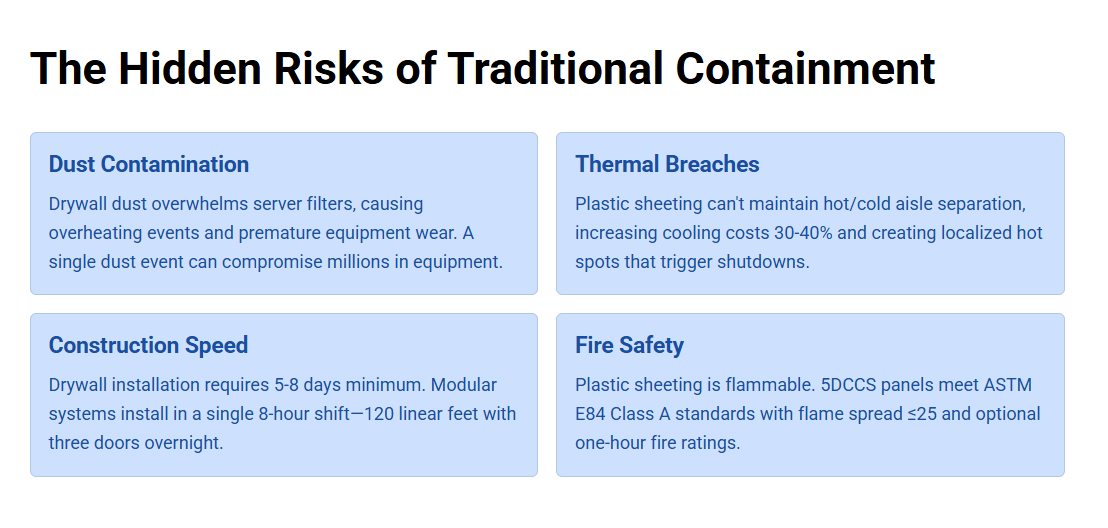
Server equipment pulls thousands of cubic feet of air per minute through intake filters. During construction, even small amounts of drywall dust, concrete particulate, or metal shavings can overwhelm these filters, causing:
-
- Accelerated filter clogging that reduces cooling efficiency
-
- Overheating events that trigger emergency shutdowns
-
- Particulate infiltration damaging sensitive components
-
- Premature equipment wear
A single dust event can compromise equipment worth millions. Traditional drywall barriers create dust during installation and removal—exactly what data centers can’t tolerate.
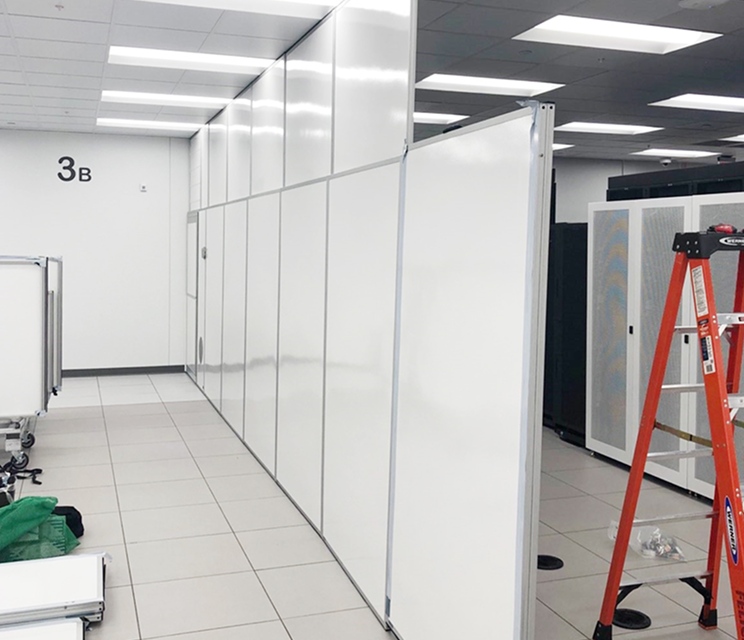
Our containment systems are designed to install with zero cutting, zero finishing, and zero on-site dust generation. Panels arrive pre-fabricated and assemble using sealed interlocking connections.
Thermal Barrier Breaches Compromise Cooling Efficiency
Data centers rely on hot aisle/cold aisle containment. Mixing hot and cold air can increase cooling costs by 30-40% and create localized hot spots that trigger thermal shutdowns.
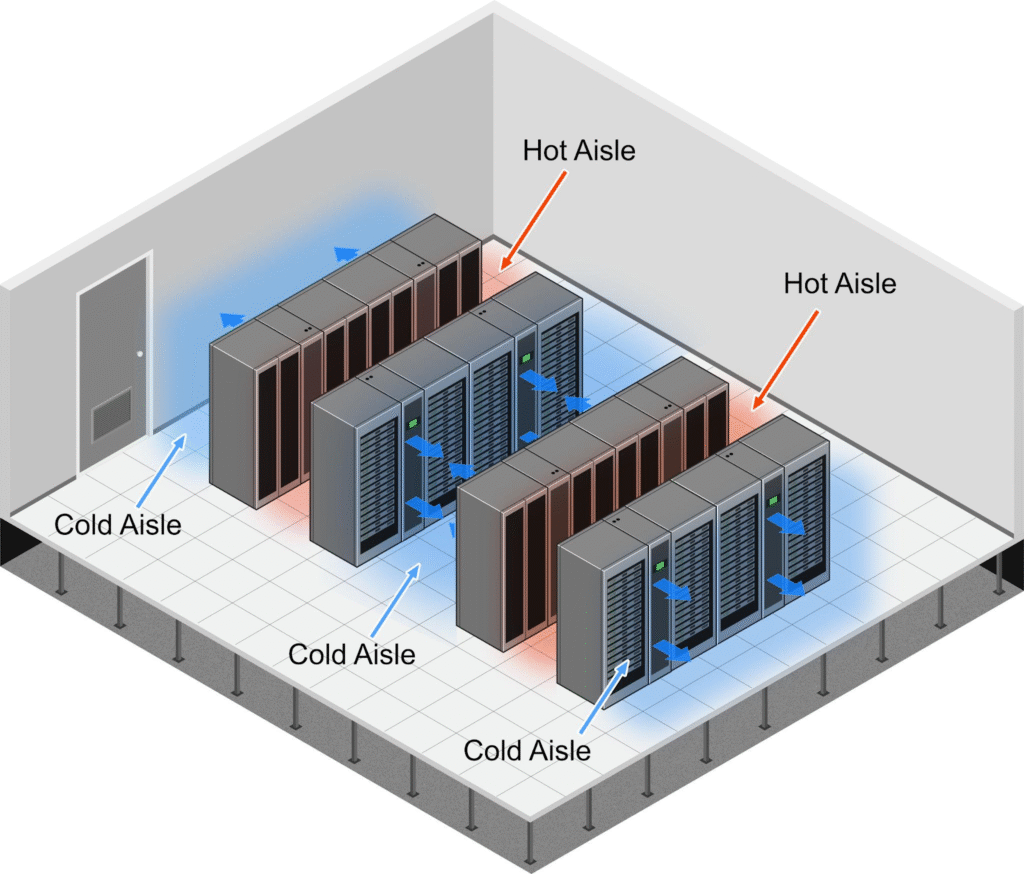
Plastic sheeting can’t maintain thermal separation. It’s porous, flexes with air pressure, and creates gaps at floor and ceiling interfaces.
We deploy modular walls with solid-core construction providing R-7 thermal insulation. This creates true thermal barriers that maintain hot/cold aisle integrity throughout construction.
Construction Speed Matters
Drywall partition installation requires 5-8 days minimum (framing, installation, finishing, painting, removal).
Our installation teams complete the same work in a single 8-hour shift. We can install 120 linear feet of containment walls with three access doors between 10 PM and 6 AM and ready for construction crews the next morning.
This speed isn’t just crew efficiency. It’s system design: pre-fabricated panels, tool-free assembly, no finishing required.
Fire Safety and Code Compliance
Plastic sheeting is flammable. Temporary drywall may not meet fire rating requirements near electrical rooms.
We provide containment systems meeting ASTM E84 Class A standards (flame spread ≤25). Our panels are non-combustible or fire-resistant. For projects requiring one-hour fire ratings, we deploy specialized systems that maintain UL certification while offering modular speed and cleanliness.
Why Data Centers Are Different
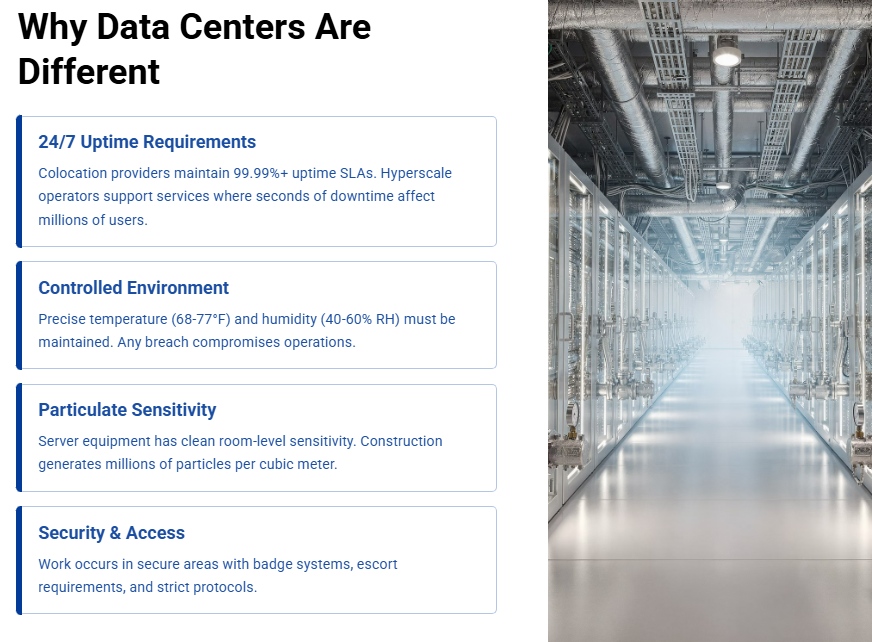
24/7 Uptime Requirements
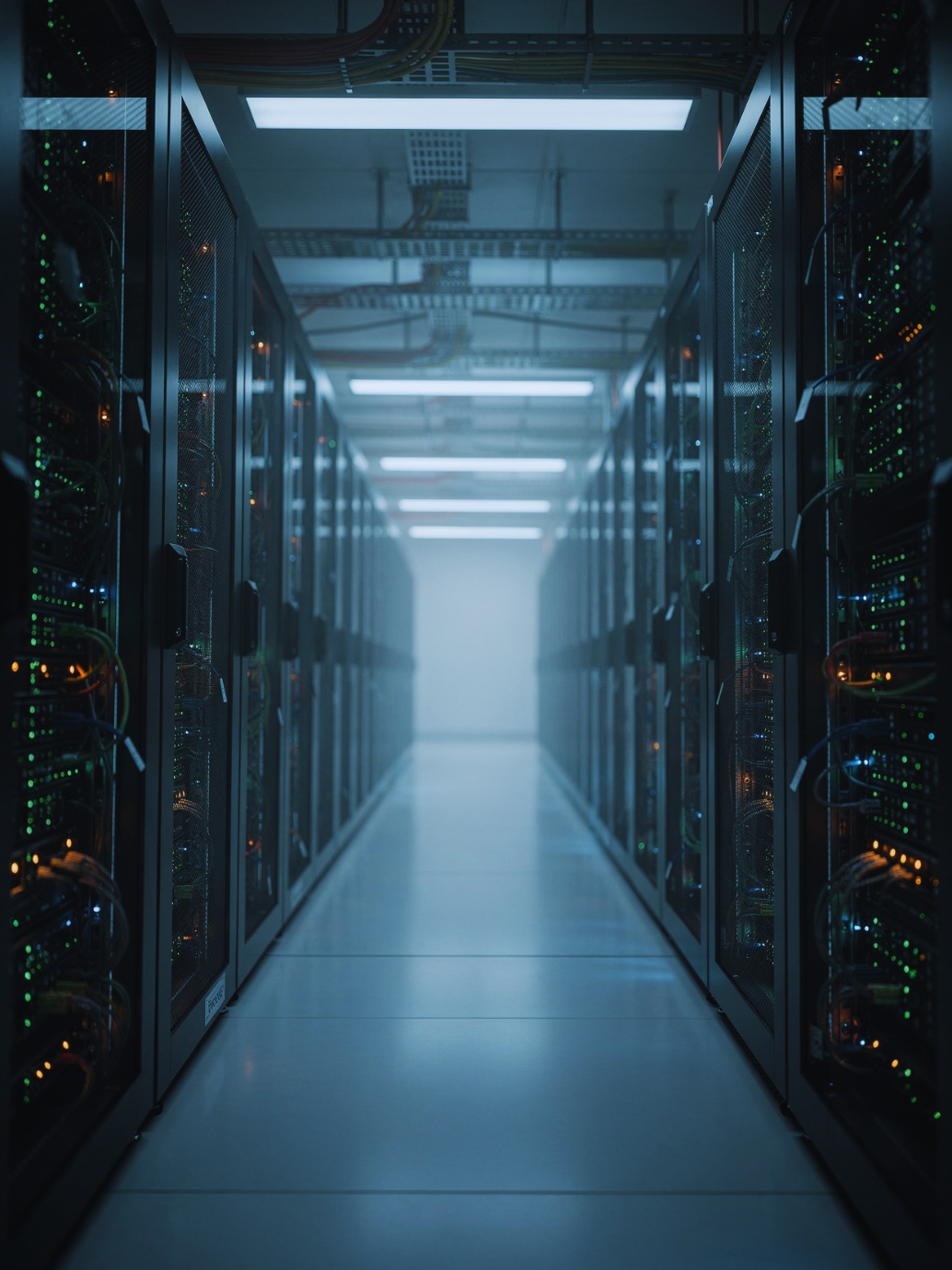
Unlike office buildings that can shut down for construction, data centers must maintain continuous operations. Colocation providers have 99.99%+ uptime SLAs. Hyperscale operators support services where seconds of downtime affect millions.
We design every data center project around this requirement. Our installation process requires zero power shutdowns, maintains infrastructure accessibility, supports 24/7 crew access, and allows rapid reconfiguration.
Our teams are available for night and weekend installations specifically because data center operations can’t stop for construction convenience.
Controlled Environmental Conditions
Data centers maintain precise temperature (68-77°F) and humidity (40-60% RH). Our containment systems seal thermal zones, maintain pressure differentials, prevent HVAC contamination, and support negative air systems when needed.
We complete HVAC replacement projects where our containment maintained ±2°F temperature stability in operational zones adjacent to active construction.
Particulate Sensitivity
While not classified clean rooms, data centers have similar sensitivity to airborne particulates. Construction generates millions of particles per cubic meter.
Our approach creates sealed barriers preventing particle migration. For high-risk work like concrete cutting, we deploy HEPA-filtered negative air machines maintaining -0.02 to -0.05 inches water column pressure differential—the same standard used for hospital infection control.
Security and Access Control
Data center construction often occurs in secure areas. Our containment integrates with existing security by providing lockable access points compatible with badge systems, offering clear panels for visual monitoring when required, and creating secure material staging areas.
We’ve worked in facilities with strict escort requirements, multi-factor authentication, and video surveillance. Our crews are accustomed to security protocols common in mission-critical facilities.
How 5DCCS Modular Containment Solves These Challenges
Speed: Install in Hours, Not Days
Our walls use interlocking panels assembling with minimal fasteners and zero on-site cutting. A typical installation sequence involves delivering and positioning panels (Hour 1), installing wall panels (Hours 2-3), and installing doors with final inspection (Hour 4).
This represents a dramatic time savings compared to drywall, which would require 5-8 days for the same scope.
Thermal Separation
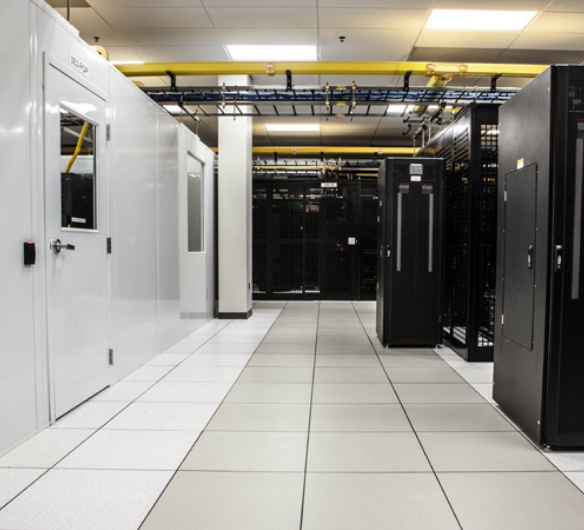
Our solid-core panels provide R-7 thermal resistance. Combined with sealed edges, gaskets at floor interfaces, and ceiling integration, this delivers true thermal barriers maintaining temperature differentials.
The barrier performance maintains design temperature zones so HVAC systems don’t work harder, and there’s no risk of hot spots affecting equipment.
Dust Control
Our modular walls create sealed barriers from the moment of installation:
-
- No cutting or finishing means zero dust generation
-
- Interlocking seals prevent air and particle infiltration
-
- Gaskets and weatherstripping complete the seal
-
- Compatible with negative air systems for high-risk work
For dust-intensive projects, we provide HEPA-filtered negative air with three-stage filtration (99.97% efficiency).
Flexibility
Data centers often work in phases. Our panels disassemble quickly, relocate without damage, adapt to different configurations, and support multiple reconfigurations.
For example, a multi-phase electrical upgrade might require moving containment barriers three or four times as work progresses through different areas. Our panels can be reconfigured in 4-6 hours per phase and reused throughout the project with zero waste.
Professional Appearance
Many operators host client tours or maintain colocation facilities where customers visit equipment. Our systems offer clean finished surfaces, custom graphics options when needed, consistent appearance across phases, and no exposed framing.
This matters beyond customer perception. Technical staff working around the clock appreciate clean, well-defined work zones rather than flapping plastic barriers.
Learn more about our Modular Wall Containment Services.
Illustrative Scenario: Data Center HVAC Upgrade
To understand how modular containment solves real challenges, consider a typical data center HVAC project:
The Project
A colocation provider needs to replace aging CRAC units in a 10,000 square foot data hall. The work involves removing four existing units, installing new high-efficiency cooling equipment, upgrading electrical and controls, and performing ductwork modifications. Timeline: 6 weeks with work occurring nights and weekends.
The Challenge
The data hall houses customer equipment under 99.99% uptime SLAs. The facility cannot shut down equipment, allow dust contamination, compromise thermal separation, or disrupt customer access during business hours.
Drywall would take a week to install (generating dust) and another week to remove. Plastic barriers couldn’t maintain thermal separation.
The Modular Containment Approach
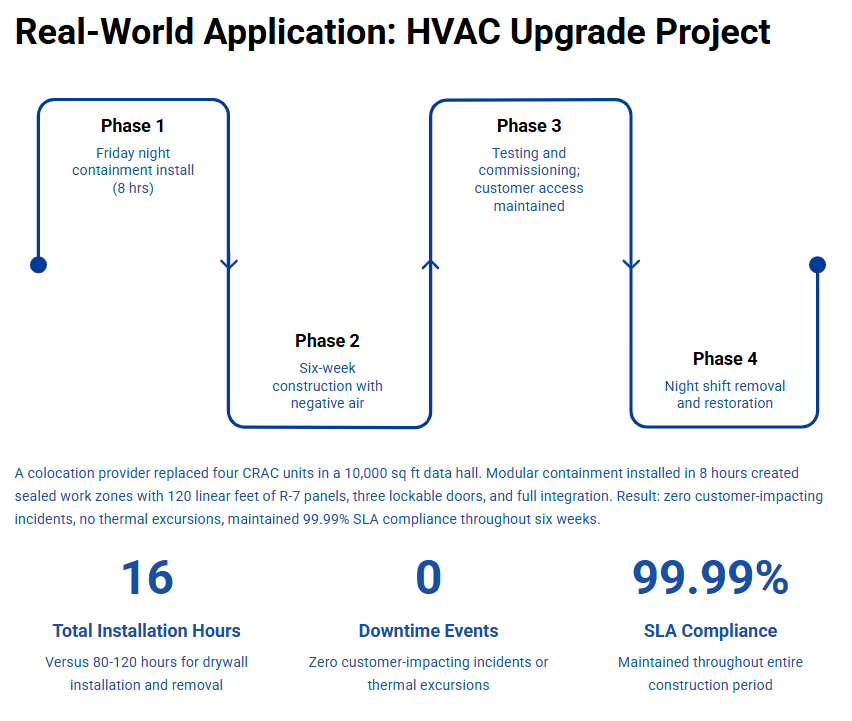
Phase 1 Installation: Modular containment walls are installed during a Friday night shift, creating a sealed work zone: 120 linear feet of thermal-rated panels (R-7), three lockable doors, one clear monitoring section, and full ceiling and raised floor integration. Installation completes in an 8-hour window.
During Construction: HEPA-filtered negative air maintains proper pressure inside the work zone. Dust remains contained. Thermal separation is maintained so cooling efficiency is unaffected. Customer access to adjacent areas continues normally. Professional appearance is preserved for scheduled client tours.
Removal: After final testing and commissioning, the containment is removed during another night shift. The data hall is restored to full operational configuration. Panels are cleaned and prepared for the next project.
Expected Outcomes
This approach is designed to achieve:
-
- Zero customer-impacting incidents
-
- No thermal excursions or efficiency loss
-
- No dust contamination in operational areas
-
- Maintained SLA compliance throughout the project
-
- Reusable system for future facility upgrades
The installation time of approximately 16 hours contrasts sharply with the 80-120 hours typically required for drywall installation and removal.
Understanding the ROI
Avoided downtime: Preventing one hour of thermal-related shutdown ($100,000 to $500,000) pays for professional containment multiple times over.
Equipment protection: Preventing dust infiltration that accelerates hardware wear can save hundreds of thousands of dollars per rack in avoided premature replacement costs.
Cooling efficiency: Maintaining thermal separation prevents efficiency losses of 30% or more that can cost thousands of dollars weekly in additional electricity consumption.
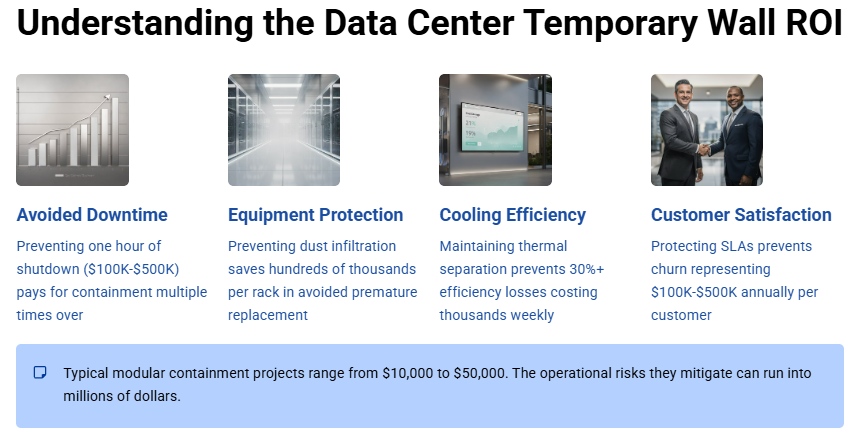
Customer satisfaction: For colocation providers, maintaining operations during construction protects SLAs and prevents customer churn that could represent $100,000 to $500,000 annually per lost customer.
Bottom line: Typical modular containment projects range from $10,000 to $50,000. The operational risks they mitigate can run into millions of dollars.
Why Bay Area Data Centers Choose 5DCCS
Local Expertise and Rapid Response
We’re based in San Jose with local inventory, enabling same-day or next-day mobilization for urgent projects. We understand Bay Area facilities and work with major Northern California general contractors.
California Regulatory Knowledge
We understand Cal/OSHA silica regulations, Title 24 energy code requirements, seismic considerations, and local permitting requirements that affect temporary construction barriers.
Veteran-Led Service Excellence
As a veteran-owned company, we bring military discipline to data center projects: mission-focused execution, attention to detail, clear communication, and accountability.
Full-Service Model
Unlike equipment rental companies that drop off panels, we provide site assessment, installation and integration, project supervision, mid-construction adjustments, and removal with cleaning. One point of contact, one invoice, complete execution.
Next Steps
In Part 2 of this series:
-
- How to select the right containment partner
-
- Performance specifications that matter
-
- Planning checklists for phased projects
-
- Common mistakes to avoid
Ready to Start Planning?
Construction Containment Services (5DCCS)
San Jose, California
(855) 684-3752
We serve data center operators, colocation providers, and general contractors throughout the Bay Area. Our containment systems are engineered for live operational environments where downtime isn’t an option. Contact us to discuss your project timeline, containment challenges, and performance requirements. We provide free consultations and site assessments.