
Keep Students in the Classroom While the Building Improves Around Them
Educational facilities renovate year-round, and the school day does not stop for construction. 5DCCS delivers modular containment systems engineered specifically for occupied school environments: sound-dampening panels that keep construction noise out of classrooms, fast installation that works around bell schedules, and fire-rated barriers that meet the compliance standards California schools require.
Classroom Noise Standards Make Construction Containment a Learning Outcomes Issue
ANSI/ASA S12.60, which is the national acoustic standard for schools, limits background noise in occupied classrooms to 35 dBA. A teacher speaking at a normal volume of 65 dBA needs background noise below 50 dBA to maintain the +15 dB signal-to-noise ratio required for adequate speech comprehension. Construction noise that breaches those thresholds during instructional periods does not just disrupt, it makes learning measurably harder, particularly for students with hearing difficulties or language differences.
This means the containment barrier is not just a safety measure in a school setting, it is an acoustic intervention. The panel system selected, how it seals to the floor and ceiling, and whether it provides meaningful sound attenuation at the frequencies construction generates all directly affect what students can hear and understand in adjacent classrooms. We carry sound-dampening panel options specifically for situations where construction must proceed near active instructional spaces.

Bell Schedules, State Testing, and Summer Windows All Change the Project Plan
School construction does not operate on the same schedule as commercial renovation. High-noise activities like core drilling, saw cutting, and heavy demolition, are essentially incompatible with instructional periods in adjacent spaces. Most school projects schedule the loudest work after dismissal, during school holidays, or over summer break. For work that must happen during the school year, the containment system is what makes it possible to proceed without disrupting classrooms in adjacent zones.
We plan containment layouts with the school's operational calendar in mind. California's Division of the State Architect (DSA) reviews and approves construction plans for K-12 schools, adding an additional compliance layer that we account for during project planning. When construction must proceed during state testing windows or other high-sensitivity periods, we coordinate with school administration and your GC to identify the right sequencing and the right panel specifications for the noise environment.
Where We Work
Containment Solutions Across Every Educational Setting
From elementary school hallway renovations to large-scale university campus modernization projects, every educational facility has its own occupancy schedule, noise sensitivity, and compliance requirements. Here is how we support active construction across the full range of educational environments.
Classroom & Lecture Hall Renovations
Renovations to classrooms, lecture halls, and instructional spaces adjacent to active teaching areas require sound-dampening containment that meets the acoustic requirements ANSI/ASA S12.60 establishes. Our highest-STC panel options reduce construction noise transmission into adjacent classrooms, keeping teachers able to instruct and students able to hear during high-noise renovation phases scheduled for after school hours.
Science Labs & Specialized Academic Spaces
Science labs, computer labs, art studios, and maker spaces involve equipment and materials that require extra protection from construction dust during adjacent renovation. Our sealed barrier systems prevent dust from reaching sensitive instrumentation, computer hardware, and teaching materials. For lab renovations that occur while adjacent spaces remain in use, we design containment that maintains clean air quality on the occupied side throughout the project.
Libraries & Study Area Upgrades
Library renovations and study space upgrades present the tightest noise tolerance of any educational environment, a library quiet zone runs at ambient noise levels well below what any construction activity can generate without containment. Our modular barriers provide the acoustic separation needed to allow shelving installations, HVAC upgrades, and technology infrastructure work to proceed without penetrating the quiet zones students depend on for focused study.
Cafeterias & Dining Hall Expansions
Cafeteria renovations and dining facility expansions in occupied schools must allow meal service to continue without exposing students and staff to construction dust, debris, or noise during service periods. We design phased containment that keeps the maximum food service area operational while construction proceeds in isolated sections, with barriers that seal kitchen exhaust paths and prevent food safety contamination events during renovation.
Gymnasium & Athletic Facility Upgrades
Gymnasium renovations many times involve flooring replacements, bleacher upgrades, HVAC improvements, locker room expansions, and more. They often need to happen while the rest of the athletic complex remains in use for PE classes and after-school sports. Our barriers define construction zones within large open gym spaces, provide access-controlled entry points, and prevent construction debris from reaching active court surfaces and equipment storage areas.
Dormitory & Student Housing Projects
University dormitory renovations and student housing upgrades occur in spaces where students live continuously, sleep on varying schedules, and have limited ability to relocate during construction. Our containment systems isolate renovation work in dormitory corridors, mechanical rooms, and common areas to protect residents from construction noise, dust, and debris, maintaining the living environment standards universities are obligated to provide throughout multi-month renovation projects.
Standards & Compliance
The Regulations That Govern Construction in California Schools
School construction in California operates under a compliance framework that most commercial renovation projects do not encounter. The Division of the State Architect reviews and approves construction plans for K-12 facilities under the Field Act, adding a state review layer on top of local building department requirements. ANSI/ASA S12.60 establishes the acoustic performance criteria that determine whether construction can proceed during instructional periods in adjacent spaces. And the same NFPA fire and ADA accessibility requirements that apply in any occupied building apply in schools and often with stricter enforcement because of the student population involved.
The containment barrier sits at the intersection of all of these requirements. It must meet fire rating standards for occupied public assembly spaces. It must maintain ADA-compliant accessible routes for students with mobility equipment. It must provide meaningful acoustic performance during instructional hours. And it must present a professional, non-threatening appearance appropriate for a student environment. Our systems are specified to meet these requirements from the initial configuration.
Why Modular Walls
What Plastic Sheeting Cannot Do in a School Environment
Plastic sheeting is the default choice for construction containment in schools because it is inexpensive. It fails at nearly every measure that matters in an occupied school: acoustic performance, fire compliance, structural integrity under student contact, and the professional appearance that a student learning environment deserves. Here is what modular walls provide instead.
Sound Attenuation That Actually Protects Adjacent Classrooms
Plastic sheeting provides essentially no acoustic performance. It transmits nearly all construction noise directly into adjacent spaces. Our modular panel systems provide meaningful STC-rated sound attenuation, reducing the noise energy reaching adjacent classrooms during construction. For projects near active instructional spaces, we recommend our highest-STC panel options, which are specifically engineered for noise-sensitive occupied environments.
ASTM E84 Class A Fire Rating (Required in School Corridors)
Plastic sheeting does not meet the ASTM E84 Class A fire rating required for barriers in occupied public assembly buildings, including school corridors, classrooms, and egress paths. All panels in our systems carry Class A ratings as standard. In a student environment where fire egress response time matters most, this is not an optional upgrade. It is the minimum acceptable standard for any barrier in a hallway or occupied space.
Rigid Structure That Holds Under Student Contact
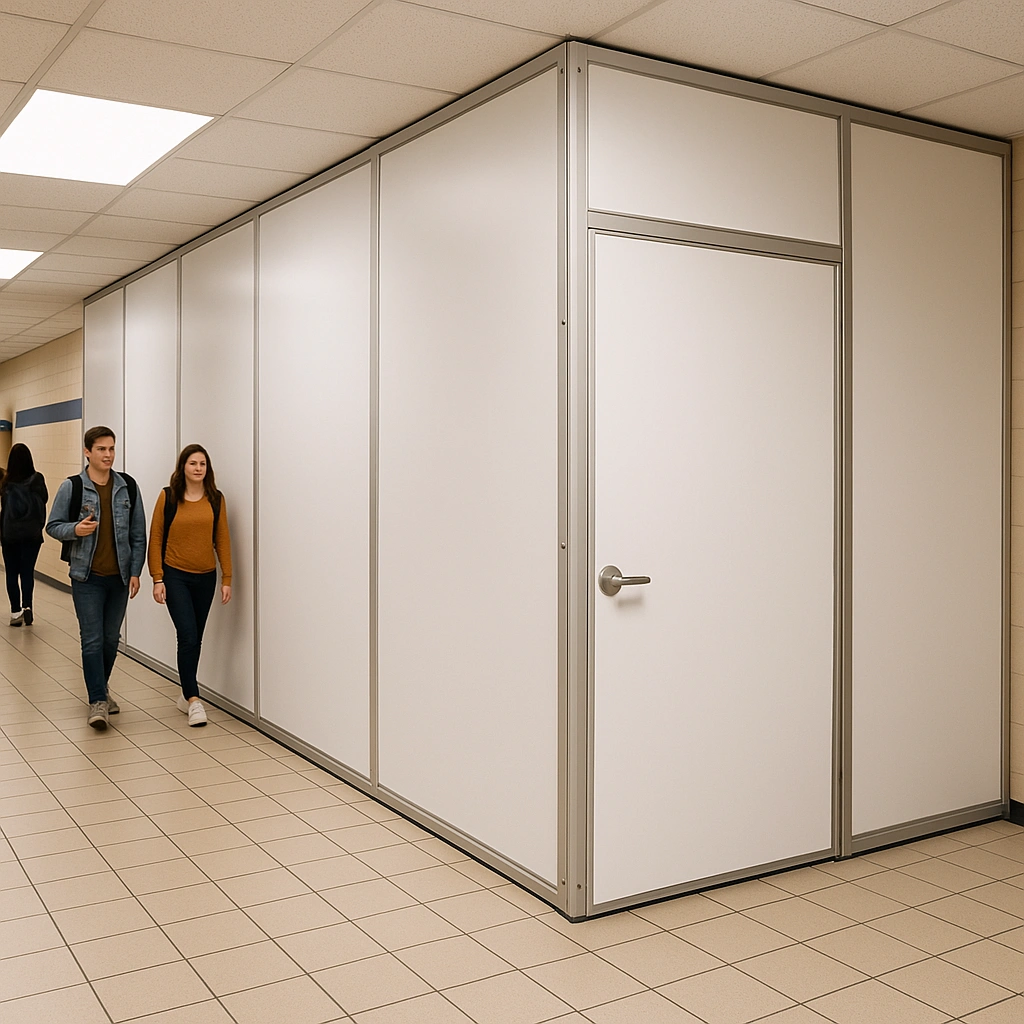
Students, especially in K-12 environments, contact barrier systems in ways that adults in commercial settings typically do not: backpacks brushing against them, accidental collisions in crowded hallways, leaning against them while waiting between classes. Plastic sheeting tears and gaps under this kind of incidental contact. Our rigid panels maintain their integrity and their seal throughout the project without daily patching.
Dust Containment That Protects Student Health
Construction dust in school environments is a health issue, not just a housekeeping issue. Silica dust from concrete and masonry work, gypsum dust from drywall demolition, and general construction particulate expose students and staff to respiratory hazards that OSHA regulates for construction workers. Our sealed panel systems prevent construction dust from reaching occupied school spaces, protecting the student population that California law places particular obligations on schools to keep safe.
Professional Appearance Appropriate for a Student Environment
The construction environment students move through every day affects their experience of the school. A professionally installed modular barrier (clean, solid, properly fitted from floor to ceiling) communicates that the renovation is controlled and that student safety is being actively managed. Torn plastic sheeting communicates the opposite. In K-12 environments particularly, the physical environment sends a signal about institutional care that matters.
Supports LEED and Sustainability Goals
Many school districts and universities have sustainability commitments that extend to construction practices. Our reusable modular systems eliminate the drywall demolition debris and single-use plastic disposal that conventional containment methods generate on every project. Schools pursuing LEED certification for renovation projects can document the material reuse and waste reduction our systems provide as part of their LEED materials and waste credits.
How It Works
From First Call to Final Removal in 5 Steps
We make containment straightforward. Most setups complete in a single day, with no mess left behind on either side of the wall.
Consultation & Site Assessment
We review your scope, timeline, and compliance needs from drawings or a site walk.
Custom Containment Plan
We design a layout with door placement, negative air ports if needed, and multi-phase sequencing.
Delivery & Installation
Our crew delivers and installs. Most setups finish in a single day. Clean and professional on both sides.
Ongoing Support & Adjustment
Projects change. If your layout needs to shift or expand, we handle it without rebuilding from scratch.
Removal & Closeout
When work is done, we remove everything. No demolition dust, no debris, no cleanup left for your team.
Renovating a School or Campus Facility?
Most quote requests receive a response within one business day. Tell us your facility type, your school's operational calendar, and your renovation scope, and we will put together a containment plan that protects the learning environment throughout the project.
FAQ
Education Containment Questions
Not finding what you need? Call us at (855) 684-3752 or use the contact form — we are happy to talk through your project before you commit to anything.