
Construction Containment for GMP Facilities Where One Contamination Event Can Invalidate an Entire Batch
Life sciences construction containment is categorically different from any other environment. A single breach adjacent to an ISO-classified space can trigger FDA enforcement, batch rejection, and facility shutdown. 5DCCS delivers modular containment systems with the non-particle-shedding surfaces, HEPA negative air compatibility, and IQ/OQ documentation support that pharmaceutical and biotech Quality Assurance teams require.
Why Life Sciences Containment Is Different
A Contamination Event Here Is Not a Cleanup Problem — It Is an FDA Problem
In January 2025, the FDA issued a Warning Letter to Sanofi's Framingham, Massachusetts biologics facility documenting that approximately 20% of bioreactor runs over a 30-month period had been rejected for contamination — a rate the FDA characterized as "excessive and calls into question the state of control of your process." The facility's contamination issues were directly tied to physical facility conditions and construction-adjacent activities.
This is the regulatory environment that life sciences construction containment operates within. Every temporary barrier installed adjacent to a classified manufacturing space must be treated as a quality control instrument, not just a physical separator. The barrier's material composition, its surface properties, its pressure differential management, and the documentation package that accompanies it all become part of the facility's cGMP record. Getting containment wrong in this environment does not generate a complaint — it generates an FDA 483 observation or a Warning Letter.
The Bay Area Life Sciences Construction Market
The Second-Largest Life Sciences Market in the World Is in Your Backyard
The Bay Area is one of the two largest pharmaceutical and biotech construction markets in North America. Genentech announced plans in February 2026 to demolish 18 buildings and renovate its South San Francisco headquarters campus through 2033. Genentech and Roche broke ground on a new $700 million manufacturing facility in August 2025 as part of a $50 billion U.S. investment commitment. Gilead Sciences is expanding its Foster City campus. Multiple clinical-stage biotech companies occupy GMP suites in converted industrial spaces across the South Bay and Peninsula.
This sustained construction activity occurs in and adjacent to operating GMP facilities — creating ongoing demand for containment subcontractors who understand the FDA framework, can work within Environmental Monitoring programs, and can provide the qualification documentation that QA teams require before any barrier adjacent to a classified space is accepted. That specialized capability is what 5DCCS brings to life sciences GCs in the Bay Area.
Where We Work
Containment Across Every Life Sciences Facility Type
From early-stage biotech R&D labs to large-scale GMP manufacturing facilities, every life sciences environment has distinct ISO classification requirements, contamination sensitivities, and QA documentation obligations. Here is how we support active construction across the full spectrum.
Pharmaceutical Cleanroom Modifications
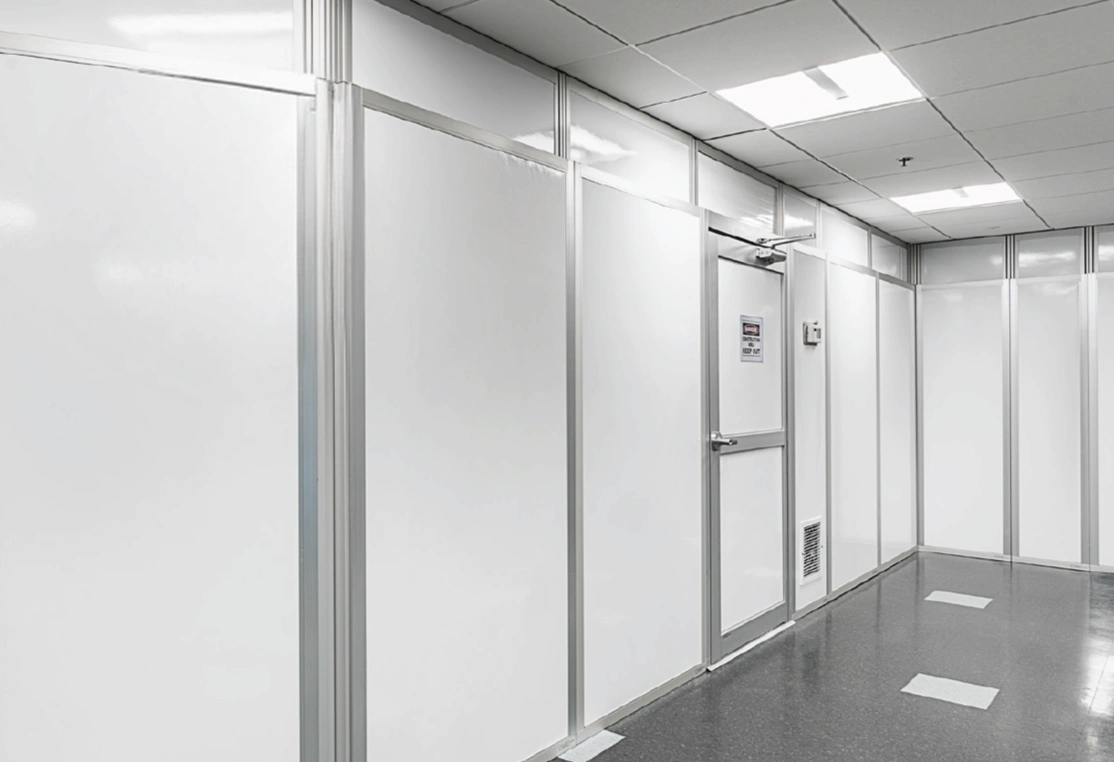
Cleanroom reclassification projects — upgrading ISO 8 to ISO 7, or ISO 7 to ISO 5 — require construction adjacent to active classified spaces. Our barriers provide the functional separation required between the construction zone and classified spaces, with HEPA-filtered negative air exhaust, non-particle-shedding panel surfaces, and the IQ/OQ documentation support that QA requires before any adjacent classified space continues in production.
Biotech Research Lab Renovations
Research laboratory renovation in occupied biotech facilities — new instrumentation installation, BSL upgrade work, HVAC reconfiguration, and lab expansion into adjacent tenant space — requires containment that keeps construction particulate and microbial contamination from reaching active experiments. Our systems provide the sealed physical separation and negative pressure capability needed to maintain research integrity while renovation proceeds in adjacent zones.
cGMP Manufacturing Facility Expansions
Manufacturing facility expansions that add GMP-classified suites adjacent to existing production areas require containment that satisfies FDA 21 CFR Part 211 requirements for facility design and construction. Our systems support change control documentation, risk assessments in ICH Q9 format, and the Environmental Monitoring baseline and verification sampling program that QA requires before, during, and after construction adjacent to GMP spaces.
Sterile Compounding & Pharmacy Facility Upgrades
Hospital pharmacies and compounding facilities renovating to comply with USP 797 and USP 800 require contamination-free construction adjacent to active compounding areas. Our rigid panel barriers maintain the pressure differentials that protect sterile compounding zones from construction-generated particulate, with surfaces compatible with IPA and quaternary ammonium disinfectant cleaning protocols that pharmacy QA teams require.
BSL-2 and BSL-3 Laboratory Containment
Biosafety Level 2 and BSL-3 laboratory renovations require containment that maintains the directional airflow and pressure regime the biosafety design depends on. Construction that disrupts the negative pressure relationship between BSL-classified spaces and adjacent corridors creates a direct containment failure. Our systems define clean construction zone boundaries and support the independent HVAC exhaust configuration required to maintain biosafety pressure relationships during renovation.
HVAC System Replacements & Infrastructure Upgrades
Aging HVAC systems in 1980s and 1990s biotech facilities serving classified spaces represent one of the most common and most challenging life sciences renovation projects. Replacing or modifying an HVAC system that serves classified spaces requires isolation containment during the work that does not compromise classified space pressure differentials. We design containment specifically around HVAC replacement sequencing, including temporary exhaust pathways and pressure monitoring provisions during transition periods.
Regulatory Framework
The Standards That Govern Construction in Life Sciences Facilities
Barrier requirements in life sciences construction are not one-size-fits-all — they are determined by the ISO classification of the space adjacent to the construction zone. The table below summarizes the minimum barrier requirement by adjacent ISO class, drawn from ISPE Baseline Guide and ICH Q10 quality system principles. These are the requirements your QA team will enforce — and that our systems are specified to meet.
| Adjacent Classified Space | EU GMP Grade | Minimum Barrier Requirement | HEPA Required | Continuous Pressure Monitoring |
|---|---|---|---|---|
| ISO 5 (Critical Zone) | Grade A | Full isolation; fully validated barrier with antechamber and negative pressure. Construction in active state not permitted adjacent to ISO 5. | Yes — ULPA in most protocols | Yes — continuous |
| ISO 6 | Grade B | Full negative pressure containment with HEPA-filtered exhaust; continuous particle monitoring; no shared HVAC between construction zone and classified space. | Yes — H13/H14 minimum | Yes — continuous |
| ISO 7 | Grade C | Negative pressure containment with HEPA exhaust; restricted access; daily surface cleaning of adjacent corridors; daily pressure log. | Yes | Yes — daily log minimum |
| ISO 8 | Grade D | Robust physical barrier with non-particle-shedding surfaces; filtered exhaust; controlled access; change control documentation. | Filtered exhaust — HEPA recommended | Documented inspection |
Barrier System Requirements
What Life Sciences Construction Requires That Standard Containment Cannot Provide
Barrier materials for use adjacent to classified pharmaceutical spaces must meet requirements that exceed healthcare ICRA standards. Wood-based panels are generally unacceptable. Porous materials that absorb moisture or harbor microbial growth are unacceptable. Every material specification in a life sciences containment system is a GMP decision — not just a construction one.
Non-Particle-Shedding Panel Surfaces
Panel faces must not shed particulate, flake paint, or release fibers into adjacent classified spaces. Wood-based panels (OSB, plywood) are generally unacceptable in pharmaceutical adjacencies. Our systems specify non-shedding panel faces appropriate for classified environment adjacency, with surfaces that can be documented in material certifications for QA review.
Chemical Compatibility with Pharmaceutical Disinfectants
Panel materials must not react with or absorb the disinfectants that pharmaceutical and biotech QA teams use: IPA (70%), quaternary ammonium compounds, hydrogen peroxide vapor, and sporicidal agents. We provide material safety data sheets and chemical compatibility documentation for barrier components used adjacent to classified spaces, as part of the qualification documentation package.
HEPA Negative Air Integration
Construction zones adjacent to ISO 7 and ISO 8 spaces require HEPA-filtered negative air exhaust to maintain pressure differentials that protect classified spaces from construction particulate. Our panel systems accept HEPA-filtered negative air machines through sealed ports, and we can document the negative air configuration — including machine placement, filter specification, and pressure monitoring provisions — for QA review as part of the IQ/OQ documentation package.
IQ/OQ Documentation Support
Working adjacent to GMP-classified spaces requires formal Installation Qualification (IQ) and Operational Qualification (OQ) protocols for the temporary barrier system. We provide the system specifications, material certifications, and installation records that your QA team needs to complete IQ/OQ documentation before construction begins adjacent to any classified space. We understand that this documentation is a prerequisite for QA approval, not an afterthought.
Change Control Documentation Support
FDA 21 CFR Part 211 and ICH Q10 require that any construction affecting facility design, HVAC, or classified space integrity go through formal change control before work begins. We provide barrier system documentation — scope, material specifications, contamination control measures, and IQ/OQ protocols — in the format your change control request requires, so the QA approval process is not delayed by incomplete contractor documentation.
Antechamber and Airlock Configuration
Construction access to areas adjacent to ISO 6 and higher-classified spaces requires antechamber or airlock design to prevent pressure differential loss during entry and exit. We design barrier configurations that incorporate antechamber provisions where required by the facility's QA team or the applicable ISO class requirement, maintaining continuous pressure differential protection throughout the construction period.
How It Works
From First Call to Final Removal in 5 Steps
We make containment straightforward. Most setups complete in a single day, with no mess left behind on either side of the wall.
Consultation & Site Assessment
We review your scope, timeline, and compliance needs from drawings or a site walk.
Custom Containment Plan
We design a layout with door placement, negative air ports if needed, and multi-phase sequencing.
Delivery & Installation
Our crew delivers and installs. Most setups finish in a single day. Clean and professional on both sides.
Ongoing Support & Adjustment
Projects change. If your layout needs to shift or expand, we handle it without rebuilding from scratch.
Removal & Closeout
When work is done, we remove everything. No demolition dust, no debris, no cleanup left for your team.
Planning Construction in or Adjacent to a GMP Classified Space?
Most quote requests receive a response within one business day. Tell us your ISO classification requirements, your QA team's documentation needs, and your project timeline — and we will put together a containment plan that your QA team can approve.
FAQ
Life Sciences Containment Questions
Not finding what you need? Call us at (855) 684-3752 or use the contact form — we are happy to talk through your project with your GC and QA team before you commit to anything.