
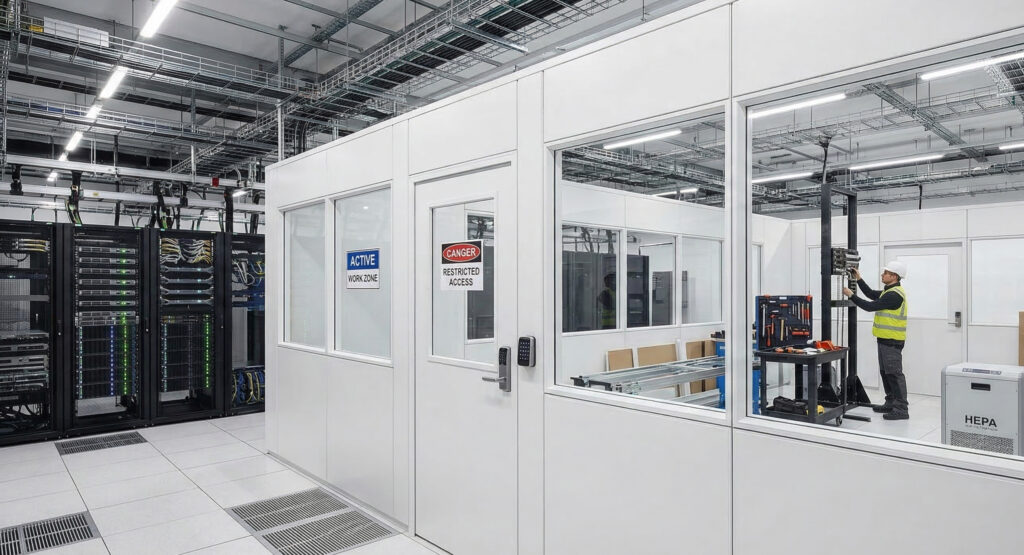
Choosing the Right Containment Partner for Data Center Projects (Part 2)
This is Part 2 of our series on modular containment for data centers. Part 1 covered why data centers need modular containment and the key risks of traditional methods.
In Part 1, we covered why live data center environments demand a fundamentally different approach to construction containment and what makes traditional drywall and plastic sheeting so problematic in these settings. Now we turn to the practical side: how do you actually plan and execute a containment scope in a mission-critical facility, and what separates a containment partner who understands the environment from one who doesn’t?
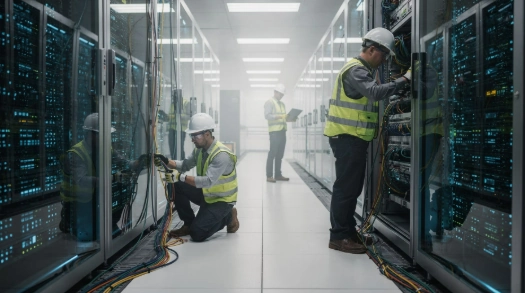
How to Select the Right Containment Partner
The stakes in a live data center are high enough that choosing a containment provider deserves the same rigor you apply to any critical vendor. A crew that is experienced in office renovations but has never worked in a data hall may not understand why a bag of drywall compound sitting open is unacceptable, or why the containment barrier needs to hold negative pressure overnight, not just during active work hours.
Planning containment in a live data center construction environment requires more than simply installing a temporary barrier. The containment strategy must control dust, maintain airflow stability, preserve thermal separation, and comply with strict operational and security protocols. Selecting the right containment partner is one of the most important decisions in any data center renovation project.
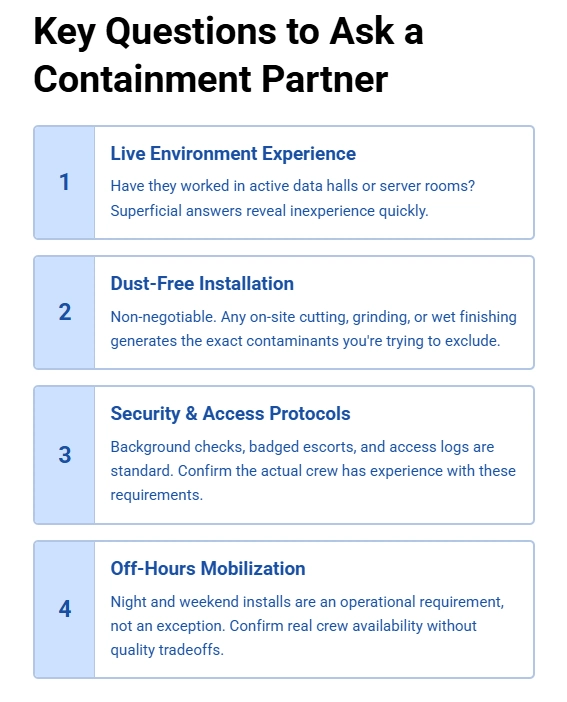
Here are the most important questions to ask when evaluating a containment partner for a data center project.
Do they understand occupied, live environments?
There is a significant difference between a company that provides temporary walls for general commercial construction and one that has real experience deploying containment in live, mission-critical facilities. Ask specifically whether they have worked in active data halls, server rooms, or similar environments. Their answers to follow-up questions will tell you quickly whether the experience is substantive or superficial.
Is their system dust-free during installation?
This is non-negotiable. Any containment system that requires on-site cutting, grinding, or wet finishing generates the exact contaminants you are trying to exclude. Modular systems that arrive pre-fabricated and assemble without on-site cutting eliminate this risk entirely. Ask for a description of their installation process and listen for any mention of cutting, sanding, or finishing compounds.
Can they work within your security and access protocols?
Data centers often require background checks, badged escorts, and check-in and check-out logs for anyone entering sensitive areas. A containment crew that has only worked in open commercial construction sites may not be accustomed to these requirements. Ask how they have handled security requirements on previous projects, and confirm that the actual crew members who would be on site have experience with these protocols.
Can they mobilize for off-hours installation?
Most data center projects require installation during nights or weekends to minimize impact on operations. This is not just a scheduling preference but a real operational requirement. Confirm that the company actually staffs night and weekend crews rather than treating off-hours work as an exception that carries significant premium pricing or crew quality tradeoffs.
What is their approach to thermal integrity and negative air?
The containment barrier is only part of the solution. A partner who understands data center environments should be able to speak to thermal separation, pressure differentials, and how their system integrates with negative air machines when dusty work is involved. If these concepts are unfamiliar to them, that tells you something important.
Do they offer a full-service model or just equipment rental?
There is a meaningful difference between a company that drops off panels and expects your team to manage the installation, and a company that handles site assessment, installation, mid-project reconfigurations, and removal as a single managed scope. In a data center environment, you want one accountable party for the containment, not a shared responsibility that creates gaps.
Learn more about how 5DCCS structures its full-service model on our Services page.
Performance Specifications That Matter
When you are reviewing a proposal or evaluating a containment system for a data center project, here are the specific performance attributes worth asking about.
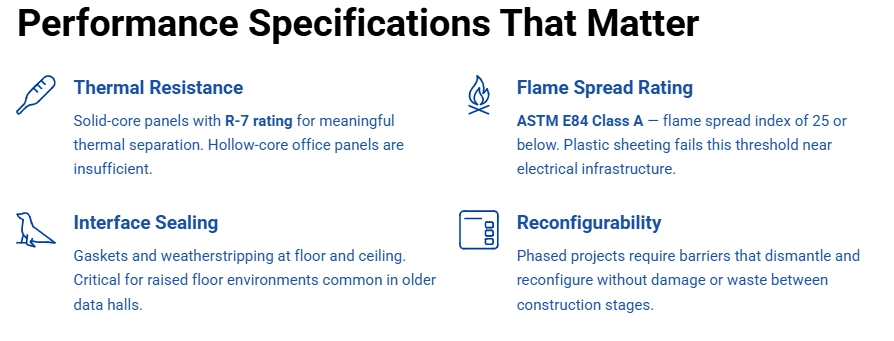
Thermal resistance. Solid-core modular panels with an R-7 rating provide meaningful thermal separation. Hollow-core or lightweight panels used for general office construction are not designed to maintain temperature differentials in environments where even a few degrees of variation matters.
Flame spread rating. Look for panels meeting ASTM E84 Class A standards, which require a flame spread index of 25 or below. Plastic sheeting commonly used in construction does not meet this threshold and poses a fire risk near electrical infrastructure.
For more on when fire-rated walls are required, see our guide on fire-rated temporary walls.
Sealing at interfaces. A panel’s rated performance only holds if the system seals properly at the floor and ceiling. Ask about gaskets, weatherstripping, and how the system handles raised floor environments, which are common in older data halls.
Negative air compatibility. For projects involving concrete cutting, demolition, or other high-dust activities, the containment system needs to work with HEPA-filtered negative air machines that maintain a pressure differential between the work zone and the live floor. Negative air pressure with HEPA filtration is a standard protocol in live data center construction to capture airborne contaminants before they can reach active equipment Cadence. Ask whether the system supports this and how penetrations for ductwork are managed.
Reconfigurability. Phased projects are common in data centers. Cooling upgrades, electrical room work, and raised floor modifications often proceed in sections as equipment is migrated and infrastructure is brought online in stages. A containment system that can be dismantled and reconfigured without damage, and without generating waste material, is significantly more practical than one that requires a full reinstall between phases.
Door configurations. Access points need to be functional, not afterthoughts. Door selections should be tailored to each facility’s specific spatial requirements, and configurations including swing and sliding options should be available to fit the environment Data Center Knowledge. In data centers with narrow aisles or raised floors, the door design matters for both equipment access and emergency egress.
Planning Checklist for Phased Data Center Projects
Containment planning for a multi-phase data center project requires more coordination than a single-scope renovation. The following checklist covers the decisions and details that tend to surface problems if left unresolved.
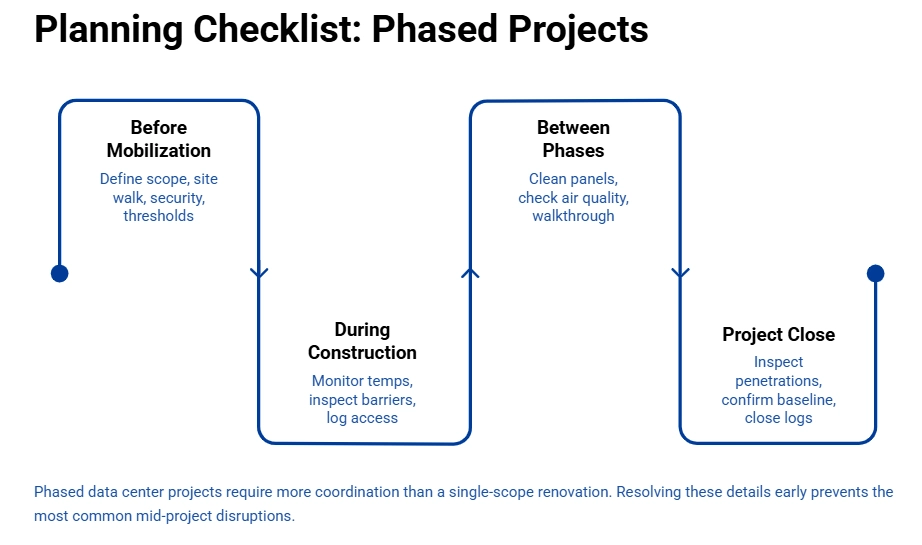
Before mobilization:
- Confirm the scope of each phase and where containment boundaries will need to be repositioned between phases
- Walk the site with the containment team to identify raised floors, cable trays, overhead obstructions, and existing aisle containment
- Identify all security requirements, including badging, escort protocols, and any restrictions on tools or materials brought onto the floor
- Establish communication with the facility’s IT and facilities teams regarding temperature monitoring and any thresholds that would require a work stoppage
- Confirm access windows for installation. Night or weekend installs require confirmed crew availability and loading dock or freight elevator access. Our installation teams are experienced with off-hours data center work
- Document the location of fire suppression system components. Fire suppression design, including whether the facility uses sprinklers, gas systems, or VESDA, affects containment panel selection and placement Data Center Knowledge
- Confirm power availability for negative air machines if dust-intensive work is planned
During active construction:
- Monitor temperature in operational zones adjacent to the work area at regular intervals
- Maintain a log of anyone entering and exiting the containment zone
- Inspect barrier seals at the start of each shift, particularly at floor and ceiling interfaces
- Coordinate with the general contractor and trades on any work that will generate vibration or significant noise, and notify the data center operations team in advance
- Keep containment doors closed except during active material movement
Between phases:
- Remove and clean panels before reconfiguring, particularly if the previous phase involved any dust-generating work
- Conduct an air quality check or allow the negative air system to run for a defined period before opening the zone to the live floor
- Walk the newly opened area with the facilities team before construction activities resume in the adjacent zone
At project close:
- Inspect for any floor penetrations, ceiling tile damage, or interface gaps created during the project
- Confirm temperature stability has returned to baseline in all zones before demobilizing
- Ensure all security logs and access records are properly closed out per facility requirements
Common Mistakes to Avoid
Even well-intentioned projects run into problems when certain assumptions go unchecked. These are the issues that come up most often in data center containment work.
Starting with the wrong type of barrier. This is the most common and costly mistake. Dust or debris that is not properly controlled can interfere with server airflow and cooling systems, and if particulates are not contained, they can trigger equipment failure or even fire suppression systems Cadence. Yet facilities still approve temporary drywall or plastic sheeting for live data hall work, often because it appears cheaper at the time. The risk that comes with those materials does not show up in the initial quote.
Treating containment as a commodity scope. When containment gets bundled into a general contractor’s bid as a minor line item, it is often awarded to whoever submitted the lowest number rather than whoever demonstrated they understand the environment. The result is crews on a live data floor with no background in mission-critical protocols. Containment in a data center is not a commodity scope. It is a specialized service that benefits from a dedicated partner. See how our approach differs on our Service Applications page
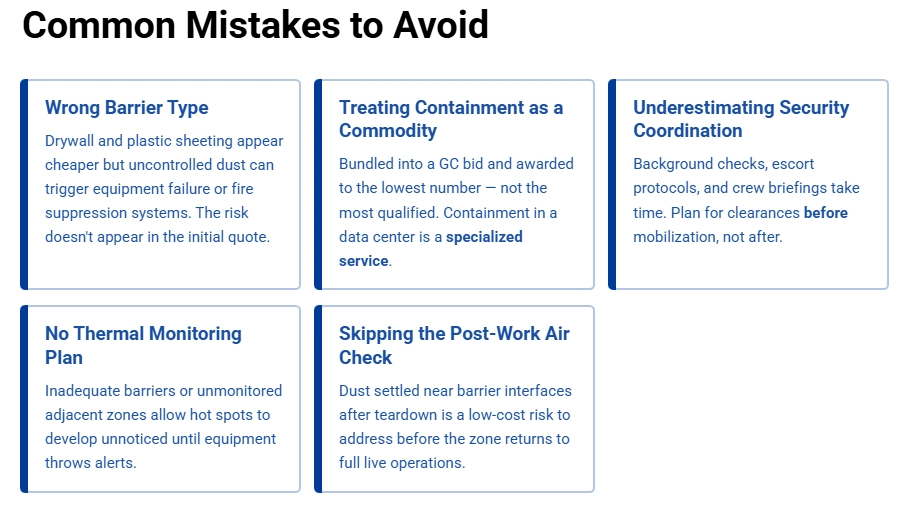
Underestimating security coordination time. Workers must pass background checks and all activities must be logged and monitored, but the time required to process clearances, establish escort protocols, and brief crews on facility rules is frequently underestimated. Plan for this time before the project start date, not after mobilization begins.
No plan for thermal monitoring. Installing a containment barrier that is thermally inadequate, or failing to monitor temperature in adjacent zones during construction, can allow hot spots to develop without anyone noticing until equipment begins throwing alerts. Establish monitoring thresholds and communication protocols before construction starts.
Phasing the work but not the containment. It is common to plan the construction phases carefully and then treat the containment as a static installation. If the containment barrier is not designed for reconfiguration, moving it between phases can take as long or longer than installing it originally, and creates unnecessary disruption. Design the containment plan to match the construction phasing from the start.
Skipping the post-work air check. Once the containment comes down, it can feel like the project is done. But if any dust was generated during the work, some of it may have settled on horizontal surfaces near the barrier interface. A brief air quality assessment and visual inspection before the zone returns to full live operations is a low-cost step that is worth doing.
Bringing It Together
Data center construction is one of the most demanding environments for containment work. The combination of 24/7 operations, particulate sensitivity, thermal precision requirements, and strict security protocols means that almost every standard construction assumption needs to be revisited.
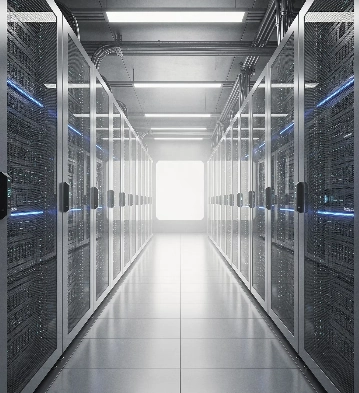
The good news is that these challenges are manageable with the right planning and the right partner. A containment system that installs quickly without generating dust, maintains genuine thermal separation, and can be reconfigured between phases removes a significant source of risk from an already complex project.
At Construction Containment Services (5DCCS), we work alongside general contractors, facility managers, and data center operators throughout the Bay Area to plan and execute containment scopes in live environments. If you have an upcoming project and want to talk through the containment requirements, we offer free consultations and site assessments.
Construction Containment Services (5DCCS) San Jose, California (855) 684-3752 Contact Us
Have questions about temporary containment for an upcoming data center project? We are happy to walk through the requirements with you before you commit to a scope.