
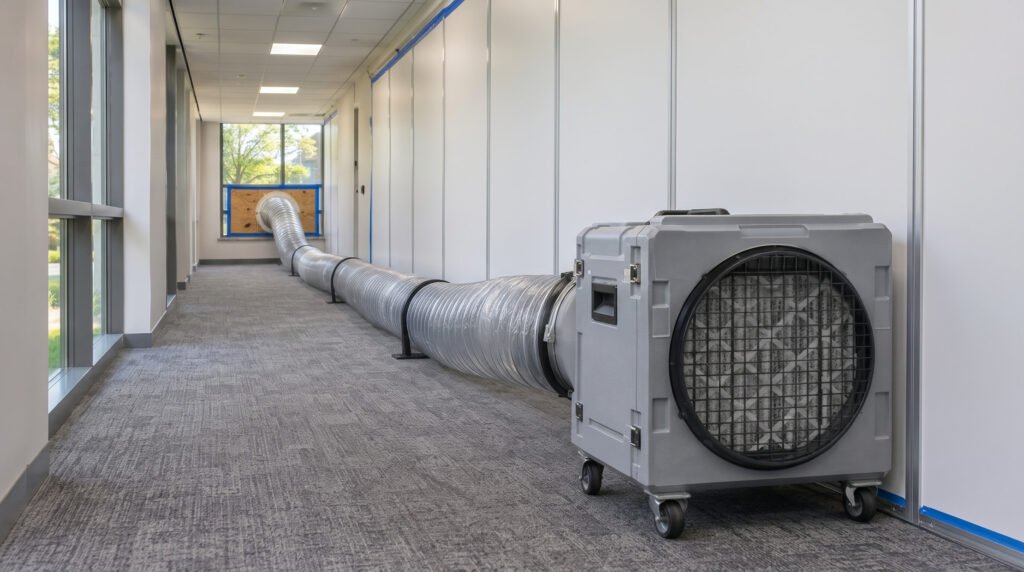
HEPA Air Scrubbers on Construction Jobs: What They Cannot Do
Learn what a HEPA air scrubber does on construction jobs, what it cannot do without a barrier, and how placement, filters and checks affect results.
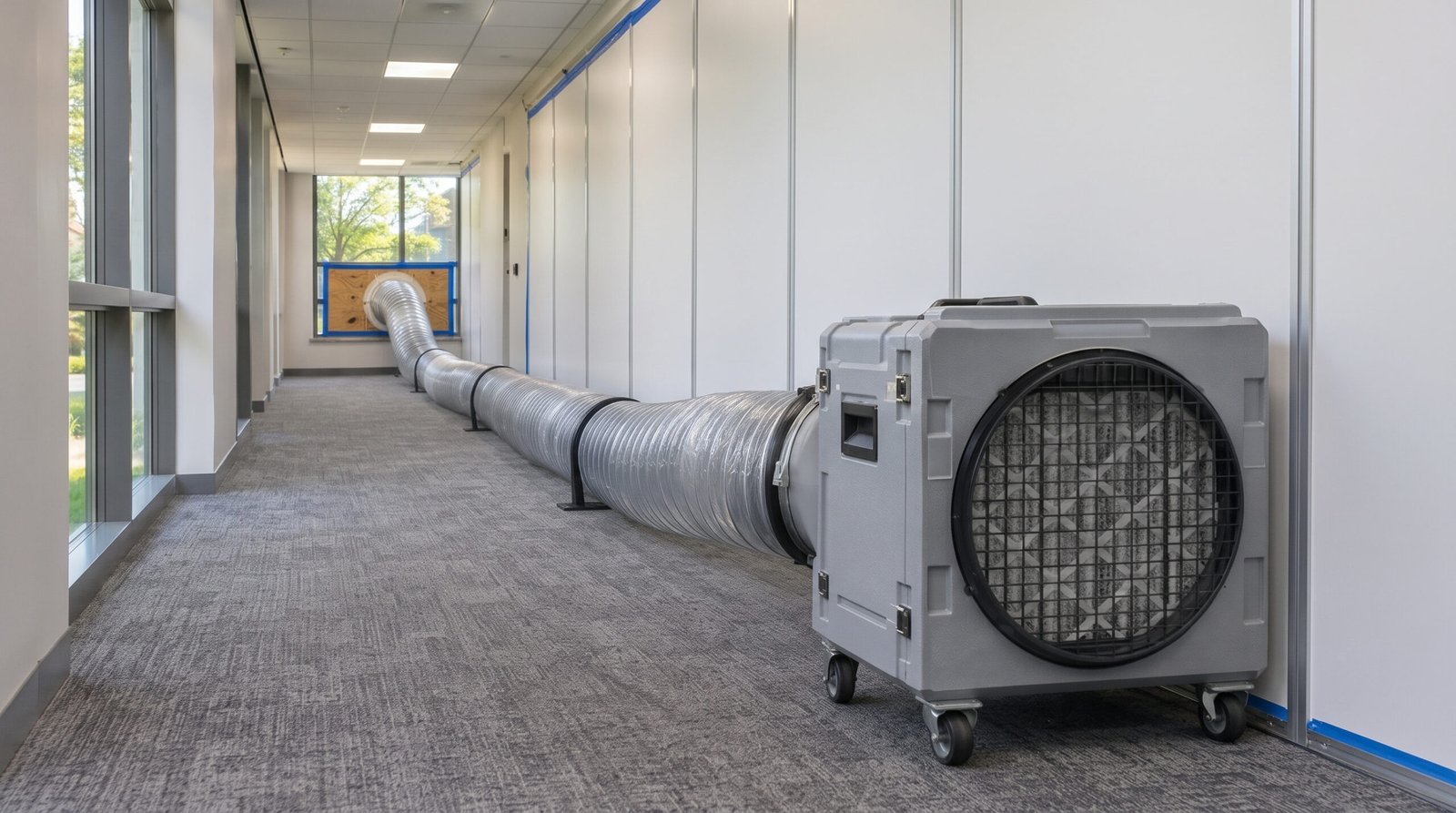
A HEPA air scrubber is one of the most visible pieces of equipment on an occupied-building renovation, and one of the most misunderstood. A running unit is not proof that dust is under control. A scrubber cleans the air that passes through it. It does not keep dust inside the work zone, and it does not show anyone whether the space is protected.
This guide explains what a HEPA air scrubber does, what it cannot do without a barrier, and the field mistakes that most often undermine it. A separate sizing guide will cover how many units a space may need.
What a HEPA air scrubber actually does
A HEPA air scrubber is a portable unit that pulls room air through a series of filters and discharges it, either back into the room or through ducting to another location. The final stage is the HEPA filter. According to the EPA, a HEPA filter can theoretically remove at least 99.97 percent of airborne particles at 0.3 microns, the most penetrating particle size.
Ahead of the HEPA stage, most units carry one or more pre-filters that catch coarse dust so the final filter does not clog early. Stage counts and ratings vary by unit and by facility specification. An older EPA summary notes that some higher-efficiency pleated filters are inaccurately called “HEPA” or “HEPA-type” but use less efficient media. A label alone does not show that a filter meets the HEPA criterion, so ask for the test documentation.
What it does not do
- It cleans air, not surfaces. Larger particles settle quickly, and a scrubber does not remove dust that has already landed on floors, framing or equipment.
- It filters only the air that reaches its intake. Dust that leaves the work zone through a gap never reaches the unit.
- It is a particle filter. A HEPA filter does not address gases, vapors or odors, so paint and adhesive fumes need a separate plan.
- It does not replace source capture, such as tool-mounted vacuum shrouds, or housekeeping.
Why an air scrubber is not a containment barrier
Running a scrubber in an open room does not create containment. Without a continuous boundary, air moves through doorways, ceiling gaps and shafts by the easiest path, and the unit’s own airflow can stir up settled dust. A recirculating scrubber can reduce airborne particles, but its presence alone does not show that dust is contained or that neighbors are protected.
CDC’s environmental infection control guidelines for health-care facilities, summarized here, include constructing barriers to keep construction dust out of patient-care areas, and monitoring those barriers and repairing gaps or breaks in the joints. For where flexible film tends to fail, see plastic sheeting compared with modular walls.
Air scrubber vs negative air machine: same hardware, different job
The two terms are often used interchangeably, but they describe two ways of operating similar equipment.
- Recirculating (air scrubber): The unit discharges filtered air back into the same space. It cleans the air in that space, but by itself it does not create a pressure difference between the work zone and its surroundings.
- Exhausting (negative air machine): The unit discharges filtered air through ducting outside the work zone, which removes more air than is supplied and draws air inward through the barrier. That inward flow is what the project monitors.
One large health system’s construction standard draws the same line: powered HEPA recirculation units may be used to achieve air changes, but the negative pressure is expected to come from exhausting air out of the construction area. Which setup is appropriate, where the exhaust goes and what pressure is targeted are decisions for the project’s permit, the facility’s infection prevention team and the project engineer. For the pressure side, see negative air pressure systems.
Do you need one on every project?
No. It depends on the work and the space. These questions help settle it before the job starts:
- What dust-generating work is planned, such as demolition, cutting or grinding?
- Who is next door: patients, laboratory processes, data equipment or office occupants?
- Does the project have an Infection Control Risk Assessment permit, and who sets the requirement: the facility, an industrial hygienist, the specification or the owner?
Not every task calls for a full enclosure. Facility standards, including UC Davis Health’s, allow other controls such as glove bags for suitable small tasks, and higher-risk work calls for more. ASHE’s ICRA 2.0 tool and permit ties precautions to the type of work and the area affected. For background, see ICRA compliant containment walls and ICRA Class IV vs Class V in Bay Area hospitals.
How many units? Start with the space, not a guess
Unit count is not a rule of thumb. The inputs include the volume of the enclosed area, the air change target that the permit or facility sets, the airflow a unit actually delivers once filters are loaded and ducting is attached, and how leaky the barrier is. Larger or divided spaces may call for more than one unit.
Where projects go wrong
Most failures on site come from setup and follow-through, not from the machine itself.
Placement and dead zones
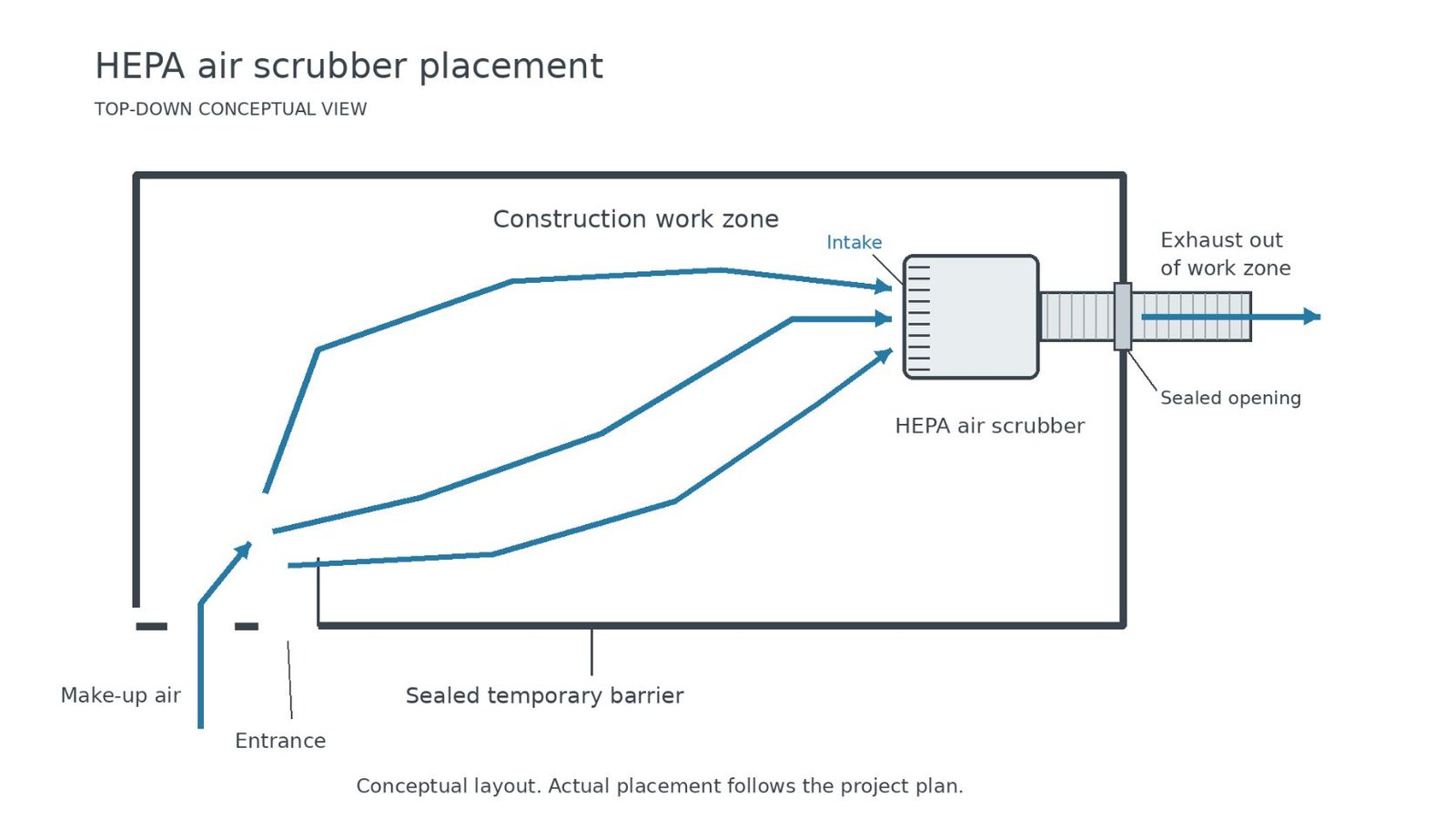
One California health system’s published construction standard, from UC Davis Health, calls for locating the HEPA-filtered negative pressure unit as far from the containment entrance, or other make-up air source, as possible. A unit placed next to the door can pull clean corridor air into its intake while dust lingers in the far corners.
Other common placement mistakes:
- Blocking the intake or discharge with stacked materials, columns or temporary partitions.
- Pointing the discharge at settled debris or open drywall, which stirs dust back into the air.
Make-up air
Air that is exhausted from a work zone has to be replaced. If the project provides no planned path for replacement air, it arrives through whatever leaks exist, such as door gaps, seams and penetrations. The UC Davis standard also cautions that excessive negative pressure can pull containment inward. Make-up air paths are a design decision for the project engineer, not something to improvise after the unit is running.
Unsealed HVAC openings
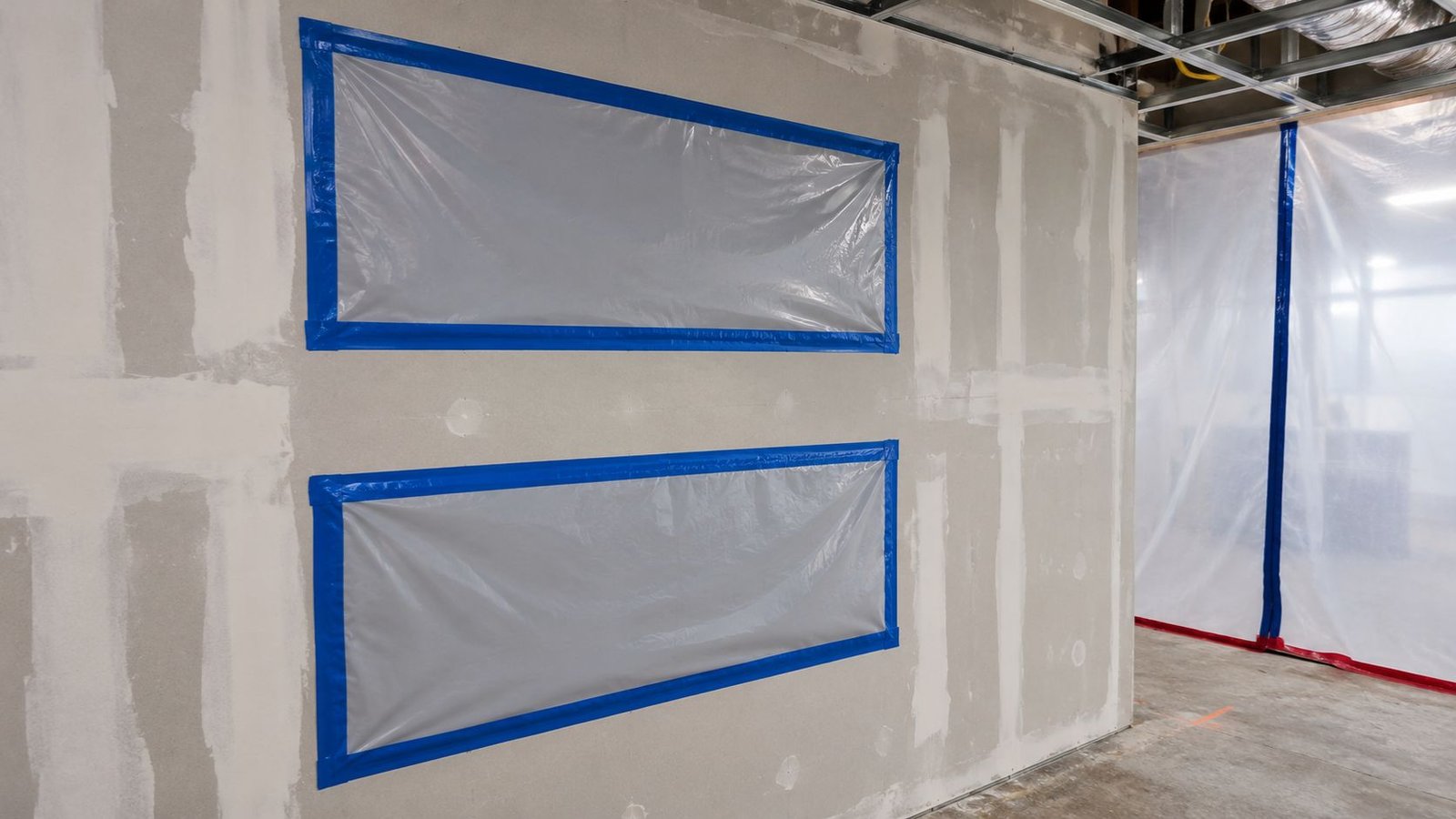
Supply and return openings inside a work zone can carry dust well beyond it. CDC’s guidelines include blocking and sealing off return air vents when rigid barriers are used for containment, and the UC Davis standard describes sealing all sources of air infiltration, including HVAC supply and return registers, before the barrier goes up.
ASHE’s ICRA 2.0 matrix goes further for its higher precaution classes, listing isolation of return diffusers to keep dust out of the HVAC system and isolation of supply diffusers to avoid positively pressurizing the space, which would work against the negative pressure the project is trying to hold.
Details vary by source and building system, so the project’s adopted requirements and the mechanical engineer decide what is sealed or filtered. A scrubber cannot offset an open return moving dusty air through the building. See how construction dust escapes occupied spaces.
Trusting the label
A 2019 field study of portable HEPA units on construction sites found measured airflow was predominantly below stated capacity, with manufacturers using different rating bases. Ask what an airflow figure represents and how it was measured.
A HEPA label does not guarantee a leak-free machine either. An independent 2018 study that tested 85 portable filtration devices used in building construction found most capture tests fell short of 99.97 percent, and higher particle counts around filter perimeters pointed to bypass leakage. The study is older and does not describe all current equipment, but it shows why testing the assembled unit matters.
Exhaust outside or recirculate?
Each approach has trade-offs.
- Ducting outside supports a pressure difference across the barrier, but it needs a suitable exit path and a discharge point away from air intakes, windows and pedestrian areas.
- Recirculating indoors avoids exterior ducting, but it does not create negative pressure on its own and leaves the equipment’s heat in the space.
Sources do not agree on every detail. CDC’s older background guidance accepts returning construction-zone air to the HVAC system after pre-filtration and HEPA filtration when recirculation is unavoidable, while ASHE’s ICRA 2.0 matrix treats exhaust into shared or recirculating HVAC systems, or shared exhaust such as restrooms, as not acceptable for its higher classes. Whichever framework the project adopts decides the arrangement. Confirm it with the facility, the project engineer and the authority having jurisdiction before work begins.
Filters: what gets replaced, and who decides
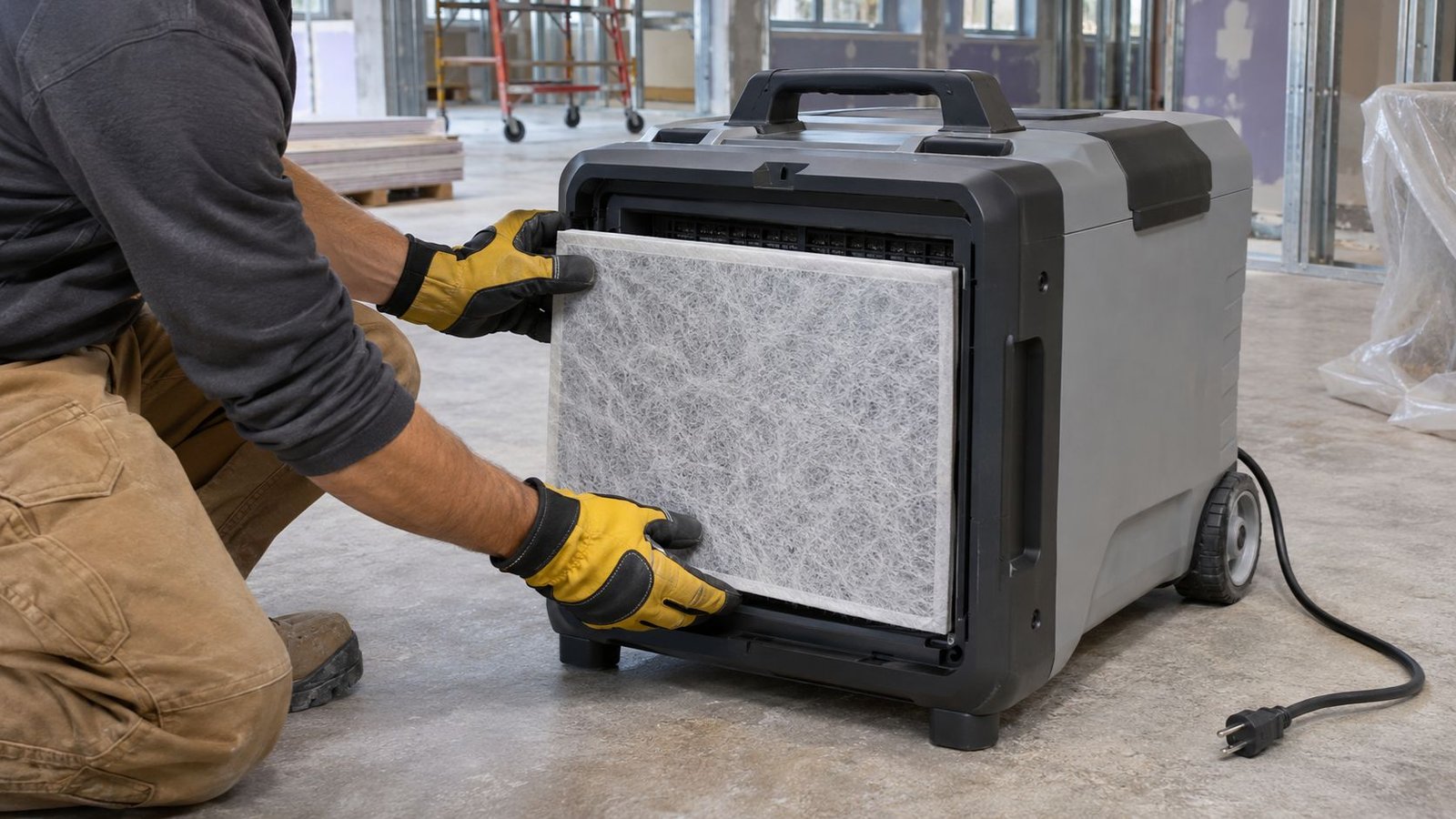
According to the EPA’s technical summary on air cleaners, excessively loaded filters can cut airflow and allow bypass around a clogged filter.
- Pre-filters are changed first and most often, which protects the final HEPA stage.
- A filter pressure indicator shows loading. It does not show room pressure or whether the filter or housing leaks.
- Replacement timing is based on performance indicators and the manufacturer’s guidance, not a calendar. Some health-system standards call for new filters at project start, a change record kept with each unit and very frequent pre-filter changes during dusty work, while CDC points to facility-specific schedules. No single interval fits every job.
- Who authorizes a final-stage HEPA change, and how spent filters are bagged and disposed of, comes from the permit, the facility’s infection prevention team, the industrial hygienist or the equipment instructions.
Ask for testing documentation up front. The UC Davis standard, for example, calls for on-site challenge testing of HEPA-filtered equipment by an independent contractor to confirm the integrity of the filter and housing, with a label showing the test date and testing party. Ask what documentation exists for the unit coming to your site.
Checking that it is working
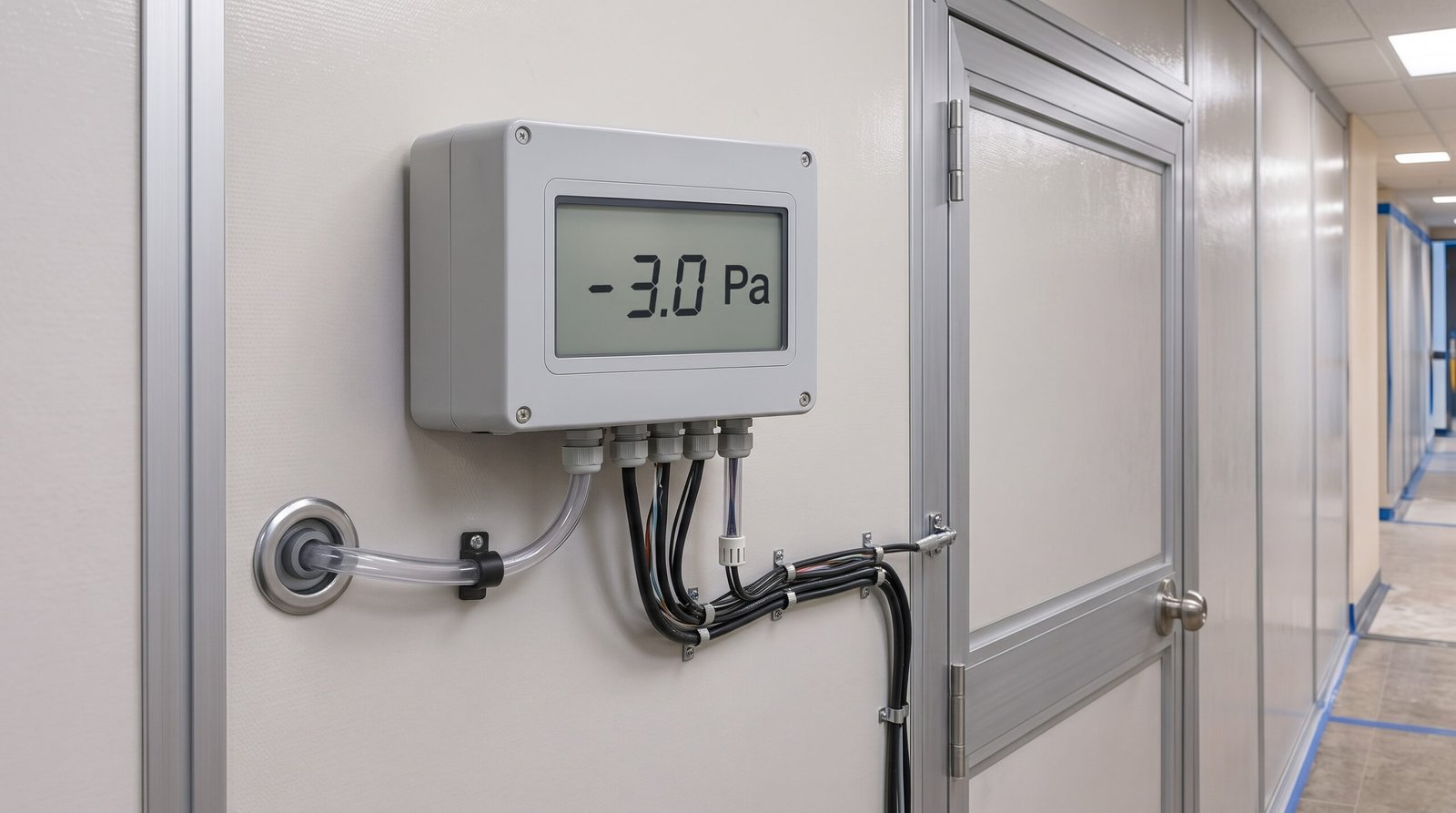
A running motor is not verification. A unit can hum along with a loaded filter, a kinked duct or an open boundary.
- Measure pressure, do not just look at it. A plastic sheet bowing inward is a visual cue, not a measurement. It does not show that the right pressure difference is being held. CDC’s guidelines include monitoring negative air flow inside rigid barriers, and the UC Davis standard describes continuous electronic manometer monitoring with logged inspections.
- Know what each check tells you. A filter indicator shows loading, not leaks. A room pressure monitor shows the difference between the work zone and its neighbors, not filter efficiency. An airflow measurement shows delivered flow, not filter integrity. A challenge test shows filter and housing integrity, not room pressure. No single gauge or “filter good” light covers all four.
- Confirm airflow direction. Some teams use smoke tubes at door gaps to see which way air is moving.
- Walk the setup each day. Check ducting for crimps and loose connections, confirm intakes are clear, read the filter indicator and record the pressure reading.
The target pressure reading comes from the project permit or the facility’s policy, not from this article. For a practical routine, see the containment inspection checklist guide and download the free Construction Containment Inspection Checklist.
HEPA vacuums and cleanup
A standard shop vacuum is not designed to hold fine dust and can return it to the air through its exhaust. Ask for a HEPA-rated vacuum with documentation, and pair it with damp wiping so settled dust is removed instead of re-suspended.
How barrier quality changes the scrubber’s workload
A leaky barrier makes every part of the system harder. A large measured airflow can still fail to produce the pressure relationship the project needs. Soft film that flexes under continuous exhaust can open seams over time. Rigid panels with sealed joints leave fewer paths for air to find.
Where 5DCCS fits
5DCCS provides and coordinates air scrubbers, HEPA filters, negative air pressure and monitoring alongside its containment walls. Planning the barrier and equipment together helps avoid the mismatches described above. Pressure targets, monitoring methods and documentation follow the project’s permit and the facility’s requirements. No equipment setup guarantees compliance, safety or a clean result, and 5DCCS does not set those targets.
Frequently asked questions
Is an air scrubber necessary on every project in a sensitive environment?
Not automatically. It depends on the work, the neighboring occupants and the controls in the project’s permit or specification. The facility’s infection prevention team, an industrial hygienist or the project engineer can confirm what applies.
How many air scrubbers does a space need?
It depends on the enclosed volume, the air change target set by the permit or facility, the airflow each unit actually delivers, and how tight the barrier is. A separate sizing guide covers the arithmetic.
How often are HEPA filters replaced, and how often is a unit maintained?
Pre-filters are changed first, and the final HEPA filter is changed based on performance indicators, manufacturer guidance and project documentation. Ask who is responsible for inspections, filter changes and records before the unit arrives.
How does a construction air scrubber compare with an ordinary air purifier?
The two are built and rated for different jobs. According to NIOSH, the clean air delivery rate program covers smaller home and office air cleaners, and larger ducted units may not carry one. A room purifier also typically recirculates air, while a construction setup may be ducted to move filtered air out of the work zone. A consumer unit can contain genuine HEPA media and still not suit a project’s exhaust and containment needs.
What certifications or testing documentation should a unit have?
Ask for the filter’s efficiency test documentation, any on-site integrity testing of the filter and housing with the test date and testing party, and records of recent inspections and filter changes. Requirements differ by facility, so confirm them with the project team.