
Construction Containment Inspection Checklist: What to Check and What to Do When It Fails
Use this construction containment inspection checklist to catch barrier and pressure failures early and know what to do when containment stops performing.
A containment barrier is not a one-time installation. It is a system that has to keep working every shift, through door traffic, HVAC changes, equipment swaps, trade overlap and the occasional bumped panel. The costliest failures are often the quiet ones, where a gap opened, a machine loaded up or a pressure reading drifted, and nobody noticed until dust, odor or a complaint made it obvious.
This guide is for general contractors, facility managers and owner's representatives working in occupied buildings, hospitals, life science facilities and data centers. It covers what published healthcare guidance and one California health system's own written standard say about inspecting and monitoring containment, where that guidance stops short, and a response sequence for when containment stops performing. We kept to what primary sources support and flagged the places where your project documents, your infection preventionist or your authority having jurisdiction (AHJ) have to fill the gap. A free printable checklist is available at the end of the inspection section.
Short answer
Inspect containment at setup, at the start and end of every shift, after any disruption, and at closeout, against the targets in your ICRA permit or facility policy. Record pressure as a number and check doors, seals and penetrations. If containment fails, stop dust-generating work, notify your chain, find the cause, and verify the repair before restart.
What Healthcare Guidance Actually Requires You to Inspect
The foundational federal reference for construction infection control is the CDC and HICPAC guideline for environmental infection control in health-care facilities, published June 6, 2003. It is older than most of the projects it still influences, so check which editions your facility and project have adopted. What it says is useful, and it is also narrower than many people assume.
Its construction recommendations call for maintaining negative air pressure in the construction zone, monitoring barrier integrity, and repairing gaps or broken joints. One of its suggested outcome measures calls for daily monitoring and documenting of the presence of negative airflow within the construction zone or renovation area. That is the one daily interval in the document, and it is framed as an outcome measure, not as a standalone regulation.
Swipe to read the full table →
| Source | What it says | What it does not say |
|---|---|---|
| CDC/HICPAC, June 6, 2003 | Maintain negative pressure in the construction zone, inspect barriers, repair gaps and joints, and document negative airflow daily as an outcome measure. | No hourly, per-shift or continuous inspection interval in the construction clauses. |
| CMS QSO-22-20-Hospitals, July 6, 2022 (A-0750, A-0773) | The infection control program should monitor maintenance activities, including repair, renovation and construction. The infection preventionist is responsible for documenting infection prevention activities. | No construction pressure target, continuous monitoring requirement or fixed frequency. |
| ASHE ICRA 2.0 permit template | Includes a "Verification method and frequency" column and stop-work language when scope changes or additional hazards are found. | The template leaves the actual method and frequency to the project and facility. |
The pattern is consistent. Published guidance expects you to monitor, document and have a plan to suspend work. The interval, the pressure target, the instrument and the alarm response are set by your ICRA permit, the facility's policy and the project specification. If those fields are blank at kickoff, fixing that is the first inspection task. For more on the classification side, see our guide to ICRA Class IV vs Class V containment.
What One California Health System Requires
Federal guidance leaves the details to the facility, so it helps to see what a facility actually writes down. The UC Davis Health Construction Dust Infection Prevention Best Practice Standard (Version 5.0, July 2025) is one public example. It is one health system's rule for its own projects, not a universal requirement, and your facility's document may differ.
Swipe to read the full table →
| Topic | What the UC Davis Health standard says |
|---|---|
| Inspection timing | Inspect at initial setup, each day, when an ICRA reclassification is requested, and when work is done and the containment is cleaned. While working, inspect twice per workday, at the start of the shift before work begins and at the end. Containments on projects with extended non-work activity are inspected at least weekly. |
| Pressure | A minimum of -0.020 inch of water column or less relative to the adjacent, uncontained space, with exceptions allowed by infection prevention and listed on the ICRA permit. Negative pressure is demonstrated continuously with an electronic manometer. Inclined liquid manometers and non-digital gauges are not accepted. |
| Out-of-range readings | Zero or positive pressure is unacceptable and must be responded to immediately. A reading of -0.060 or lower can collapse a containment, so negative air is reduced and door openings enlarged. |
| Airflow | At least four air changes per hour inside the containment, with the negative air unit placed as far from the entrance as possible. |
| Equipment | HEPA-filtered equipment is tested on site with a dispersed oil particulate challenge before use. A label shows the test date, tester and expiration, and tests are valid six months if the equipment has not been moved or modified. |
| Who inspects | Negative pressure containments are inspected by a third-party consultant. In-house inspectors may inspect only containments that do not require negative pressure, unless an exemption is granted. |
| Stop work and failures | The project manager, environmental health and safety, and infection prevention can stop work for a containment breach or noncompliance. Failures are reported in writing to environmental health and safety and infection prevention as soon as possible, and root causes are determined. |
| Records | The ICRA permit, inspection log, manometer logs, HEPA certifications, sampling records and audit findings, kept until the project is complete and occupancy is granted. |
Compare that with the federal baseline. UC Davis Health adds a number, a continuous electronic reading, twice-daily inspections, named people with stop-work authority and records kept until occupancy. Those are facility choices, which is why your own ICRA permit and project specification come first.
The Pressure Number Problem
Pressure targets are where secondary sources get loose. The CDC construction clauses require negative pressure but, in the passages we reviewed, do not state a numerical minimum for construction zones. The CDC does publish numbers, but for a different application: airborne infection isolation rooms. There, it cites 2.5 Pa (0.01 inch water gauge) negative to the corridor, along with air change rates for those rooms. Those are isolation room criteria, and they should not be copied into a construction specification without a separate basis.
Trade articles and vendor pages often quote figures for construction containment and attribute them to FGI, ASHE or an industry standard. We could not verify those attributions from primary text. What we can point to is a facility's own written specification, such as the UC Davis Health minimum described above. Use a number only when you can name the document, edition and section it comes from, and for your project that means the ICRA permit and specification. A better habit is to get the target in writing before mobilization:
- Who sets the target, and in which document
- Where it is measured
- What reading triggers action
- Who is notified and who can authorize restart
One more caution. A pressure reading is not the same as knowing how much air a system is moving. The CDC relates air changes to airflow and room volume, so pressure alone cannot tell you ventilation volume.
What Each Monitoring Method Tells You, and What It Does Not
No single check proves containment is working. The CDC treats pressure control, barrier inspection, filtration maintenance and particle sampling as separate activities, and a good program uses more than one. Here is what each method can and cannot show. The right-hand column is practical reasoning, not quoted standard language.
Swipe to read the full table →
| Method | What it tells you | What it does not tell you |
|---|---|---|
| Visual walk-through | Visible defects such as open seams, damaged panels, unsealed penetrations, propped doors and tracked debris. | Whether air is actually moving in the right direction. |
| Smoke tube or flutter strip at an opening | Direction of airflow at that opening at that moment. Facility rules govern whether this method is accepted as a project check. | How large the pressure difference is, or what is happening at other openings or other times. |
| Analog manometer or gauge | The pressure difference at the sensor location when someone looks at it. | What happened between checks. It leaves no record unless someone writes the reading down, and it is only as good as its placement and zeroing. |
| Digital monitor with display | Easier reading, and some models show history. | Whether it alarms or logs. Confirm features in the manufacturer's documentation, not the sales sheet. |
| Continuous monitor with alarm and data logging | Events between visits, such as a door left open or a machine shut off, plus a time-stamped record. | Barrier integrity or filter condition. An alarm is only useful if someone is assigned to respond to it. |
| Building management system tie-in | Can route alarms to facility staff. | Anything by itself. Availability depends on the facility's systems and is not a given. |
| Airborne particle counting | The CDC suggests particle sampling as a tool for evaluating barrier integrity. It shows particle counts at the sample point during the sample period. | Where particles came from, or whether they are biological. |
| Microbiological air sampling | Little for routine construction use. The CDC describes microbiologic air sampling as controversial and says that, if performed, it should be limited to determining fungal spore density. | It should not be the basis of a pass or fail decision. |
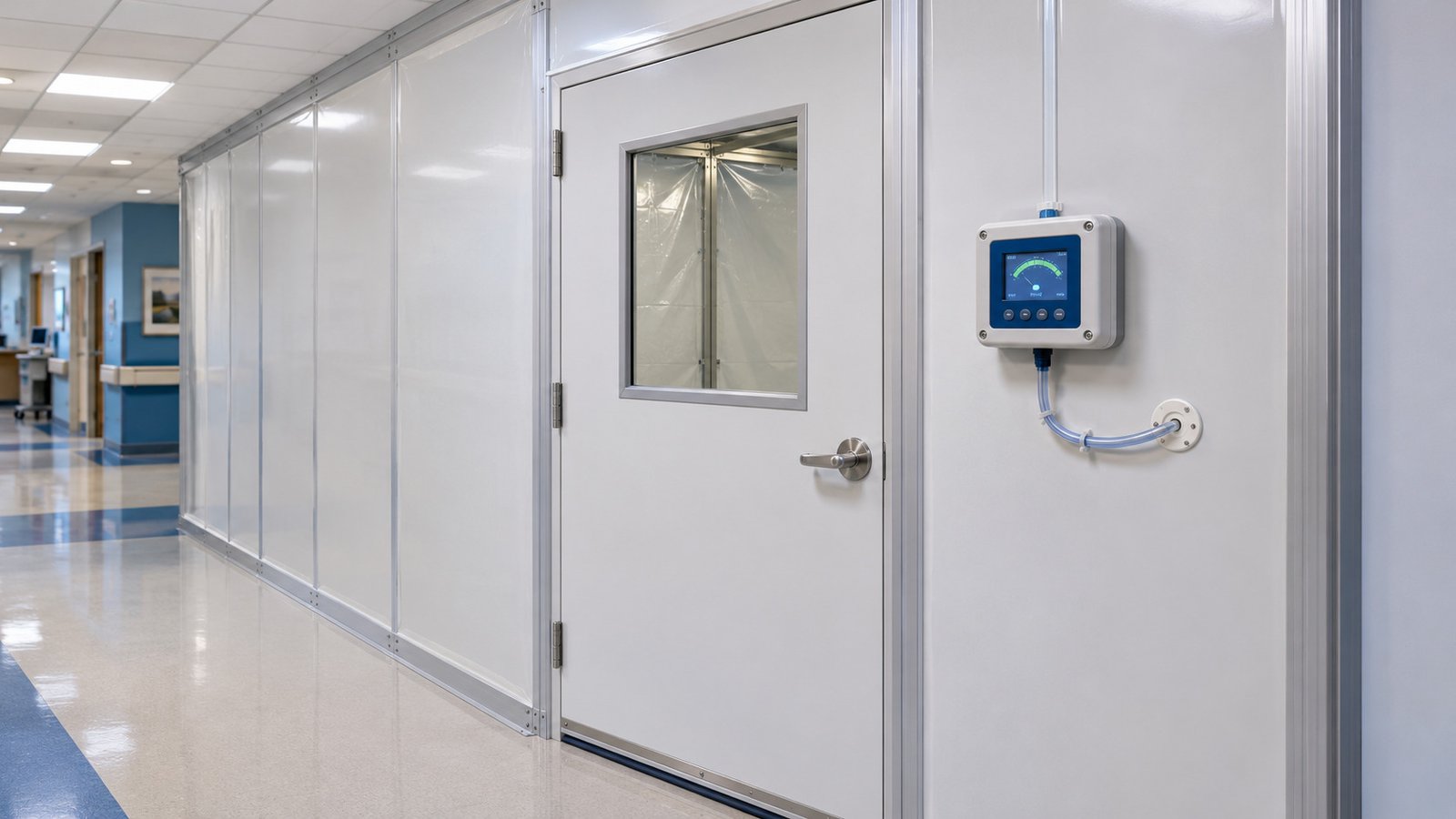
Whether your project requires continuous monitoring, alarms, or a display outside the enclosure is a project and facility decision, so confirm it against your ICRA permit and the facility's policy. Many teams find an outside display useful because staff can see status without entering the work zone. Vendor documentation for specific devices should be treated as vendor content and checked against the facility's own requirements. For the mechanics behind these systems, see our negative air pressure systems guide.
Some facilities have already decided this. The UC Davis Health standard, for example, requires a continuous electronic manometer for negative pressure containments, accepts neither inclined liquid manometers nor non-digital gauges, and calls for a manometer showing current pressure in an accessible location near the containment entrance. Other facilities may accept analog gauges, so check yours. Ask your wall provider how a monitor can be mounted on its panels, because mounting provisions vary by system and should not be assumed.
A Practical Inspection Routine

This routine draws on the CDC's barrier and cleaning recommendations, the UC Davis Health standard and common project practice. It is a suggested framework, not a quoted standard, and your ICRA permit or facility policy governs.
Four inspection moments
- Pre-start, before the first dust-generating task: barrier complete, HVAC isolation in place, HEPA equipment tested and labeled, pressure monitor reading as specified, postings up.
- Start and end of every work shift, with the start check done before work begins.
- Event-driven, after a cart strike, equipment move, HVAC change, alarm, odor or occupant complaint.
- Closeout, before dismantling: clean, dry, debris removed and signed off.
Five checks that catch most failures
- Doors and anteroom: latching, closing on their own, never propped.
- Penetrations: new or disturbed ones sealed.
- Pressure reading: recorded as a number against the target in your specification, not as a checkmark.
- Negative air machine: running, exhaust path unchanged, filter condition checked.
- HVAC isolation: supply and return openings in the work zone still sealed.
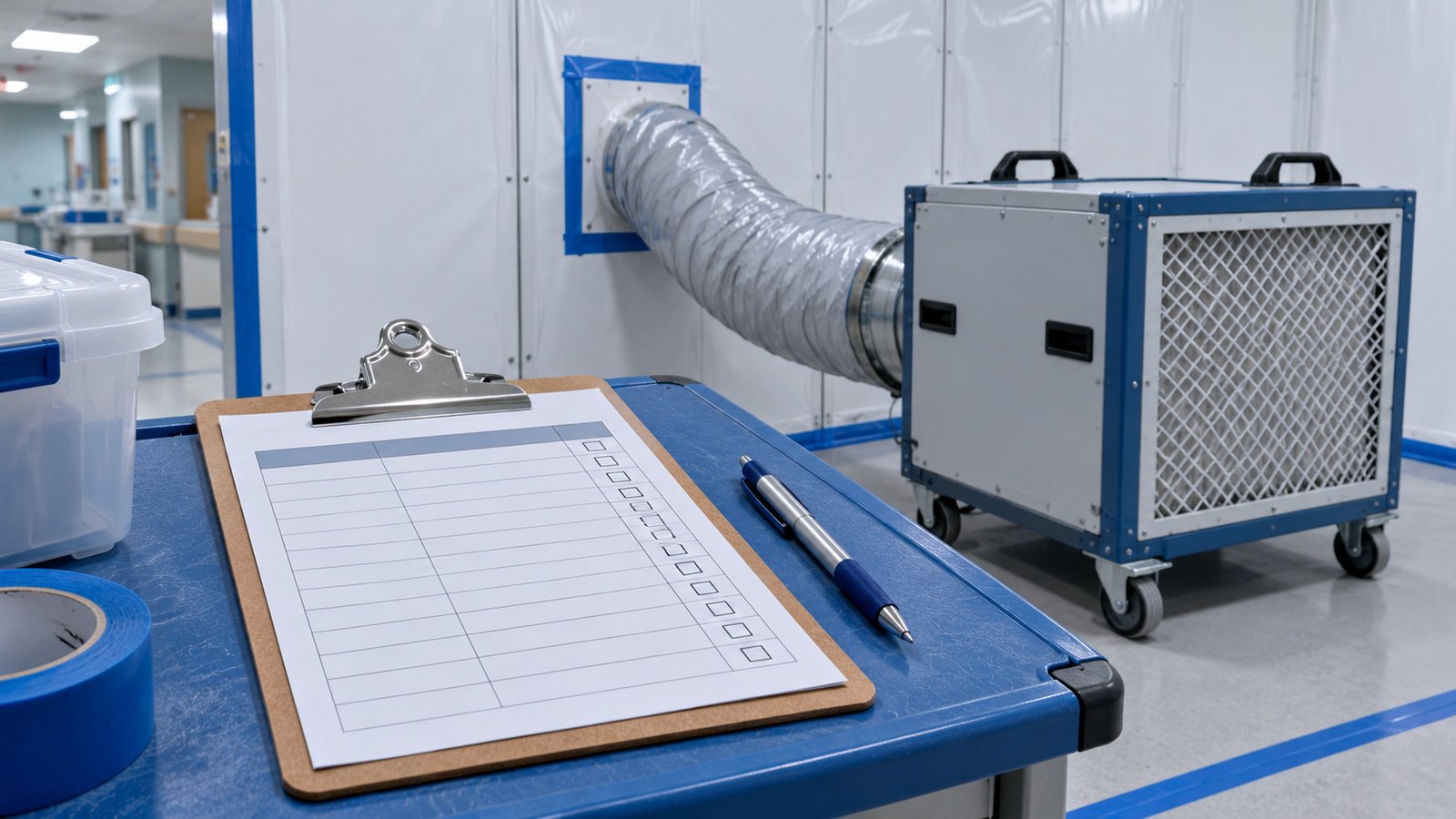
A useful log captures date and time, inspector, instrument, reading and where it was taken, barrier condition, corrective action and sign-off. The facility's infection preventionist is responsible for documenting infection prevention activities under the CMS guidance, so a clean contractor log makes that job easier. Records also matter after the fact, because they let a facility reconstruct what happened if a question comes up later.
When Containment Stops Performing: A Response Sequence
The ASHE ICRA 2.0 permit template includes stop-work language when scope changes or additional hazards are found, but the sources we verified do not lay out a complete breach protocol, so the sequence below is a suggested framework to adapt to your facility's policy.
- Stop dust-generating work. Do not finish the cut. Make the work safe, then stop.
- Notify the chain you wrote down before the project started. In healthcare that typically includes the superintendent, the facility manager or owner's representative, and infection prevention. The CDC calls for a multidisciplinary construction team that includes infection control personnel, so the names should already be on the plan.
- Protect what is exposed. Close doors, restore the barrier temporarily where practical, and follow facility direction for adjacent areas.
- Find the cause. Work through the checklist below.
- Correct and clean. The CDC says gaps or breaks in barrier joints or seals should be identified and repaired, and that the construction zone should be cleaned daily or more often as needed. Cleaning outside the enclosure should follow facility infection prevention direction.
- Verify before restart. Re-inspect the barrier, confirm the pressure reading and that it holds, and get restart authorization from the person named in the plan. The CDC's commissioning language applies before occupancy of new or renovated space, which is not the same as restarting after a breach, so write restart criteria into the plan.
- Document the event. Record discovery time, location, readings and alarms, work underway, notifications, suspected cause, corrective measures, cleaning, verification results and who authorized restart.
Swipe to read the full table →
| Check | What to look for |
|---|---|
| Seals and joints | Open panel joints, lifted base seams, damaged or displaced panels, failed tape or gasket |
| Doors and anteroom | Door propped or not latching, closer failed, traffic pattern changed |
| Penetrations | New or disturbed conduit, pipe, duct or cable passing through the barrier |
| Ceiling and plenum | Open tiles, shared plenum paths, gaps above the barrier line |
| Equipment | Negative air machine off or tripped, loaded filter, duct or exhaust path disconnected or changed |
| HVAC | Isolation removed, schedule or setpoint changes, adjacent zone changes |
| Instrument | Sensor placement, tubing, power or drift, which can make a good enclosure read badly or a bad one read well |
This checklist is practical, not quoted from a standard. Writing the event down at the time is what lets a facility reconstruct what happened later.
The UC Davis Health standard shows how a facility can formalize this. It requires the contractor to stop work when containment is breached, gives the project manager, environmental health and safety, and infection prevention authority to stop work, requires failures to be reported in writing as soon as possible, and requires root causes to be found and corrective action taken. It adds that contractor-caused containment failures may require retraining. Ask your facility whether it has a comparable document.
Keep the Equipment Honest
The CDC addresses filters and dust-containment equipment in several places. These points can be confirmed in its current text:
- HVAC filters should be cleaned or replaced using proper dust-containment procedures.
- Low-efficiency roughing filters at the outdoor air intake remove large particulate, so intakes near construction dust are worth a look on an inspection round.
- Spent filters should be placed in plastic bags immediately on removal.
The CDC text we reviewed sets no universal HEPA replacement interval for construction equipment, so change-out schedules, alarm checks and certification methods come from the equipment manual and your project plan. Keep a record for each machine: location, start date, function checks, filter changes and who performed them.
Records can be concrete. UC Davis Health, for example, requires on-site dispersed oil particulate challenge testing of HEPA-filtered equipment before use, with a label showing the test date, tester and expiration. It treats the test as valid for six months only if the machine has not been moved, modified or roughly handled. A label on the machine is a record an inspector can verify at a glance.
Fire and Life Safety Is a Separate Inspection
A barrier that is excellent for dust can still raise fire and egress questions. The CDC states that construction barriers should comply with local fire codes, and fire-code review is a different check from infection control inspection. Interpretation varies by jurisdiction, so questions like these belong with your AHJ:
- Is the enclosure only a dust barrier, or must it also provide a specified fire or smoke separation?
- What approvals apply to doors, supports, penetrations and barrier materials?
- Does it affect exit access, accessibility, signage or emergency lighting?
- Does it affect sprinkler coverage, detection or alarm operation, or a rated assembly?
- What impairment procedures, temporary protection, inspections and records apply?
Facilities write this down too. The UC Davis Health standard requires containment locations that affect emergency egress to be reported to its Fire Marshal's office and notes that an interim life safety measures plan may be required.
Many projects reference NFPA 241 for safeguarding construction operations. Confirm which edition and which provisions your AHJ applies. For more on rating questions, see our guide to fire-rated temporary walls.
Cleanrooms, Pharmaceutical Areas and Data Centers
Do not carry the isolation room pressure criterion into a cleanroom, pharmaceutical area or data center. Space classified under ISO 14644, or governed by FDA or EU GMP expectations, is typically controlled through the facility's own quality system and change control. Expect the quality or engineering group to define particle monitoring, pressure logging, alarm thresholds and requalification after adjacent work. We did not find a verified source for a universal construction-specific monitoring practice in these environments, so confirm with the facility. See our guides to biotech cleanroom construction containment and server room risks during HVAC upgrades. Live data centers are governed by the owner's own procedures and equipment protection requirements.
California: What to Confirm
Hospital projects. OSHPD, now HCAI, publishes Code Application Notices. An earlier edition of CAN 2-0 on jurisdiction (revised May 8, 2020) listed temporary construction and barriers among the items within OSHPD's review scope, and the current edition (revised August 1, 2024) points to CAN 2-108 for temporary systems, utilities and equipment. We did not find an infection control inspection schedule in the portions we reviewed. Confirm current requirements and approvals with HCAI and your project's plan review and inspection contacts.
Dust and silica. Cal/OSHA has its own requirements for respirable crystalline silica and dust-generating work. Those govern worker exposure and controls and are separate from infection control containment. Confirm applicability with your safety professional. Our guide to what happens when dust escapes the work zone covers the stakes.
What the Evidence on Failure Does and Does Not Show
We have not cited a specific incident study here because we could not independently verify one. Be careful with claims that a barrier failure caused a particular outbreak. Evidence comes in levels: construction occurred near an affected population, a barrier or ventilation defect was documented, environmental contamination was measured, clinical and environmental organisms were linked, and improvement followed corrective measures. Those are not interchangeable proof of cause. Inspection records are what let a facility reconstruct what happened.
Rigid Panels vs Plastic Film: What Changes at Inspection Time
Our companion guide on plastic sheeting vs modular containment walls covers the choice itself. Here is how the choice shows up on an inspection round. The comparison below is practical experience, not quoted standard language.
Swipe to read the full table →
| Inspection item | Plastic film and tape | Rigid modular panels |
|---|---|---|
| Seams and joints | Every foot of tape is a seam to check, and tape can lift, dry out or tear. | Fewer field-built seams, with joints set by the panel system. Each still needs checking. |
| Movement under negative pressure | Film can billow and pull at its tape. | Panels hold their position, though door and base gaps still matter. |
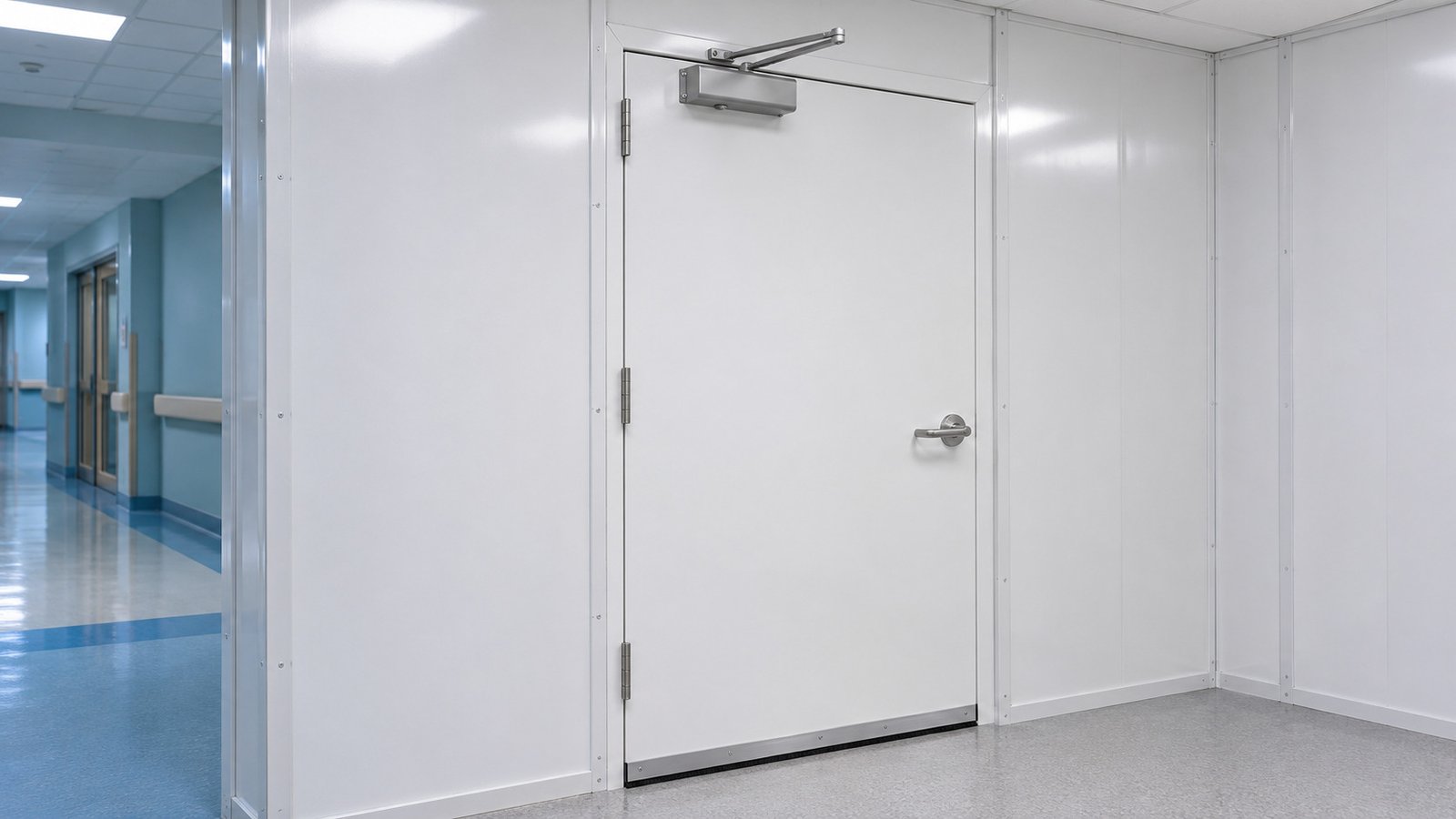
| Doors | Zipper openings and flaps depend on worker discipline. | Some systems offer hinged doors with closers and adjustable sweeps. Confirm for your system. |
| Penetrations | Often sealed ad hoc with tape. | Can follow a repeatable method, which should be defined before install. |
| Repairs | Frequent re-taping. | Less frequent, but damaged panels are replaced rather than patched. |
Facility rules can also limit which barrier you may use. The UC Davis Health standard allows fire-rated polyethylene sheeting for temporary containments in non-fire-rated locations lasting under 30 days. For containments lasting longer, needing added security, or controlling highly dusty work, it calls for rigid, airtight materials. Its examples are drywall and metal framing, so ask infection prevention whether a modular system is acceptable for your project.
Where 5DCCS Fits
Modular temporary wall systems do not replace inspection or monitoring. With rigid panels and defined joints, there are generally fewer field-built seams to check and a more repeatable layout. Barrier layout, door and anteroom placement, monitor location and access for inspection are easiest to settle before the first panel goes up, so raise them with your wall provider early. 5DCCS is familiar with Bay Area project conditions, and we always recommend confirming specific requirements with your infection preventionist, permit consultant and AHJ.
Frequently Asked Questions
How often should construction containment be inspected?
The federal guidance reviewed here sets no single universal interval. The CDC's outcome measure suggests daily documentation of negative airflow, and facilities set their own rules. UC Davis Health, for example, requires inspection at the start and end of each work shift. Your ICRA permit, facility policy or specification governs.
Is a manometer enough?
It shows the pressure difference at one place and time. It does not show what happened between readings or whether the barrier is intact. Some facilities also require continuous electronic monitoring and do not accept analog gauges.
What pressure should construction containment hold?
The target should come from your project documents. The CDC construction clauses require negative pressure but give no numerical minimum in the passages reviewed. Facilities can set their own, as UC Davis Health does for its projects at -0.020 inch of water column.
Who can restart work after a pressure loss?
The person named in your plan, which in healthcare is often infection prevention or the owner's representative. Decide this before work starts.