
What Happens When Construction Dust Escapes the Work Zone in Occupied Spaces
A single midnight phone call from a facility manager can shut down a multi-million dollar renovation. The cause is usually something nobody on the crew could see: microscopic concrete dust that tripped a cleanroom particle counter, or fungal spores that reached a transplant ward two floors above the demo site.
These are not freak accidents. Research confirms that hospital-acquired infections tied to construction activity account for more than 5,000 deaths per year in the United States. Even outside healthcare, escaped construction dust triggers sick building syndrome complaints, OSHA citations, tenant lawsuits, and equipment warranty voidances that can cost more than the renovation itself.
This is Part 1 of a two-part series on construction dust control in occupied spaces. This article covers what actually happens when containment fails: the health consequences for people inside the building, the financial exposure for general contractors, and the facility-specific vulnerabilities that make certain projects especially dangerous. Part 2 covers the protocols, barrier systems, and compliance frameworks that prevent these outcomes.
What Construction Dust Actually Is and Why It Escapes
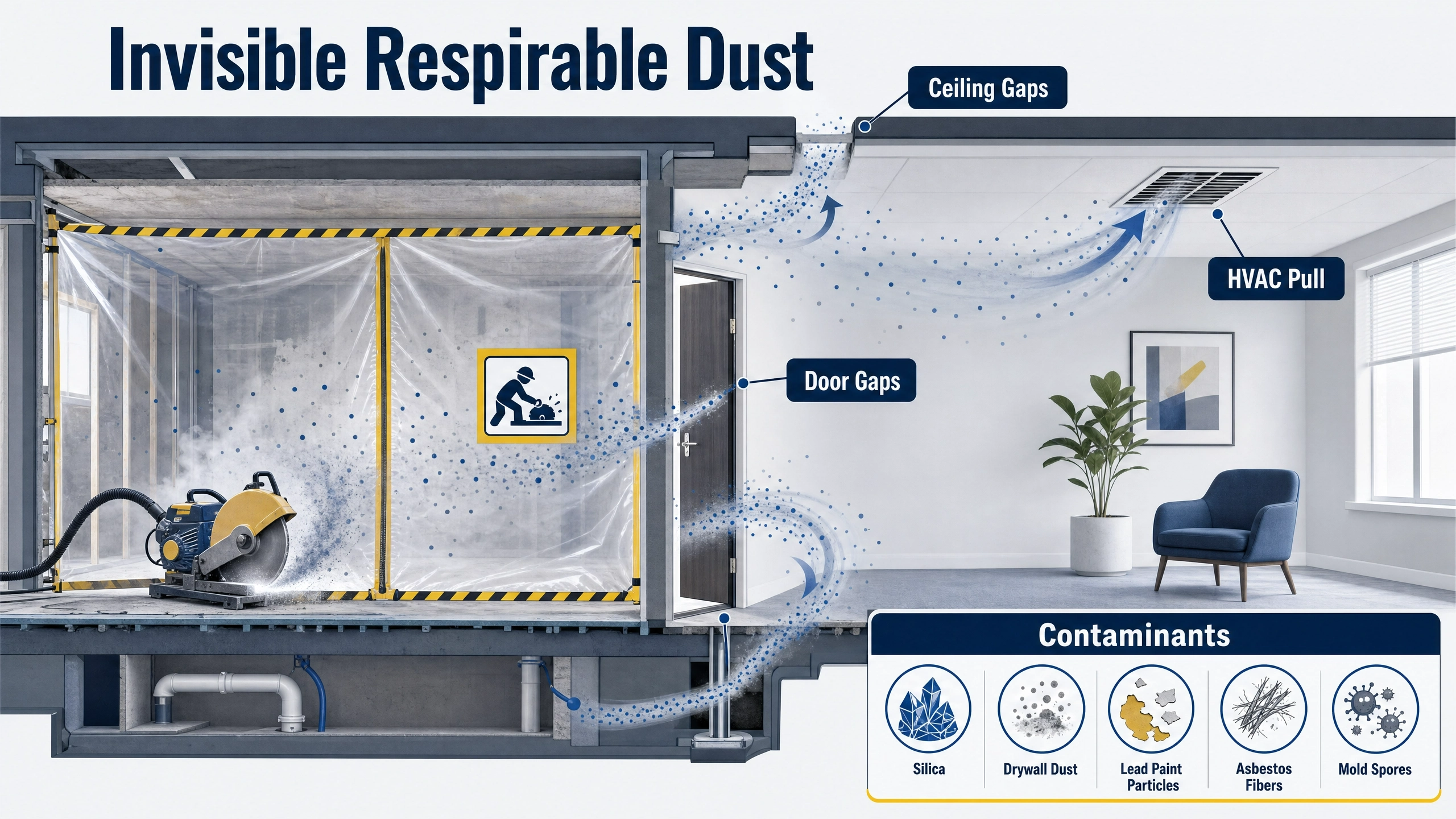
Construction dust is not one substance. It is a complex mixture of airborne particulate matter generated by drilling, cutting, demolition, grinding, and sanding of materials like concrete, brick, drywall, and composite wood. The most dangerous components include respirable crystalline silica (RCS), asbestos fibers in older buildings, lead-based paint particles, and biological contaminants like Aspergillus mold spores disturbed from existing ceiling cavities and wall assemblies.
The particles that cause the most damage are the ones you cannot see. Respirable dust smaller than 10 microns in diameter is completely invisible under normal room lighting, and because of its minimal mass, it does not settle out of the air like wood shavings or coarse debris. It stays suspended in facility air currents for hours, behaving more like a gas than a solid. A 2025 peer-reviewed study measuring dust during indoor renovation found that workers and bystanders faced a geometric mean of 0.88 mg/m³ of respirable dust, with maximum concentrations reaching 29 mg/m³. For context, that peak reading is nearly 600 times the OSHA permissible exposure limit for crystalline silica.
Six Common Reasons Containment Fails
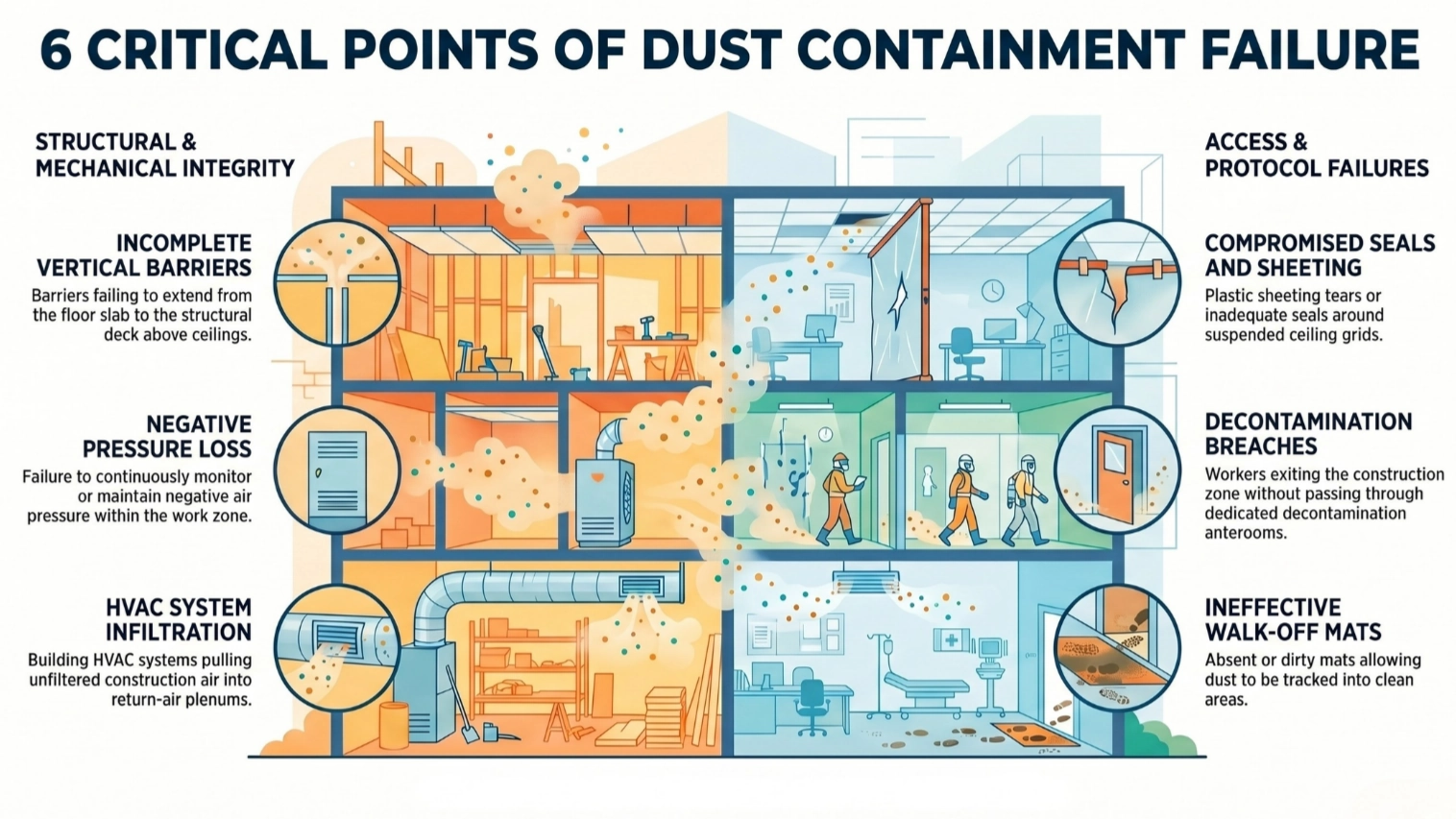
Dust escapes construction zones through predictable failure points that repeat across projects:
- Plastic sheeting tears or creates inadequate seals around suspended ceiling grids
- Temporary barriers are not built full-height from the floor slab to the structural deck above the drop ceiling
- Negative air pressure is not maintained or monitored continuously inside the work zone
- The building’s HVAC system pulls unfiltered construction air into occupied zones through return-air plenums
- Workers enter and exit without passing through decontamination anterooms
- Walk-off mats are absent or inadequately maintained, allowing tracked dust to spread on foot traffic
How HVAC Systems Become the Building’s Contamination Highway
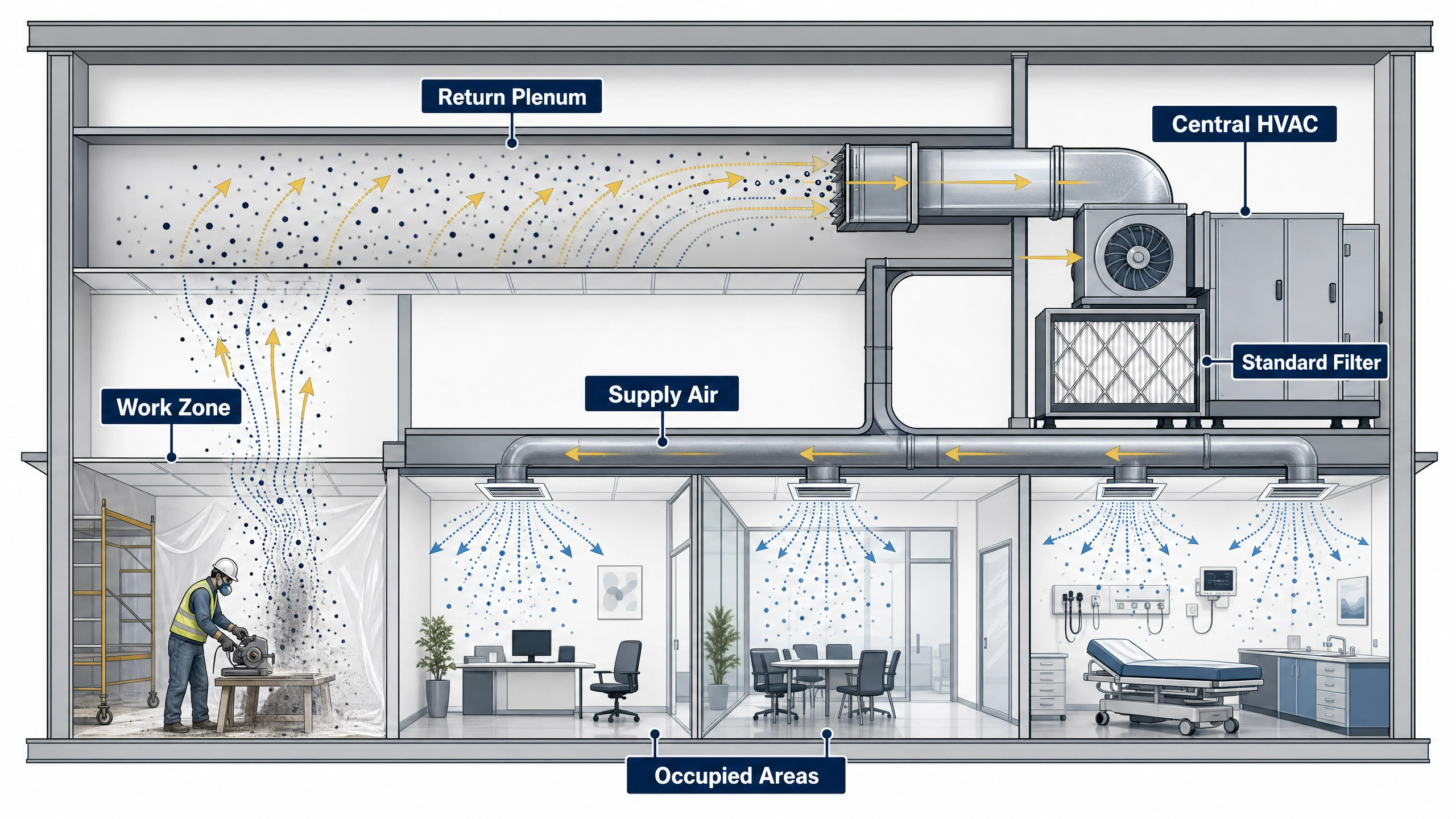
The most efficient distribution mechanism for escaped construction dust is the building’s own heating, ventilation, and air conditioning system. Most commercial buildings use the open space above drop ceilings as a common return-air plenum. When a contractor removes ceiling tiles or cuts into drywall inside an unisolated work zone, dust rises directly into this plenum. Mechanical return fans then pull the suspended particles into the primary return ductwork.
Once dust enters the centralized HVAC loop, it passes through standard commercial filters that are often completely unequipped to capture sub-micron particles. The system then redistributes contaminated air through supply diffusers on different floors or in entirely separate departments. What started as dust from a single renovation area is now circulating through the entire building.
The damage compounds after the crew leaves. Fine abrasive particles coat heating and cooling coils, reducing thermal transfer efficiency. Dust accumulates on fan blades, causing imbalances that lead to bearing wear and premature motor failure. Settled dust inside ductwork continues shedding particles every time the ventilation fans cycle on, degrading indoor air quality for months or years. Property managers who understand these hidden downstream costs often review commercial temporary barrier pricing structures before the project starts rather than absorbing HVAC remediation expenses after the fact.
Health Consequences: From Irritation to Death
Sick Building Syndrome: Symptoms, Stats, and the Post-COVID Shift
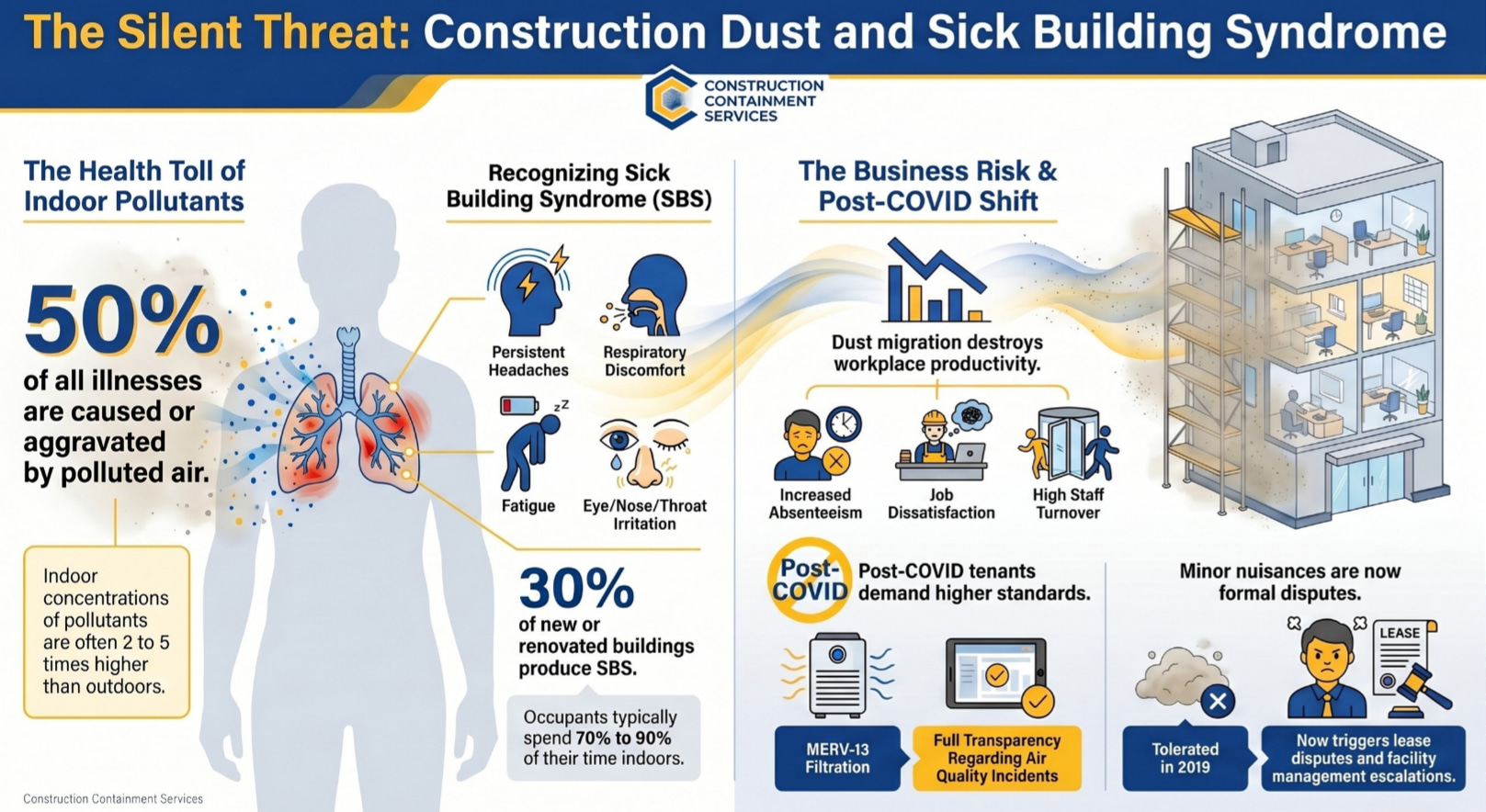
When construction dust migrates into occupied workspaces, offices, schools, retail stores, or healthcare facilities, occupants may quickly begin experiencing symptoms consistent with Sick Building Syndrome (SBS). The symptoms are common enough to dismiss individually, but the pattern is recognizable:
- Persistent headaches that resolve after leaving the building
- Eye, nose, and throat irritation
- Nasal congestion and sinus pressure
- Chronic fatigue and difficulty concentrating
- Respiratory discomfort, wheezing, or shortness of breath
- Skin irritation or dryness
The National Institutes of Health reports that 50% of all illnesses are either caused or aggravated by polluted indoor air. Up to 30% of new or recently renovated buildings produce SBS symptoms in occupants. Research shows that indoor pollutant concentrations are often two to five times higher than outdoor levels, a particular concern given that people spend 70 to 90% of their time indoors. When construction dust is added to that already challenging baseline, SBS leads directly to increased absenteeism, reduced productivity, job dissatisfaction, and high staff turnover.
In a post-COVID environment, this has gotten harder to ignore. Tenants and occupants now demand MERV-13 or higher filtration and transparency around air quality incidents. What might have been tolerated as a minor nuisance in 2019 now triggers formal complaints, lease disputes, and facility management escalations.
Silica Dust: Silicosis, COPD, and Lung Cancer
Respirable crystalline silica is among the most dangerous dusts generated by construction activity. OSHA lowered the permissible exposure limit (PEL) for silica to 50 micrograms per cubic meter (µg/m³), less than half the previous standard. About 2 million construction workers face silica dust exposure annually, but RCS does not stay inside the work zone when containment fails. It threatens everyone sharing the building’s air supply.
Silica dust is invisible to the naked eye in normal lighting. It can linger in the air and accumulate on surfaces long after construction work stops. The diseases it causes are permanent and incurable: silicosis (irreversible lung scarring), chronic obstructive pulmonary disease (COPD), and lung cancer. A 2024 study confirmed that both women and men in construction face increased COPD risks from dust exposure, and the Health and Safety Authority launched a national silica dust inspection campaign in June 2025 to address the ongoing risk.
California’s regulatory posture is especially aggressive. Cal/OSHA now enforces the strictest lead exposure limits in the country at just 10 µg/m³ compared to the federal 50 µg/m³ PEL. The EPA also finalized stronger rules in October 2024 reducing the dust-lead hazard standard to any reportable level, confirming that no amount of lead dust is considered safe for children. Lead dust from older buildings can contaminate occupied spaces through the same migration pathways as silica.
Aspergillus: When Dust Kills Hospital Patients
In healthcare environments, escaped construction dust carries a uniquely lethal risk. Aspergillus species are ubiquitous in soil, old drywall, and ceiling cavities. When disturbed by demolition, the spores become airborne and can cause fatal invasive pulmonary aspergillosis in immunocompromised patients, including those undergoing chemotherapy, organ transplant recipients, and neonatal infants.
A landmark review found that half of all healthcare-associated Aspergillus outbreaks were estimated to result from construction and renovation activities within or surrounding the hospital. One study found a statistically significant association between excavation activities and hospital-acquired mold infections with a hazard ratio of 2.8 (P = .01). Even renovation activities one floor above a renal transplant ward caused Aspergillus fumigatus to filter through acoustic ceiling tiles, causing disease in two patients and colonizing a third. The dust did not need to breach a direct wall to reach vulnerable occupants.
In late 2025, a severe outbreak at Sydney’s Royal Prince Alfred Hospital resulted in two patient deaths and four serious illnesses during a campus redevelopment. Health authorities traced the fungal infection directly to migrating construction dust that breached inadequate site barriers and reached a specialized transplant ward. Similar outbreaks reported by the BBC in the United Kingdom have forced the immediate closure of entire clinical wings. A 2023 peer-reviewed overview in the Journal of Fungi confirmed that reported invasive fungal disease outbreaks associated with construction are increasing, and that dust control remains a required component of every prevention plan.
The CDC formally recommends constructing barriers that are impermeable to fungal spores and implementing negative pressure with HEPA filtration to prevent construction dust from entering patient-care areas.
The Financial Exposure General Contractors Cannot Insure Away
Commercial Pollution Exclusion Clauses
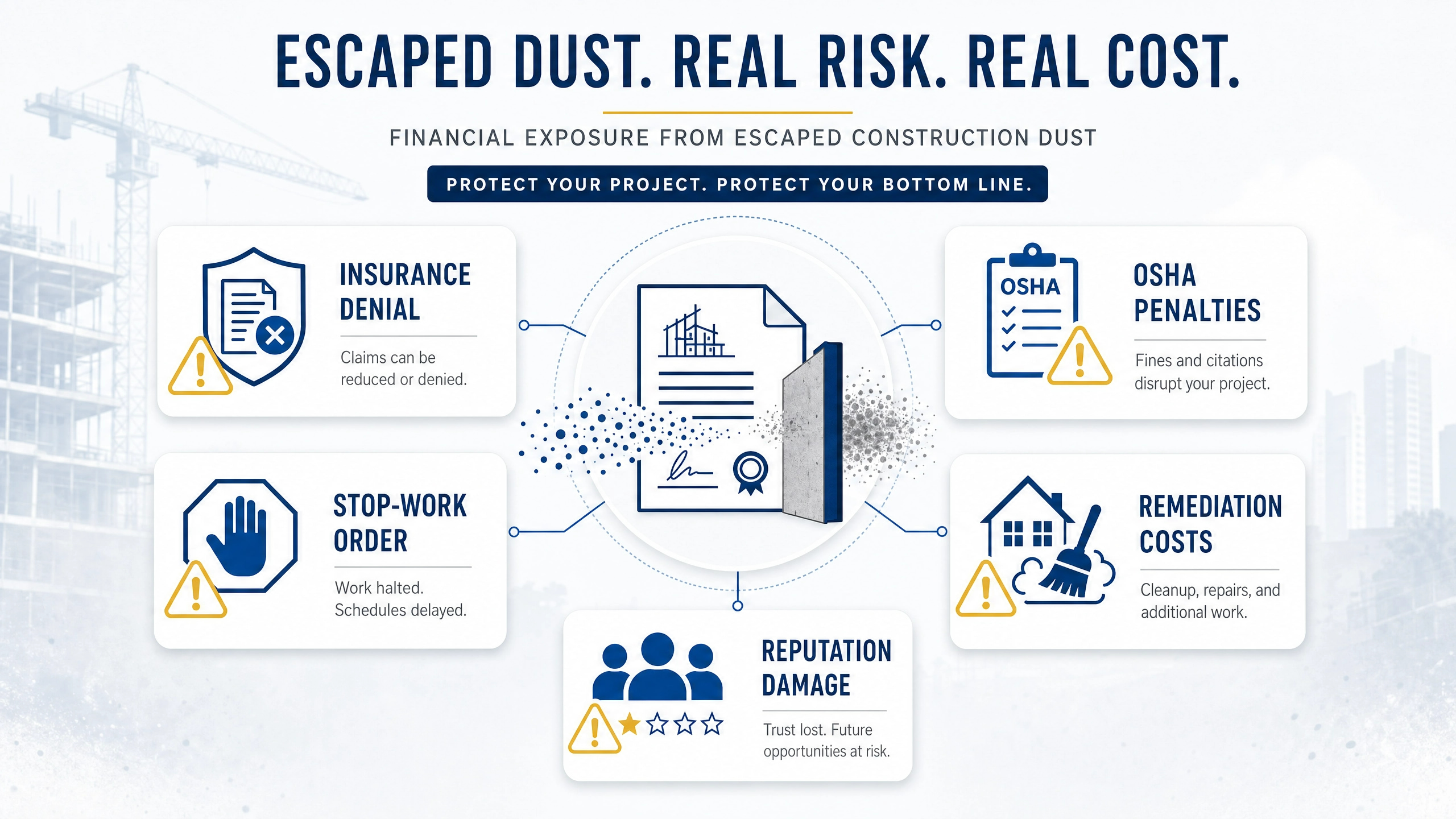
Many general contractors assume that standard commercial general liability insurance will cover property damage or business interruption claims caused by construction dust. That assumption is wrong more often than not. Modern commercial insurance policies contain standard pollution exclusion clauses, and federal courts have repeatedly ruled that industrial dust, including respirable crystalline silica and gypsum particulate, fits the legal definition of a pollutant or contaminant. Legal analyses published by JD Supra document multiple cases where property damage claims from migrating silica dust were completely barred by these exclusions. When dust enters an elevator shaft or contaminates an active commercial property, the insurer can legally deny coverage, leaving the GC directly exposed to the full cost of remediation, cleaning, and third-party losses.
OSHA Penalties and Violation Trends
When construction dust control in occupied spaces fails and OSHA gets involved, the penalties are substantial. As of January 2025:
Violation Type | Maximum Penalty (Jan 2025) |
Serious violation | $16,550 per violation |
Other-than-serious violation | $16,550 per violation |
Willful or repeated violation | $165,514 per violation |
Failure to abate | $16,550 per day past abatement date |
Respiratory protection (OSHA standard 1910.134) ranked as the 4th most-cited OSHA violation for fiscal year 2024 with 2,470 violations, a direct indicator of how widespread dust exposure non-compliance remains. A December 2024 OSHA update also now requires all personal protective equipment to properly fit workers on construction sites, adding another compliance dimension that applies to occupied renovation projects.
Project Suspensions, Liquidated Damages, and the Timeline Cascade
A major dust breach almost always results in an immediate stop-work order from the building owner, local building official, or environmental health officer. The suspension can last several days to multiple weeks while air quality testing and forensic cleaning occur. The downstream effects compound quickly:
- Mandatory project suspension while remediation and testing are completed
- Contractually mandated liquidated damages accruing daily against the GC
- Forced reallocation of subtrade labor schedules across other active projects
- Unplanned forensic cleaning, HEPA vacuuming, surface wipe-downs, and indoor air quality testing expenses
- Reputational damage that can disqualify a contractor from future bidding with that facility or property management group
Operational and Financial Consequences Beyond the Fine
The regulatory penalties are only the beginning. Failed construction dust control in occupied spaces creates financial damage at the project level and the business level that outlasts any OSHA citation:
- Project delays: dust breaches requiring remediation can add weeks to timelines, with labor and material costs compounding daily
- Rework and re-cleaning: dust settling in adjacent occupied spaces requires professional removal including HEPA vacuuming, surface wipe-downs, and air quality testing before spaces can be reoccupied
- Subcontractor liability: contractors may be held responsible for medical costs, lost productivity, or property damage when occupants are exposed to construction dust
- Insurance claims: poor indoor air quality is now linked to rising insurance claims from respiratory issues and long-term illness, and insurers are beginning to factor IAQ performance into risk assessments
- Reputation damage: in competitive Bay Area markets, a single high-profile containment failure, especially in healthcare or a marquee commercial renovation, can cost a contractor years of relationship-building with facility managers and GC partners
The IFMA (International Facility Management Association) noted in April 2026 that traditional drywall partitions are now widely regarded as inadequate for occupied-space renovations due to their single-use waste, extended installation times, and inability to maintain reliable dust containment. These findings are accelerating the shift toward reusable modular containment systems across healthcare, commercial office, and data center sectors.
Facility-Specific Vulnerabilities

Healthcare: When Containment Failure Becomes Clinical Liability
When ICRA containment fails inside a hospital, the consequences go far beyond a dusty corridor. The impacts cascade through clinical operations:
- Forced partial or complete shutdown of clinical areas, including operating rooms
- Canceled surgeries and procedures with immediate revenue loss
- Remediation costs that can delay projects by weeks
- Joint Commission citations that threaten the hospital’s accreditation
- Direct financial and legal liability for hospital-acquired infections traceable to construction activity
Healthcare facilities enforce the ICRA 2.0 framework precisely because these stakes are real. High-risk areas require rigid, airtight, hard-wall containment barriers extending from the structural floor slab to the underside of the structural deck above the ceiling tiles, with continuous negative air pressure, HEPA filtration, and anteroom decontamination. Part 2 of this series will detail these ICRA classification requirements and the specific protocols each class demands.
Data Centers: The Dust Accumulation Cascade
Data centers and IT switching rooms require exceptional environmental purity. Abrasive construction dust is highly destructive to sensitive computer hardware, optics, and copper circuit traces. When fine gypsum or concrete dust settles inside a server chassis, it triggers a progressive failure chain:
- Dust accumulation: fine particles settle on circuit boards and internal components
- Insulating layer forms: dust blankets heat sinks and blocks proper thermal dissipation
- Heat dissipation fails: localized temperatures rise beyond component tolerances
- Moisture absorption: many construction dusts are hydrophilic and attract ambient humidity
- Micro-arcing occurs: moisture across closely spaced electrical pathways causes short circuits
- System crash and data loss: cascading component failure takes servers offline
Major hardware manufacturers explicitly state in their warranty documentation that exposure to airborne particulate levels outside specified tolerances voids all equipment warranties. For a facility operator, that means the cost of a containment failure is not just the immediate cleanup. It is the full replacement cost of every affected piece of hardware.
The numbers make this concrete. Industrial cleanrooms and enterprise data halls adhere to ISO 14644-1 Class 8, which caps particulate concentration at 3,520,000 particles of 0.5 microns or larger per cubic meter. A standard uncontained job site can easily exceed 35,000,000 particles per cubic meter, more than ten times the allowable limit. A single afternoon of uncontained drywall sanding can blow past the threshold. Monitoring data from Setra’s cleanroom monitoring group confirms these benchmarks, and maintaining compliance requires high-performance containment combined with multi-stage HEPA filtration. Specialty installers can ensure their containment stays within tolerances by following proper installation methodologies for containment barriers.
Commercial Offices: Tenant Disruptions and Lease Exposure
Renovations inside active corporate offices, financial institutions, and commercial buildings face financial pressure tied directly to employee productivity. When construction dust control in occupied spaces is mismanaged, fine dust settles on desks, conference tables, and breakroom counters. Research from the World Economic Forum indicates that uncontrolled construction noise and environmental distractions can cause an immediate 66% drop in employee productivity. When a GC allows dust to escape the work zone, they directly damage the operational output of the tenant’s business.
Commercial property managers are contractually obligated to provide tenants with a habitable environment allowing quiet enjoyment of the leased premises. A failure to contain construction dust can constitute a material breach of the lease, giving tenants a legitimate basis to demand rent abatements, withhold payments, or terminate their tenancy without penalty. In San Jose and San Francisco, property owners routinely file secondary lawsuits against general contractors to recover financial losses from tenant rent abatements. Contractors facing tight office build schedules can evaluate containment approaches for restrictive floor plans by reviewing temporary partitions for tenant improvements.
Why This Matters for Bay Area Contractors and Facility Managers
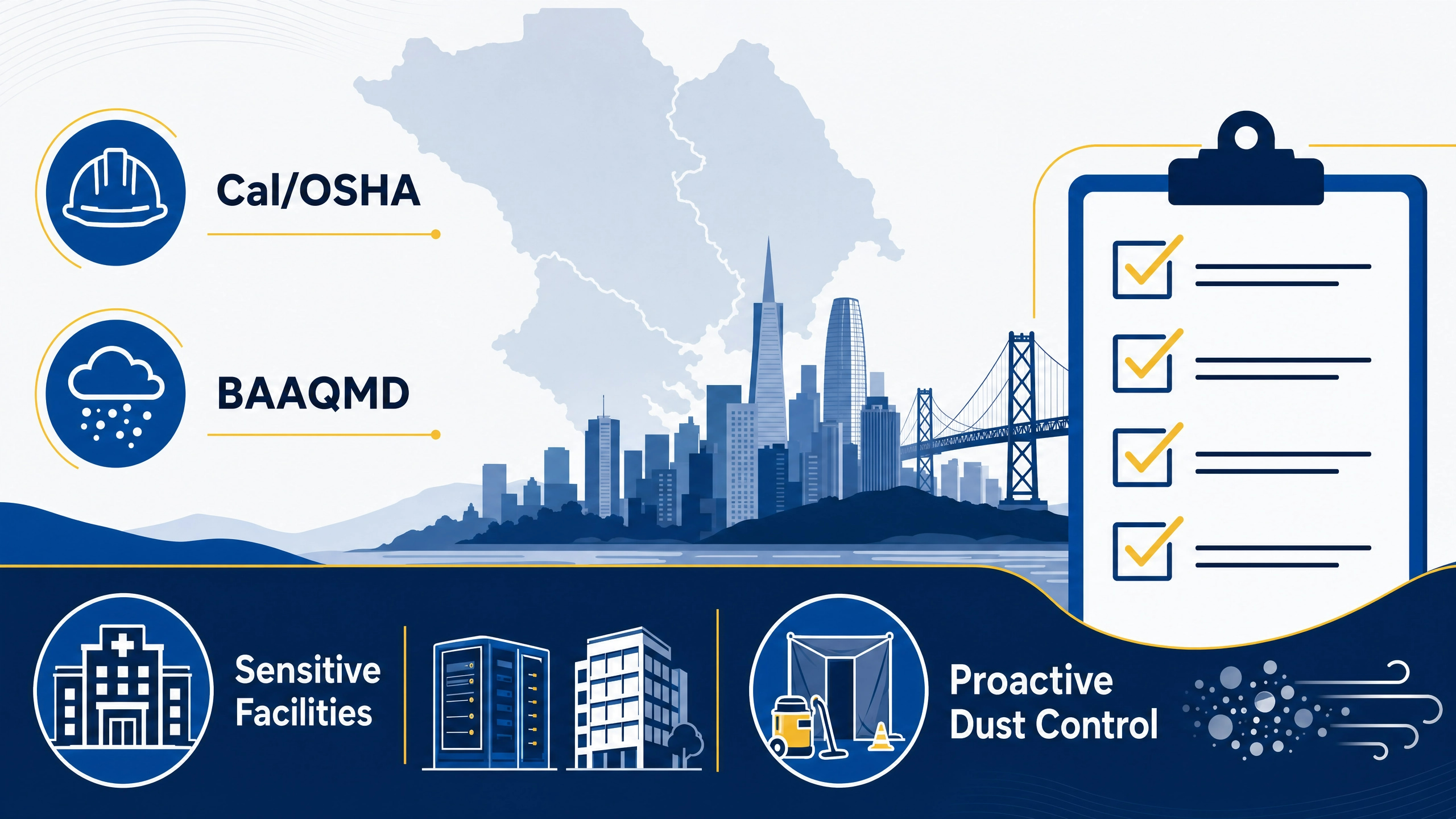
California’s regulatory environment is among the most stringent in the nation for construction dust control in occupied spaces. Cal/OSHA enforces the federal silica PEL of 50 µg/m³ alongside the nation’s most aggressive lead exposure limits at 10 µg/m³. The Bay Area Air Quality Management District (BAAQMD) is advancing its Fugitive Dust Rule Amendment as of October 2024, and fugitive dust from construction projects already accounted for 62% of total PM10 emissions in the region in 2023. Local compliance pressures are intensifying, making proactive dust control not just a health obligation but a business requirement for contractors operating in this market.
The density of sensitive facilities in the Bay Area amplifies this. Healthcare systems including Kaiser Permanente, Sutter Health, and VA hospitals depend on contractors who understand ICRA compliance to maintain clinical operations during renovation. With over 150 licensed hospitals, 600 outpatient clinics, and a concentrated population of data centers, commercial office parks, and public facilities, the demand for professional, compliant construction dust control is growing faster than most contractors are equipped to handle. Contractors can review the compliance landscape by exploring California temporary wall compliance frameworks.
These Risks Are Preventable
Every consequence described in this article, from sick building syndrome complaints to fatal Aspergillus infections, from OSHA penalties exceeding $165,000 to voided server warranties, follows from the same root failure: dust that crossed a barrier it should not have crossed. The good news is that the engineering solutions exist, and they are field-proven.
In Part 2 of this series, we break down the specific protocols, barrier systems, and negative air strategies that keep construction dust where it belongs. That article covers ICRA 2.0 classification requirements, NFPA 241 fire separation standards, the head-to-head comparison between modular containment, drywall, and plastic sheeting, anteroom decontamination procedures, and the continuous monitoring systems that detect breaches in real time.
If you are a general contractor, facility manager, or building owner planning a renovation inside a space that must remain operational, the containment plan is not a line item to minimize. It is the single decision most likely to determine whether your project finishes on time or ends up in litigation.
Get ahead of containment risk on your next occupied renovation
- Request a containment assessment from 5DCCS for your next occupied renovation project.
Explore 5DCCS modular wall rental and sales services for your upcoming occupied space contract.