
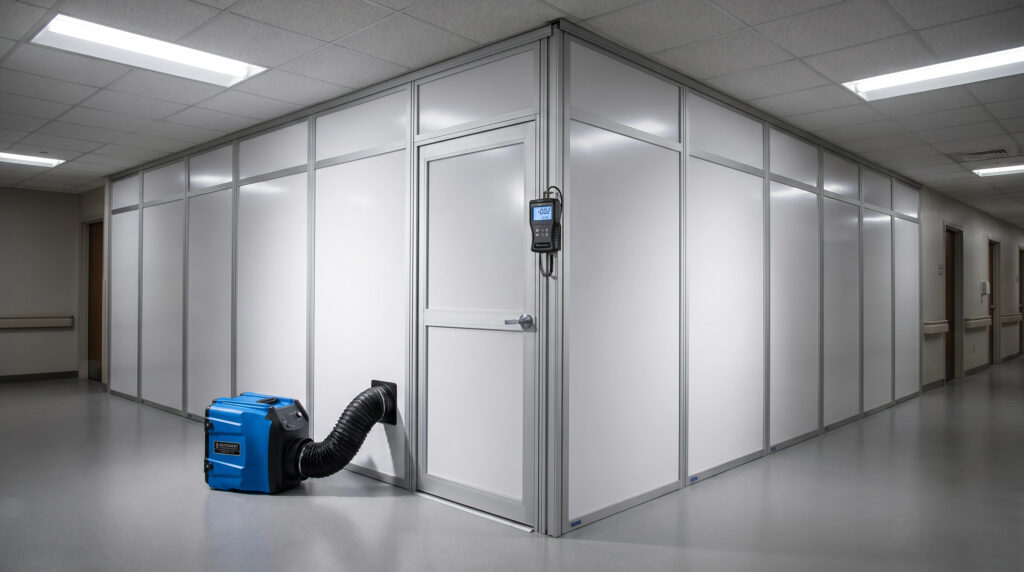
Negative Air Pressure Systems: ICRA Compliance Made Simple
By: Construction Containment Services (5DCCS)
Construction and renovation within occupied healthcare facilities present a unique set of life safety risks. Unlike standard commercial projects, hospital work occurs in environments where occupants often have compromised immune systems. The simple act of opening a wall or removing a ceiling tile can release airborne fungal spores such as Aspergillus, or create conditions that allow waterborne pathogens like Legionella to spread.
According to the CDC Guidelines for Environmental Infection Control, construction-related contaminants are significant contributors to hospital-acquired infections (HAIs), which account for an estimated 90,000 deaths annually in the United States.
To manage this risk, the industry uses the Infection Control Risk Assessment (ICRA) framework. If you are new to ICRA, our guide to ICRA-compliant containment walls covers the foundational concepts. While physical barriers provide the first line of defense, Negative Air Pressure ICRA protocols serve as the mechanical safeguard that keeps dust and microbes contained within the work zone.
The Core Principle: How Negative Air Pressure Works
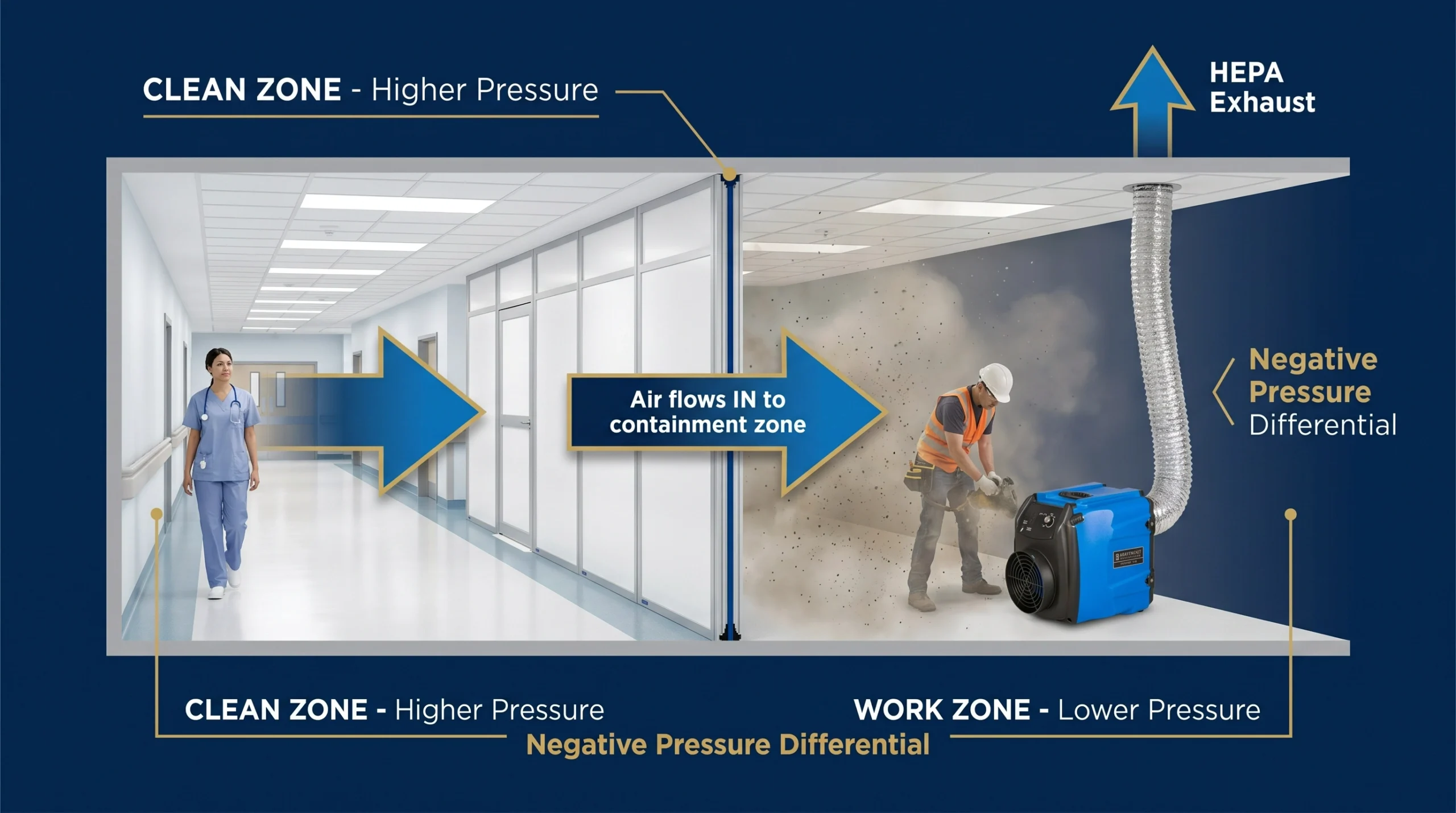
Negative air pressure is an atmospheric condition where the air pressure inside a contained space is lower than the pressure outside of it. In construction, this is achieved by using HEPA-filtered air machines to exhaust air out of the work zone faster than it can enter. Understanding pressure relationships in healthcare construction starts with this simple directional principle.
This pressure differential creates a controlled directional airflow. If a small gap exists or a door is opened, air rushes into the construction zone rather than blowing outward into the sterile hospital corridor. The fundamental rule is that air always moves from the clean clinical space into the dirty construction zone, not the other way around.
Think of it as a one-way valve for air. Even minor breaches in the barrier are self-correcting from a contamination standpoint because the pressure gradient is always pulling inward.
Minimum Pressure and Air Change Requirements
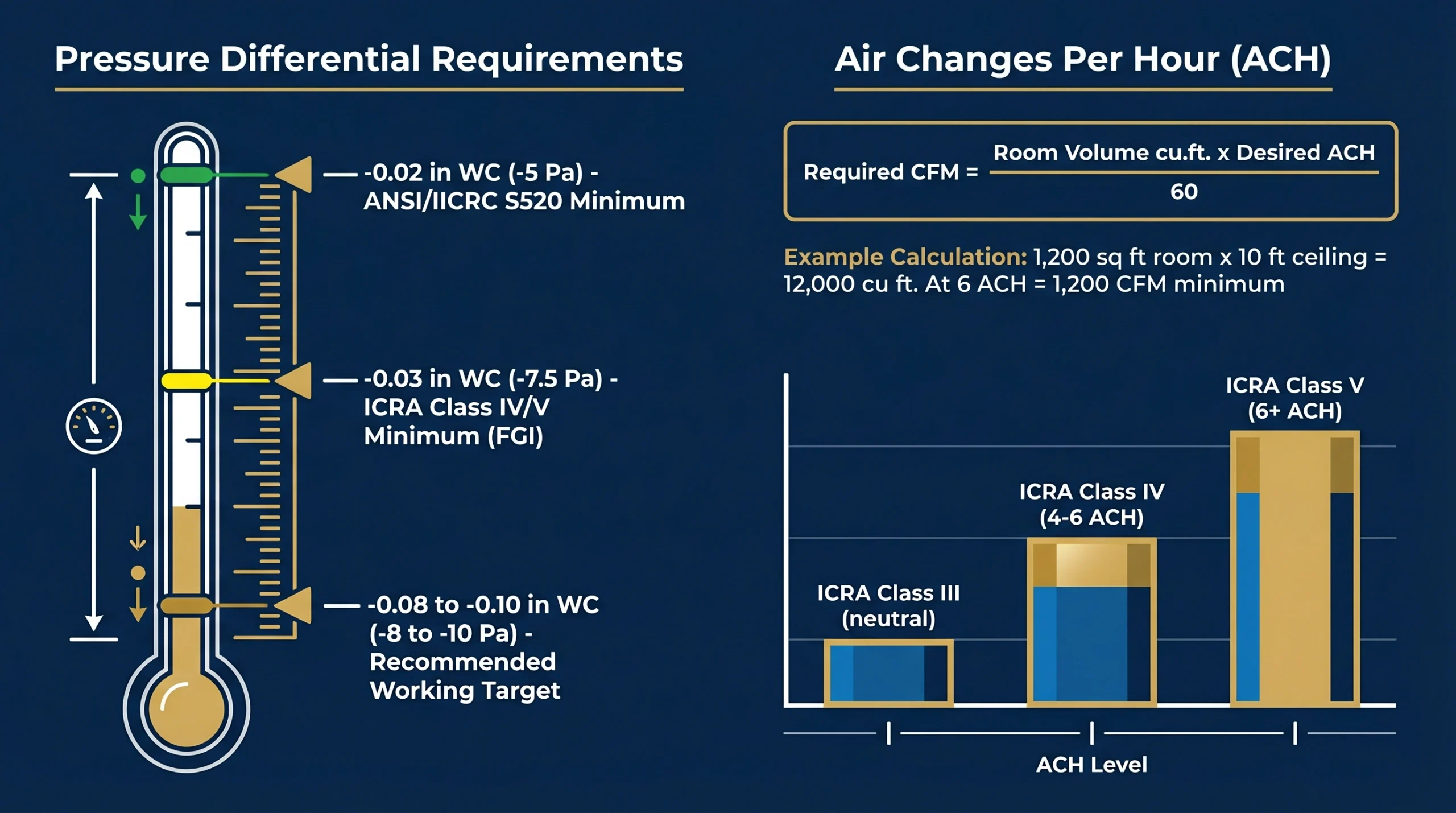
Understanding the numbers is essential for building a compliant system. These thresholds come from established industry standards and determine what type of monitoring and equipment your project requires.
Pressure Differential Thresholds
The industry minimum, established by ANSI/IICRC S520, is -0.02 inches of water column (approximately -5 Pascals). Minnesota DOH negative pressure guidelines, widely referenced as a national standard, align with this threshold and specify that the manometer must confirm this value before work begins each day.
For ICRA Class IV and Class V healthcare construction, the Facilities Guidelines Institute (FGI) and ASHE ICRA 2.0 raise that bar to a minimum of -0.03 inches of water column (-7.5 Pascals). If you need a deeper breakdown of what each class requires on-site, our ICRA Class IV vs. Class V guide walks through the full matrix. A practical working target of -8 to -10 Pascals provides a safety buffer against momentary fluctuations caused by door openings or HVAC cycling.
The Association for Professionals in Infection Control and Epidemiology (APIC) recommends a working range of -0.02 to -0.04 inches of water column for healthcare containment zones.
Air Changes Per Hour (ACH)
Beyond pressure, the system must provide sufficient air turnover. ICRA 2.0 generally requires 4 to 6 air changes per hour within the containment zone as a baseline. To calculate the required airflow capacity for your equipment:
Required CFM = (Room Volume in Cubic Feet x Desired ACH) / 60
A 1,200 square foot room with a 10-foot ceiling, for example, has 12,000 cubic feet of volume. At 6 ACH, you need at least 1,200 CFM of exhaust capacity before accounting for barrier leakage.
HEPA Filtration and Exhaust Requirements
Not just any air handler will work. ICRA-compliant systems require certified HEPA filters capable of capturing 99.97% of airborne particles down to 0.3 microns. This standard is what makes the filtration effective against fungal spores and fine construction dust.
For the exhaust destination, ASHE and ASHRAE Standard 170 specify that outdoor exhaust points must be located at least 25 feet from building air intakes and at least 10 feet above rooftop level. Recirculating filtered air back indoors during ICRA Class IV and V projects is explicitly prohibited under ICRA 2.0 unless the infection preventionist has reviewed and approved the setup and filter integrity is verified.
Exhausting into HVAC return plenums, shared ductwork, or restroom exhaust systems is never acceptable. When in doubt, run the exhaust outside.
Pre-filter maintenance is a practical compliance issue that often gets overlooked. Construction generates heavy debris. When pre-filters clog, motor load increases and actual airflow drops significantly, potentially bringing measured pressure below the required threshold. Establish a documented pre-filter change schedule from day one.
HVAC System Isolation
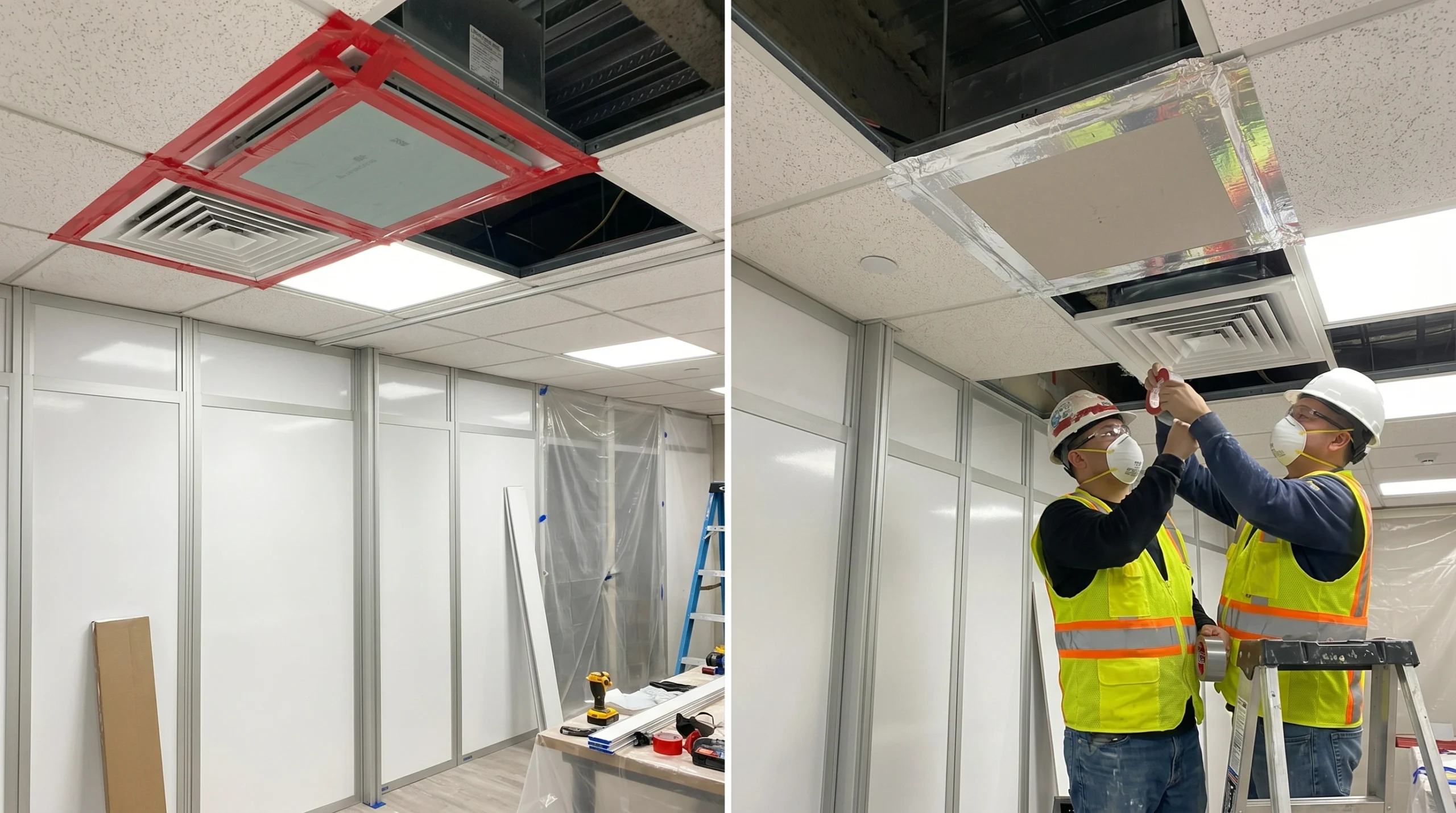
Before negative pressure can be established, the HVAC system within the work zone must be mechanically isolated. This step is frequently skipped or done incompletely, and it is one of the most common reasons containment fails in the field. For a broader checklist of what to set up before work begins, see our post on how to plan for temporary containment during renovation.
Supply air diffusers within the work zone must be sealed so they do not positively pressurize the room and fight against your negative air machines. Return air diffusers must also be blocked to prevent construction dust from being drawn into the building’s ductwork and distributed throughout the facility.
In buildings with open ceiling plenums, the containment barrier must extend from floor to the structural deck above, not just to the dropped ceiling grid. If the barrier stops at the ceiling tiles, air will bypass the entire containment through the plenum space above. Always confirm the deck-to-floor seal with the infection preventionist before work begins.
Continuous Monitoring and Alarm Systems
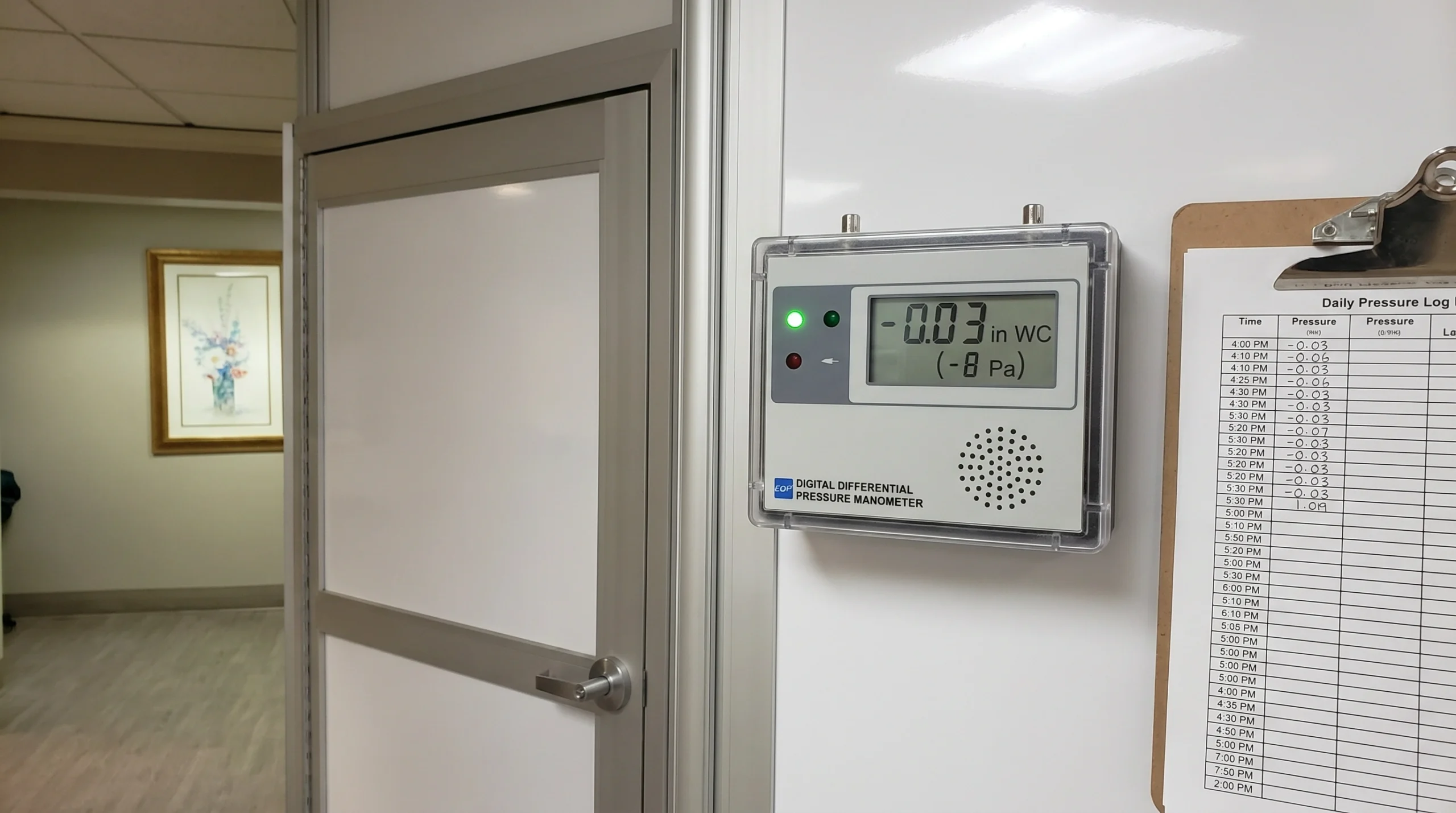
Visual cues like inward-deflecting plastic sheeting are not sufficient to verify adequate negative pressure. Even dramatic visual deflection may represent only a fraction of the required -5 Pa differential. The only reliable method is direct measurement with a calibrated manometer (differential pressure gauge).
What ICRA 2.0 Requires by Class
For ICRA Class IV projects, a digital recording manometer with a visible display is required. The system must provide visual and audible alarms when pressure falls below the minimum threshold. Northwell Health’s negative air monitoring log is a useful real-world example of what compliant daily documentation looks like.
For Class V projects, the requirements escalate to 24/7 automated logging and alert systems. This includes autodialers or equivalent notification systems that instantly alert facility staff if a pressure failure occurs outside working hours. HigginsEDU’s ICRA 2.0 overview provides a clear breakdown of how Class V mandates digital air pressure monitoring as a non-negotiable requirement.
For projects following Minnesota DOH asbestos containment standards, which are widely adopted nationally as a reference, manometer checks are required every two hours, the instrument must be zeroed before work begins each day, and calibration records must be maintained at least annually.
Documentation for Compliance
Daily pressure logs are your best protection during a safety audit or if an HAI investigation is ever initiated. Document the opening manometer reading, any pressure events, and corrective actions taken. Consistent documentation is what separates a defensible project from an exposed one.
Anterooms and Cascading Airflow
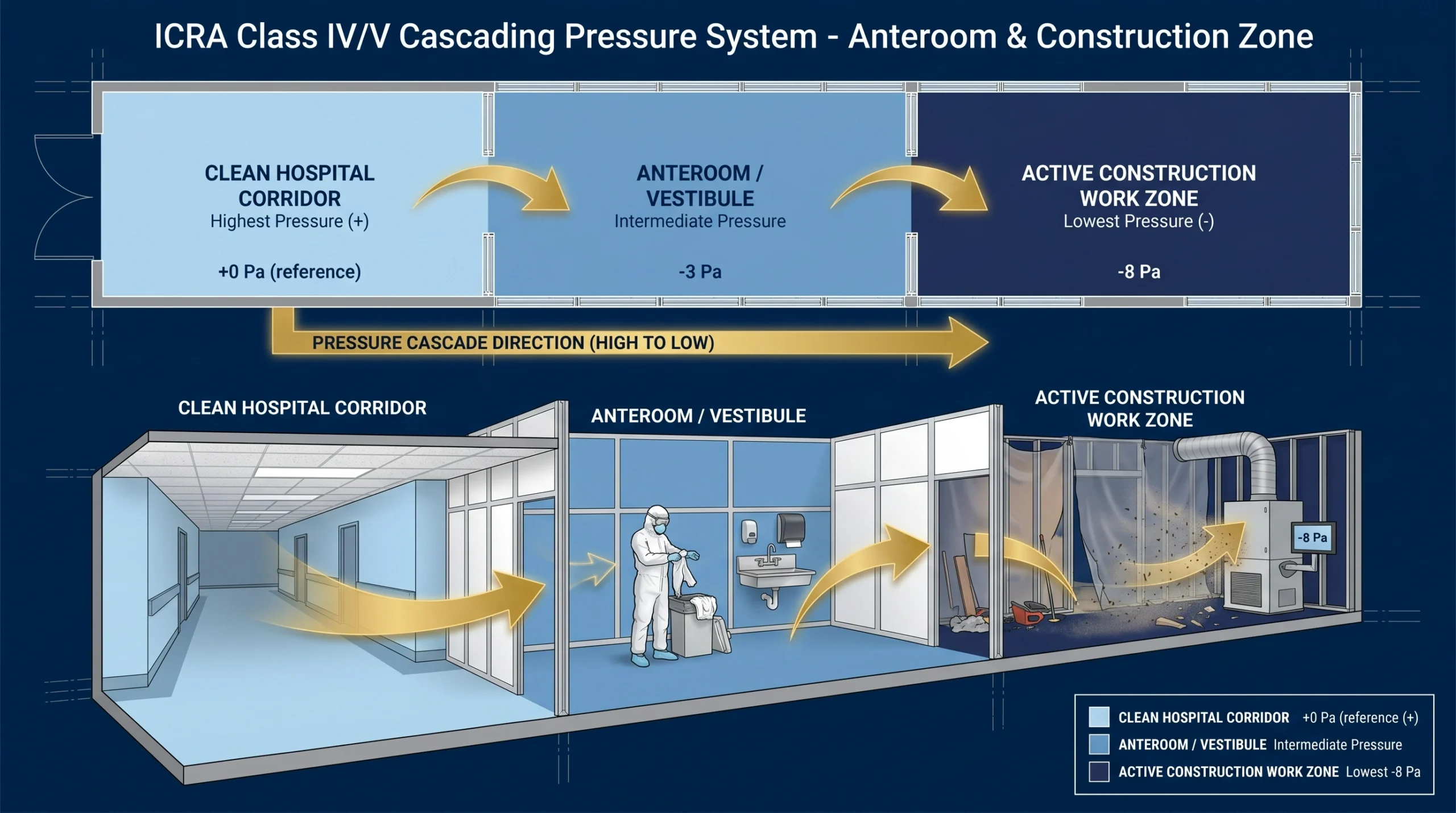
For ICRA Class IV and Class V projects, an anteroom (also called a vestibule or decontamination chamber) is mandatory. This is a small transitional space between the clean hospital corridor and the construction work zone.
The pressure must be configured in a cascading gradient: the clean corridor is at the highest pressure, the anteroom is at a slightly lower pressure, and the active work zone is at the lowest pressure. This cascade ensures that even when a worker opens the door to enter or exit, contaminated air cannot travel toward the occupied space.
The anteroom also serves as the decontamination station. Workers wipe down boots, dispose of outer garments, and clean tools before stepping back into the hospital corridor. Without this buffer, every worker entry and exit event is a potential contamination risk.
Barrier Integrity: Why the Wall Matters for Pressure
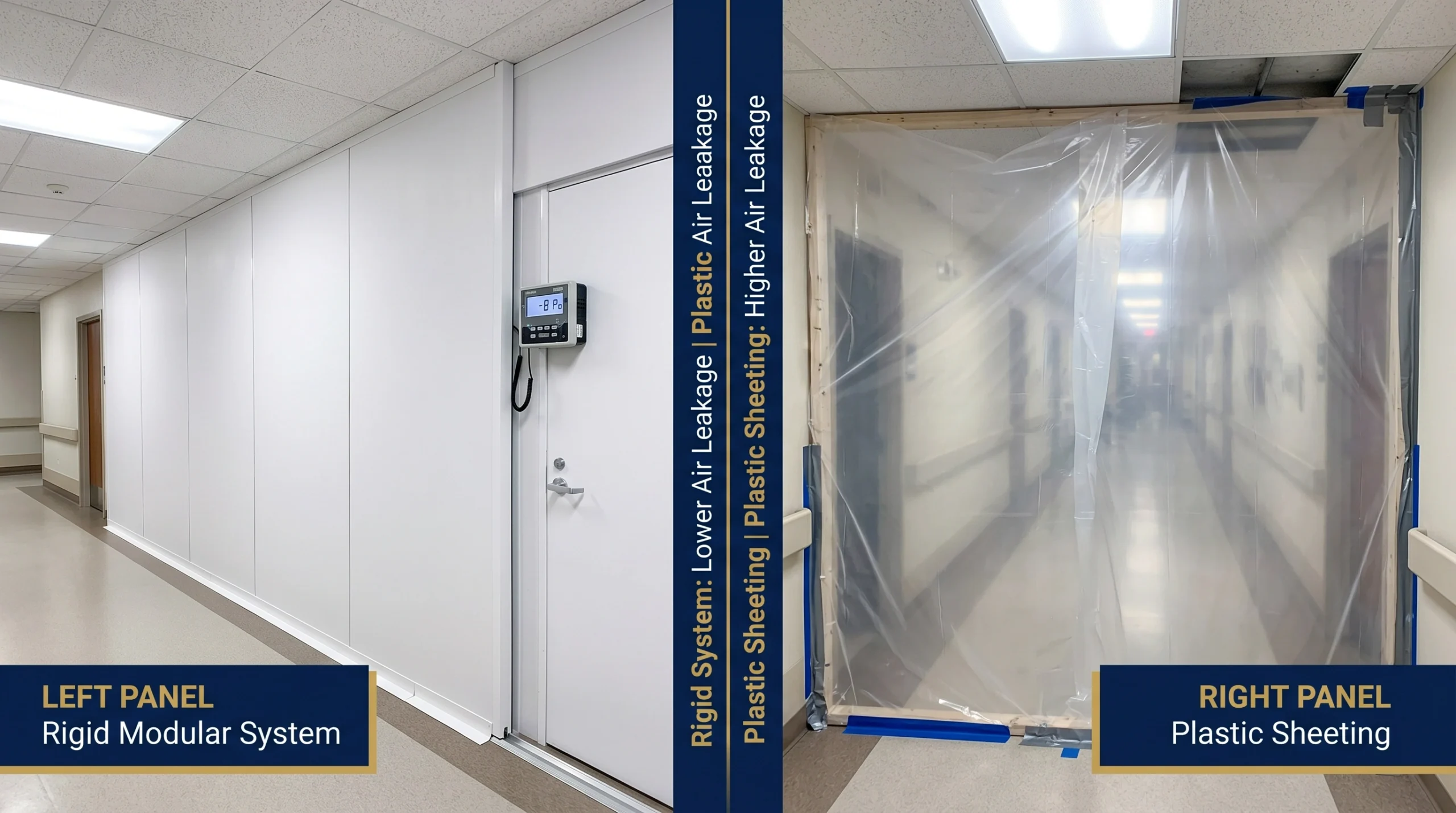
Negative pressure does not exist in isolation. The air containment system is only as good as the physical barrier enclosing the space. This is where barrier selection has a direct, measurable impact on mechanical performance.
Standard plastic sheeting has significantly higher air leakage rates than rigid systems. Under negative pressure, thin poly sheeting tends to billow and flex, which can break taped seals at the floor and ceiling line. When those seals fail, you are drawing unfiltered ambient air into the system rather than maintaining a controlled containment.
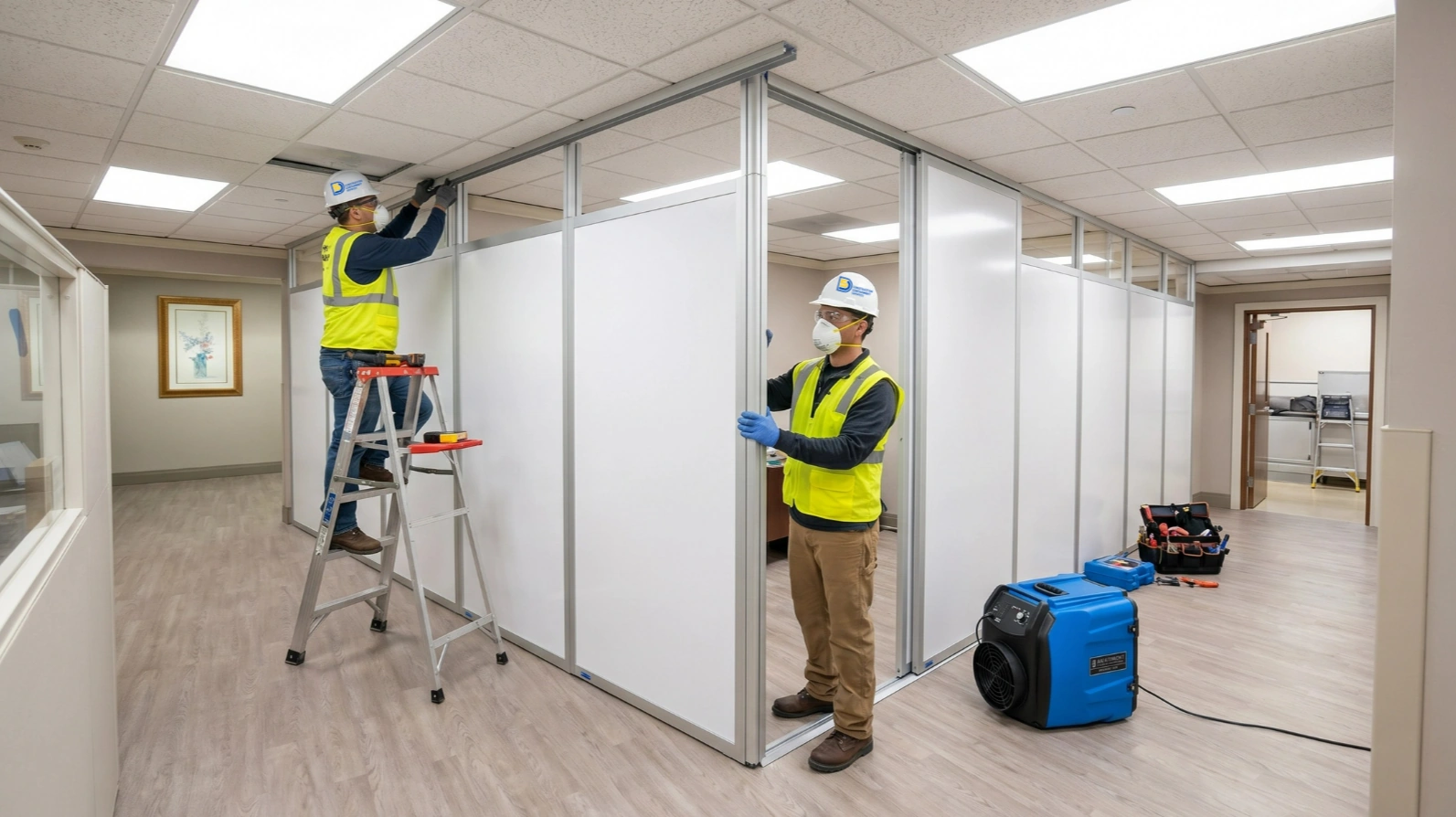
Rigid modular temporary wall systems with integrated gaskets and mechanical track connections maintain airtight seals under sustained negative pressure. Because they have lower air leakage rates, they also require less machine capacity to achieve and hold the same pressure differential. Our post on temporary walls vs. drywall breaks down why rigid systems consistently outperform both drywall and plastic sheeting in sustained negative pressure applications.
From a compliance documentation standpoint, modular wall systems can provide manufacturer test data and airflow specifications that can be submitted directly to the infection preventionist as part of the permit documentation package.
Step-by-Step: Implementing a Compliant Negative Air System
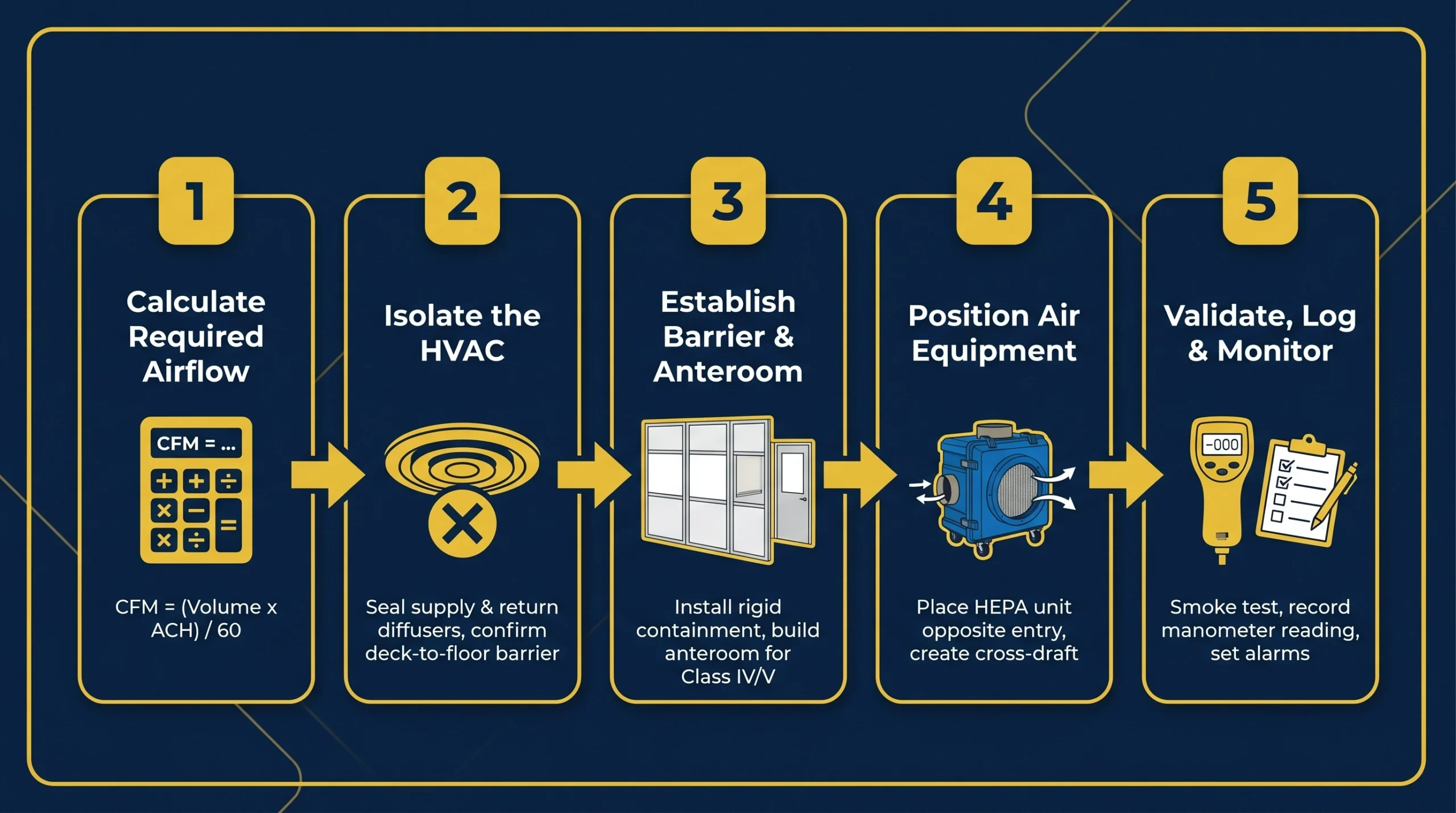
Step 1: Calculate Required Airflow
Use the ACH formula above to calculate the minimum CFM your equipment must deliver. Factor in a buffer for barrier leakage. If you are using plastic sheeting, size up. If you are using rigid modular walls, the required capacity will be lower for the same space.
Step 2: Isolate the HVAC
Seal all supply diffusers. Block all return diffusers. Confirm the barrier extends to the structural deck if a plenum exists above the work zone. Get sign-off from the infection preventionist before proceeding.
Step 3: Establish the Barrier and Anteroom
Install the physical containment first. For Class IV and V, build the anteroom before energizing the negative air equipment. Confirm floor and ceiling track seals are tight. Skipping steps here is one of the most common mistakes contractors make with temporary wall systems, and it is far more costly to fix after the fact than to get right the first time.
Step 4: Position the Air Equipment
Place the HEPA air handler at the end of the room opposite the main entry point. This creates a cross-draft that pulls dust and particles away from the exit, keeping the transition area cleaner for workers and reducing contamination risk during entries and exits.
Step 5: Validate, Log, and Monitor
Once the system is running, use a smoke pencil or tissue test to confirm inward airflow at all door gaps and seams. Record the initial manometer reading and confirm it meets your class-specific threshold. Set up your alarm system and logging protocol. For Class V, confirm your remote alert system is functional before work begins. For a broader view of California-specific compliance requirements that apply to your containment setup, see our post on California modular temporary wall regulations.
Common Field Challenges
Ducting Friction and Pressure Loss
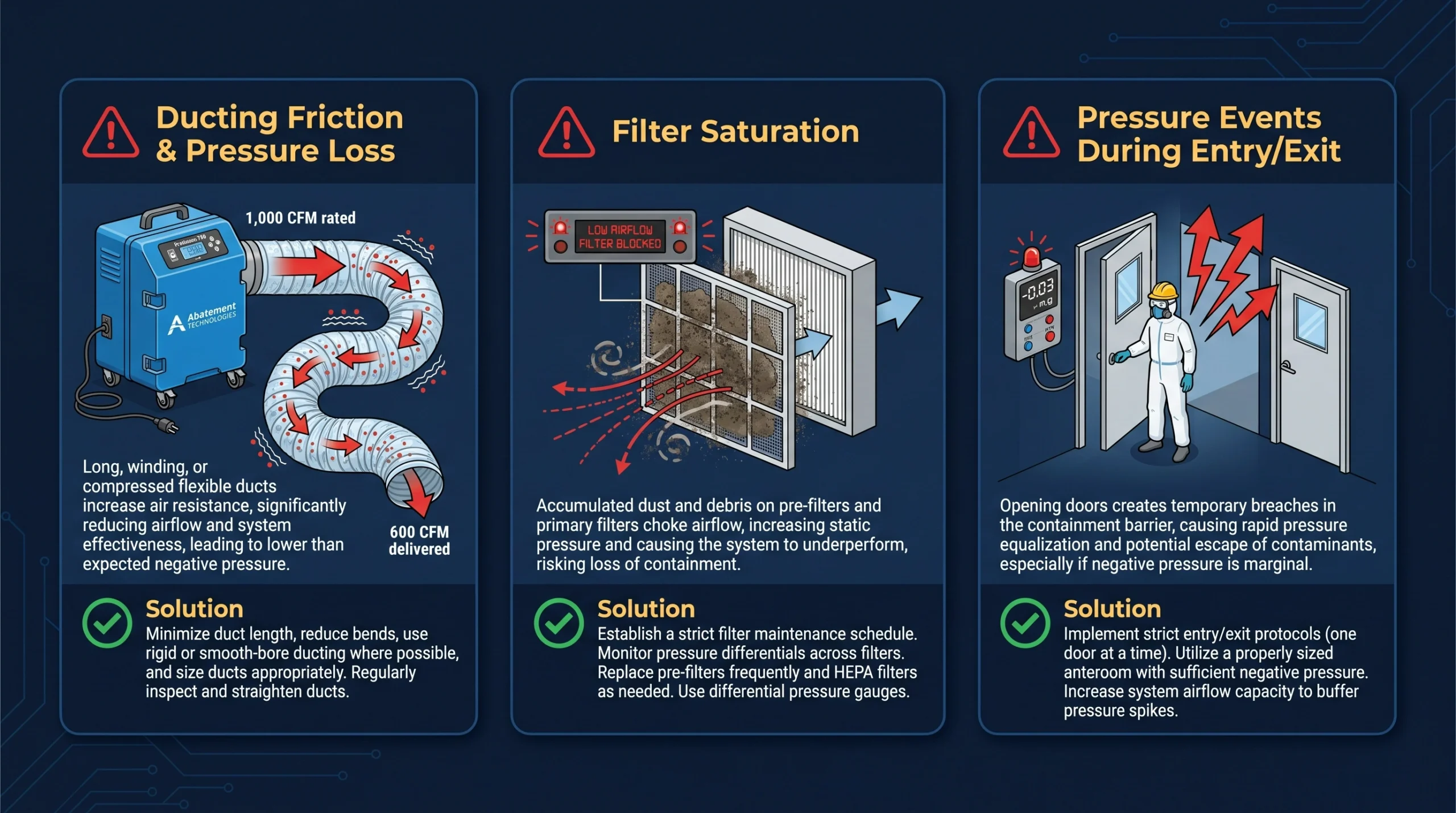
Long runs of flexible exhaust ducting cause static pressure loss. A machine rated at 1,000 CFM may deliver only 600 CFM by the time air reaches the exterior exhaust point due to duct friction. Keep duct runs as short and straight as possible, and verify delivered airflow at the source, not just the equipment rating.
Filter Saturation
Construction environments generate more particulate than most equipment assumptions account for. Pre-filters can saturate quickly during demolition phases. A clogged pre-filter reduces airflow and drops negative pressure below the required threshold without triggering a system alarm if the manometer is not being actively monitored. Build in a pre-filter inspection into your daily start-up checklist.
Pressure Events During Entry and Exit
Every door opening is a pressure challenge. Workers moving through an anteroom create momentary pressure fluctuations. Make sure the anteroom is properly sealed and that the cascading pressure gradient is established across all three zones. Train workers to close the inner door before opening the outer door.
How 5DCCS Supports Compliant Containment
At Construction Containment Services, we work with Bay Area facility managers and general contractors who are managing high-stakes projects in occupied healthcare environments. Our team is trained in Cal/OSHA Title 8 requirements and is familiar with HCAI (formerly OSHPD) documentation standards. You can learn more about our certifications and background on our about page, including our SDVOSB, DVBE, and SBE certifications.
We provide professional modular containment wall installation in San Jose, San Francisco, Oakland, and across Northern California. Our full-service rentals and installation include the rigid, gasketed modular systems that hold negative pressure consistently, and they install and remove without generating the dust that traditional drywall partitions create. If you are weighing the cost of renting versus other approaches, our cost savings breakdown shows why modular rental typically comes out ahead over the life of the project.
It is also worth noting that for ICRA Class IV and V projects, your containment barrier likely needs to meet fire-rating requirements as well as pressure performance requirements. Our guide to fire-rated temporary walls on jobsites explains when ASTM E84 Class A compliance applies and what to look for when specifying your system.
We also consult on containment strategy as part of our service, helping project teams think through HVAC isolation, anteroom placement, and barrier configuration before equipment is energized. Getting these decisions right at the start prevents costly pressure failures and stop-work events later.
Facility Manager Verification Checklist
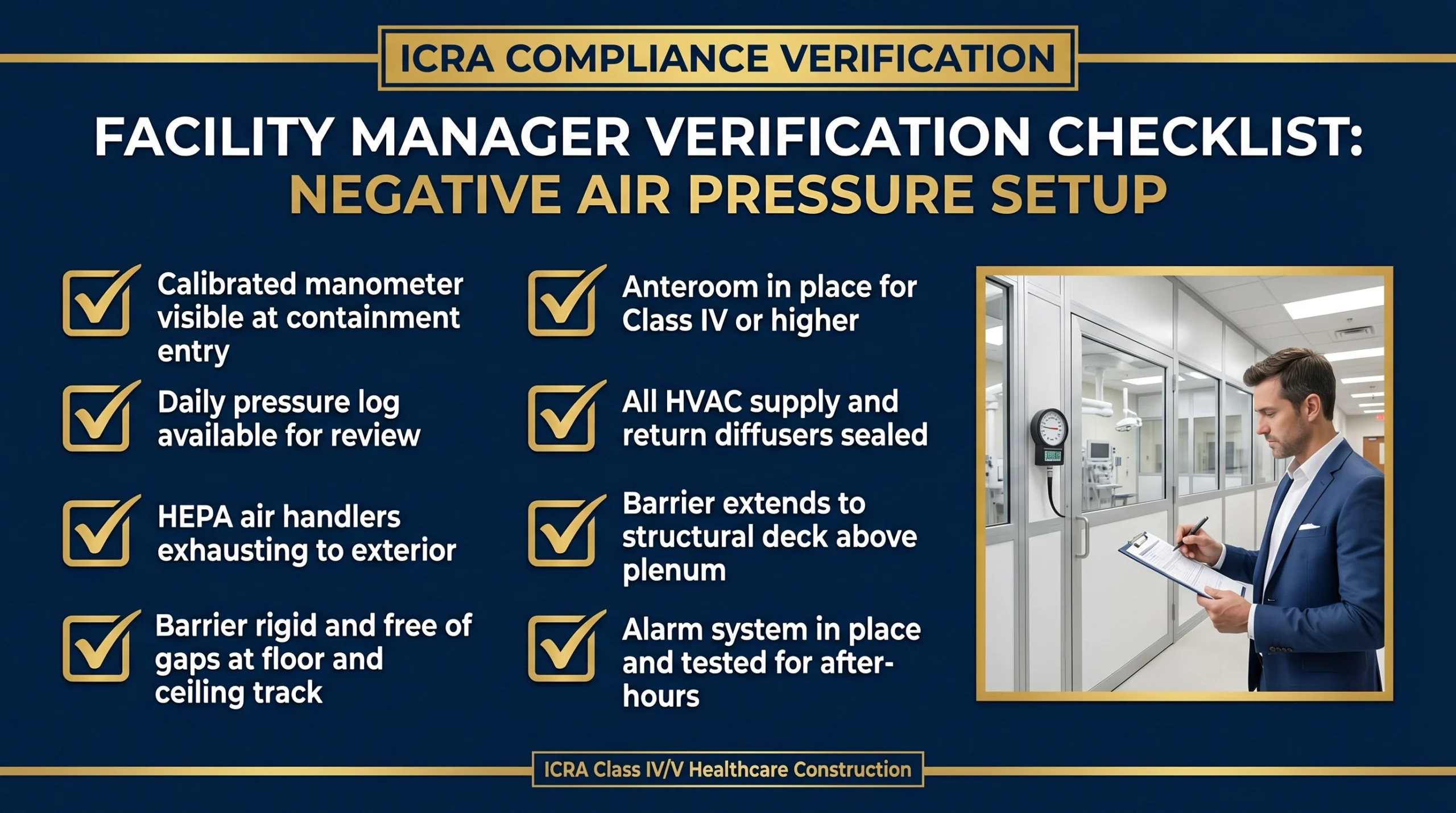
If you are overseeing a contractor on an active healthcare project, use these questions to verify their negative air pressure setup:
- Is a calibrated manometer visible at the containment entry point?
- Does the contractor have a daily pressure log available for review?
- Are HEPA air handlers exhausting to the exterior or a verified, approved exhaust duct?
- Is the barrier rigid and free of gaps at the floor and ceiling track line?
- Is there an anteroom in place for Class IV or higher projects?
- Have all supply and return HVAC diffusers within the work zone been sealed?
- Does the barrier extend to the structural deck above any plenum space?
- Is an alarm system in place and tested for after-hours pressure failure notification?
Conclusion: Safety Is a System
Negative air pressure is not just a technical checkbox. It is the mechanical commitment that backs up the physical containment barrier. When a rigid, properly sealed barrier is combined with correctly sized HEPA filtration, calibrated monitoring, and a documented daily process, you create a containment system that actually protects patients and staff, not just one that looks compliant on paper.
The risk of getting this wrong is real. In California, HCAI actively monitors healthcare construction, and documented pressure failures can lead to stop-work orders, fines, and legal liability if an infection event is traced back to the project. More importantly, the patients in those facilities are counting on every element of the containment system being done right.
Compliance does not have to be complicated. Focus on the right equipment sizing, proper HVAC isolation, a sealed barrier that holds pressure, and consistent daily monitoring. For projects in Northern California where the stakes are high and the scrutiny is real, contact 5DCCS to discuss your project requirements and get a containment strategy built around your specific facility and ICRA class.