
Introduction
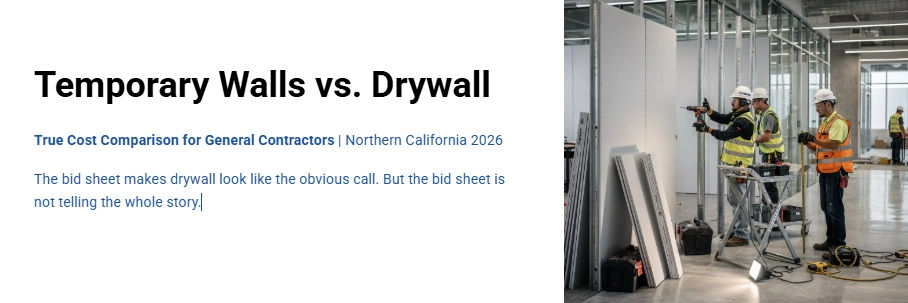
In Northern California commercial construction, the default choice is rarely the cheapest choice. General contractors have relied on metal studs and gypsum board for temporary partitions for decades, and the habit is hard to break. The bid sheet makes drywall look like the obvious call. But the bid sheet is not telling the whole story.
When you factor in the full lifecycle of a temporary drywall partition, from the first track screw to the final haul-off, the cost picture changes dramatically. Labor compounds. Schedule stalls. Disposal fees pile up. And in occupied facilities, every extra day of open drywall work carries real risk to the people inside.
This post breaks down the true cost of drywall containment vs. modular temporary wall systems for GCs operating in the Bay Area and Northern California. The numbers come from industry-sourced field data, California prevailing wage schedules, regulatory guidance, and published cost benchmarks. If your firm is still pricing containment on material cost alone, this comparison will change how you evaluate your next bid.
The Sequential Labor Trap: Why Drywall Costs More Than You Think
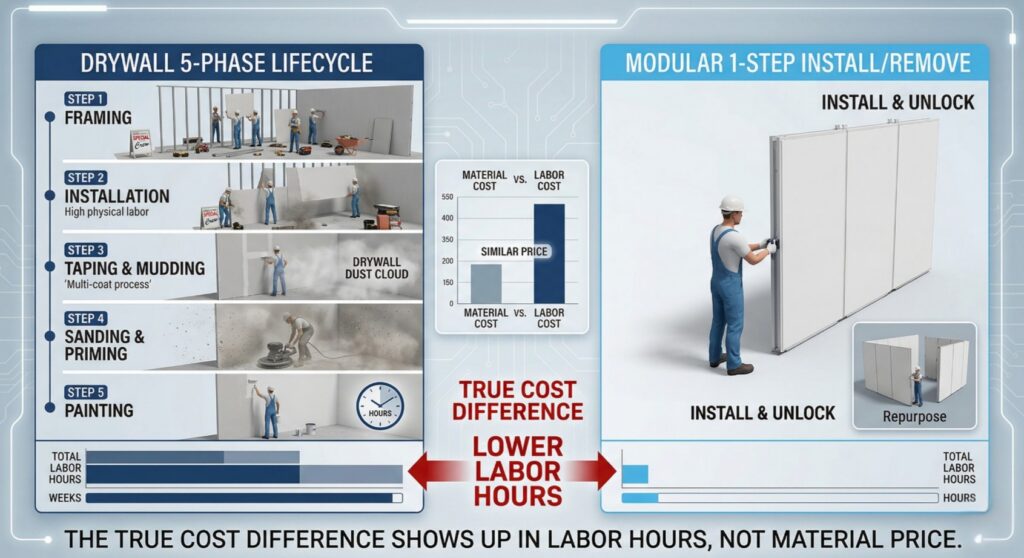
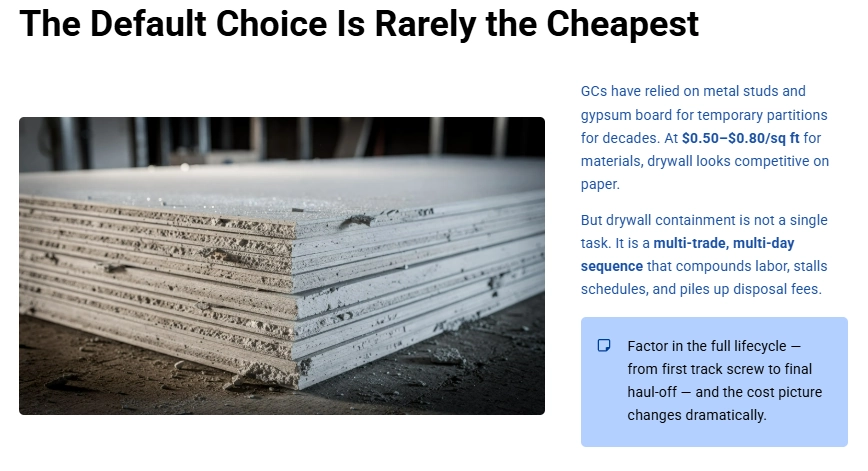
The first illusion of drywall is its material cost. Gypsum board runs roughly $0.50 to $0.80 per square foot for materials alone, which sounds competitive on paper. The problem is that drywall containment is not a single task. It is a multi-trade, multi-day sequence that compounds labor from start to finish.
The Five Phases of Drywall Containment
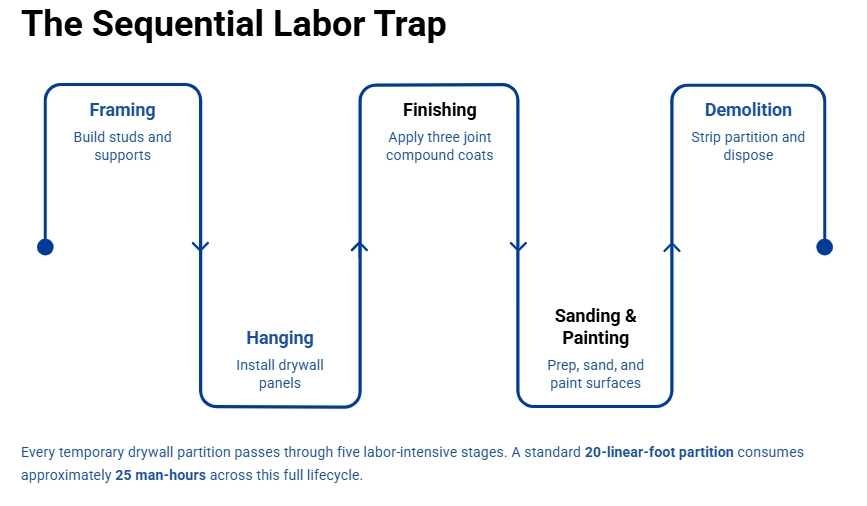
Every temporary drywall partition passes through five labor-intensive stages:
- Framing: Installing metal tracks and studs along the floor and ceiling
- Hanging: Measuring, cutting, and fastening gypsum panels
- Finishing: Three separate coats of joint compound, each requiring tape and feathering
- Sanding and painting: Surface prep and paint to meet a professional finish standard
- Demolition: Teardown, debris bagging, and site cleanup
Field data compiled from industry benchmarks indicates that a standard 20-linear-foot drywall partition consumes approximately 25 man-hours across this full lifecycle. In the Bay Area, where the 2025/2026 prevailing wage rate for a Drywall Installer/Lather is approximately $100.30 per hour including fringe benefits, that 25-hour lifecycle translates to roughly $2,507 in labor alone for just 20 feet of wall.
Bay Area Prevailing Wage and What It Actually Means
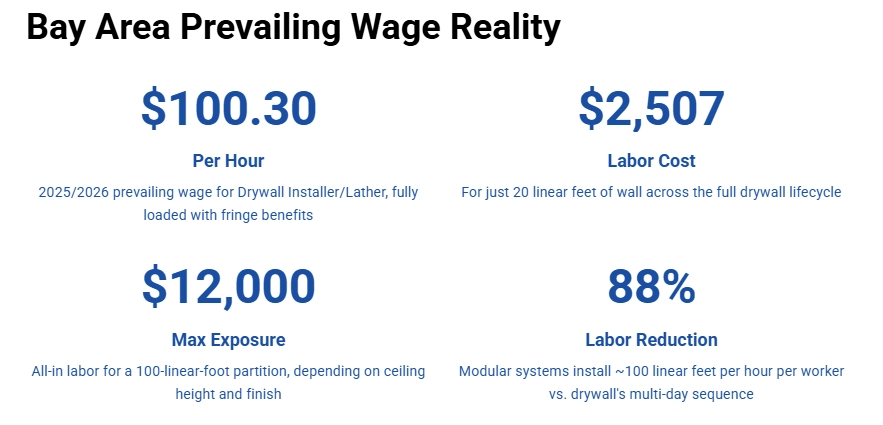
Many GCs underestimate their true labor exposure on prevailing wage work. The $100.30/hour figure reflects fully loaded rates including health and pension fringes, which apply to most public and many private commercial projects in California. On a 100-linear-foot temporary partition, the all-in labor cost for drywall installation, finishing, and removal can reach $7,000 to $12,000 depending on ceiling height and finish requirements. Modular wall systems, by contrast, can be installed at a rate of approximately 100 linear feet per hour by a single worker, cutting labor intensity by as much as 88 percent.
The Dead Time Factor: How Drywall Kills Your Schedule
Labor cost is a real problem. But the more dangerous risk for a GC managing liquidated damages or a tight tenant improvement deadline is dead time. Drywall containment introduces forced waiting into your critical path that no amount of crew size can accelerate.
The Mud Sequence and Mandatory Curing Cycles
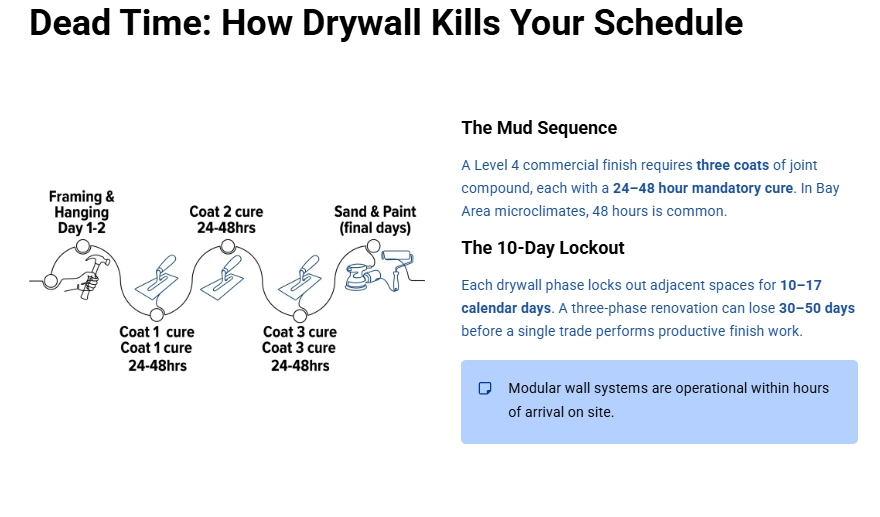
Achieving a Level 4 commercial finish requires three discrete coats of joint compound. Each coat requires a mandatory 24- to 48-hour drying window before the next coat can be applied. In the Bay Area’s variable microclimates and on active job sites with limited climate control, the 48-hour end of that range is common. Add framing and hanging time at the front end and sanding and painting at the back end, and a single temporary drywall wall takes 8 to 14 calendar days from first screw to paint-ready.
The 10-Day Lockout Window
Include demolition and final cleanup and each phase of drywall containment locks out adjacent spaces for 10 to 17 calendar days. On a multi-phase project, this compounds quickly. A three-phase renovation using drywall containment can lose 30 to 50 days of schedule before a single trade performs any productive finish work. Modular wall systems eliminate this lockout entirely. They are operational within hours of arrival on site.
For GCs carrying liquidated damages clauses, those lost days carry a price tag that often exceeds the total cost of switching to a modular system. Even without LD exposure, compressed schedules affect crew efficiency, subcontractor sequencing, and your reputation with the owner.
Debris, Disposal, and California Regulatory Costs
Northern California GCs already operate under some of the strictest environmental regulations in the country. Temporary drywall creates a disposal problem that many estimators fail to price correctly.
CALGreen and C&D Waste Diversion Requirements
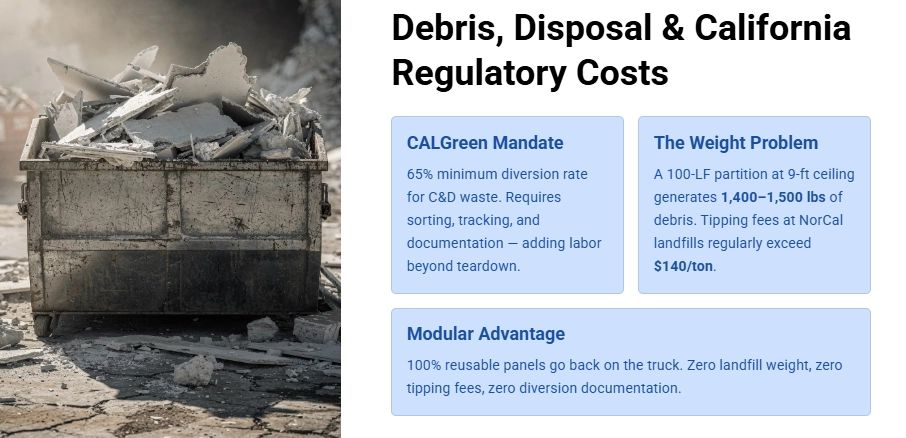
The California Green Building Standards Code (CALGreen) requires a minimum 65% diversion rate for construction and demolition waste on most commercial projects. This applies to temporary walls just as it does to any other demolition activity. Compliance requires careful sorting, tracking, and documentation of materials, which adds administrative overhead and labor time beyond the teardown itself.
The Weight Problem
Drywall is heavy. A 100-linear-foot temporary partition at a standard nine-foot ceiling height generates approximately 1,400 to 1,500 pounds of debris. This material is often contaminated with tape, compound, screws, and paint, which limits recycling options. Tipping fees at Northern California urban landfills regularly exceed $140 per ton. That weight load, combined with the administrative burden of CALGreen diversion compliance, adds real cost to every teardown.
Modular containment panels are 100 percent reusable. When the project is done, they go back on the truck. There is no landfill weight, no tipping fee, and no diversion documentation to prepare. The disposal line item disappears entirely.
Risk Mitigation: ICRA Compliance and Occupant Safety
In occupied facilities, the cost of a containment failure is not measured in dollars alone. Drywall construction and demolition are inherently dusty processes, and that dust is more dangerous than most GCs realize.
Silica Exposure and OSHA Compliance
Sanding drywall joint compound releases respirable crystalline silica (RCS), a regulated substance under OSHA’s Permissible Exposure Limits for construction. NIOSH evaluations at hospital construction sites have documented drywall workers exposed to RCS concentrations up to ten times the OSHA PEL. Achieving OSHA compliance during drywall sanding requires water suppression systems, HEPA-filtered vacuum collection, and respiratory protection programs, all of which add soft cost to every containment phase.
Healthcare: When Dust Becomes a Patient Safety Issue
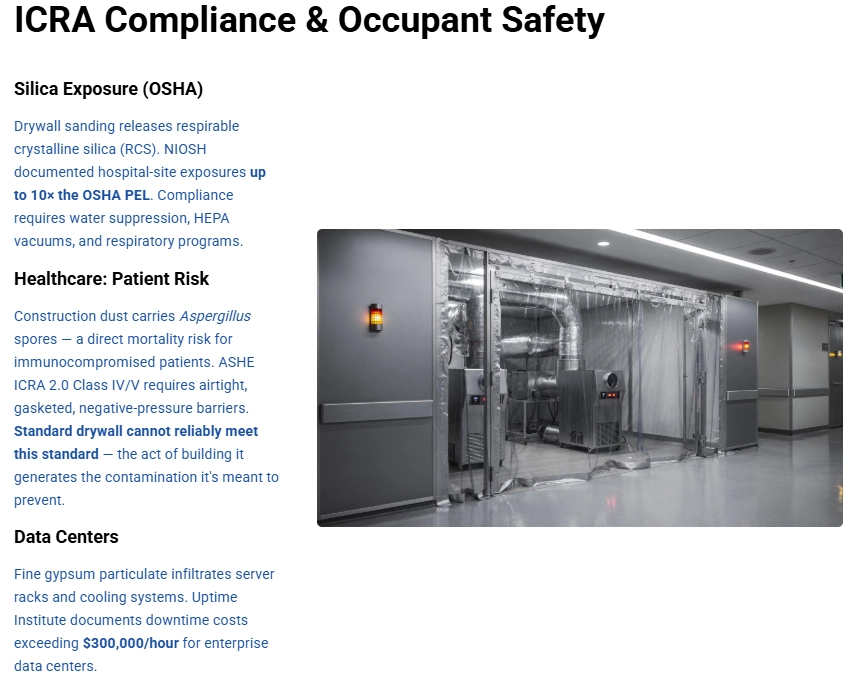
In healthcare facilities, construction dust carries Aspergillus and other fungal spores that pose a direct mortality risk to immunocompromised patients. The ASHE ICRA 2.0 framework classifies renovation work in or near patient care areas as Class IV or Class V, requiring airtight, gasketed containment barriers with negative air pressure. Standard drywall cannot reliably meet this standard because the very act of building it generates the contamination the wall is supposed to prevent.
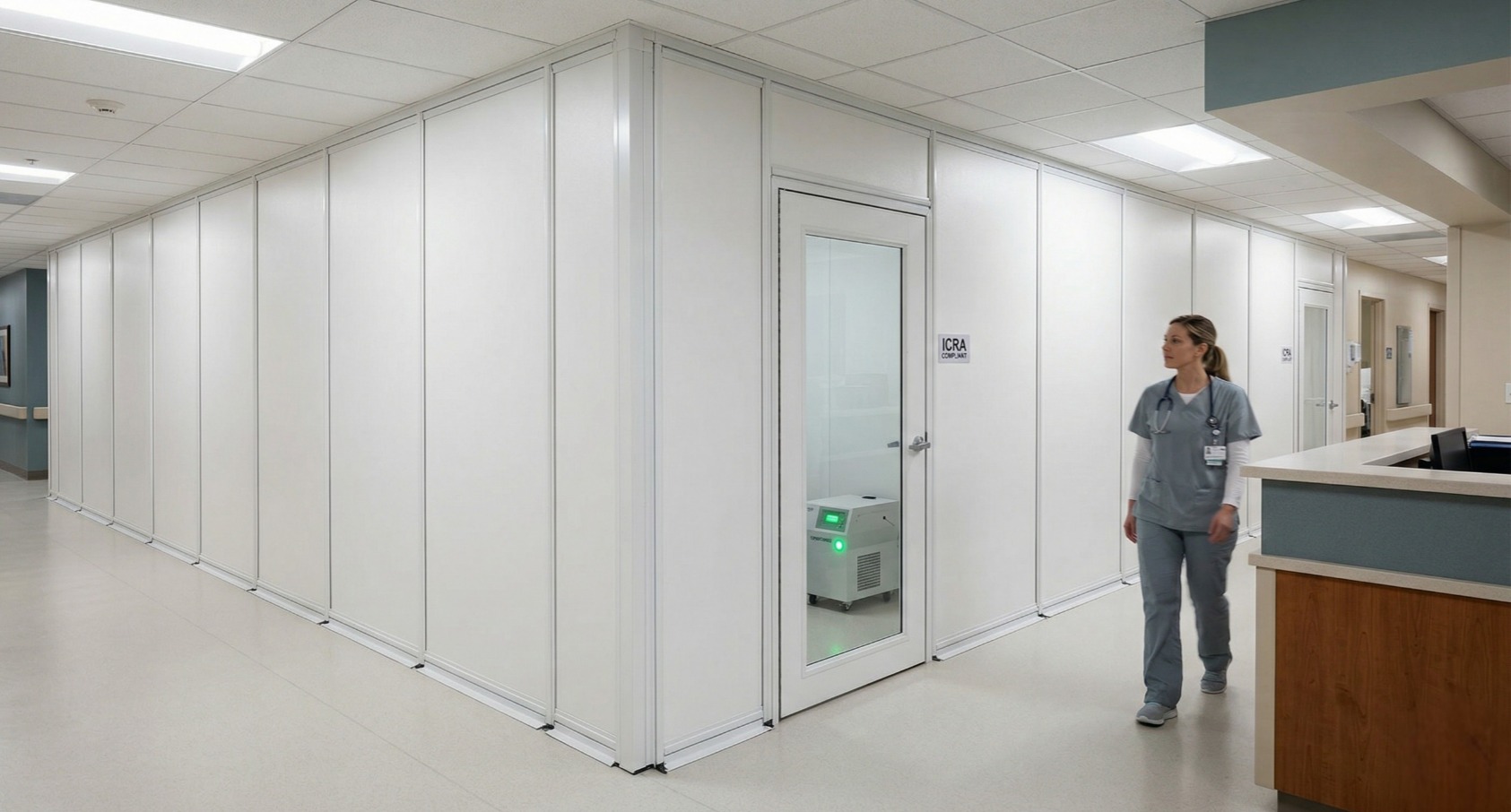
ICRA-compatible modular containment panels, when properly specified, provide gasketed floor-to-ceiling seals that maintain negative air pressure without the dust generated by cutting and sanding gypsum. They meet Class IV containment requirements immediately upon installation, which is the only way to eliminate the window of exposure between construction start and occupancy protection.
Data Centers: The Hidden Cost of Fine Particulate
Mission-critical data center environments face a different but equally serious risk. Fine gypsum particulate from drywall sanding can infiltrate server racks, coat cooling components, and trigger equipment failure. Industry analysis from the Uptime Institute has documented single-event downtime costs exceeding $300,000 per hour for enterprise-class data centers. A containment failure during renovation is not a cosmetic problem. It is a liability event.
The ROI Math: True Cost Comparison Across Multiple Phases
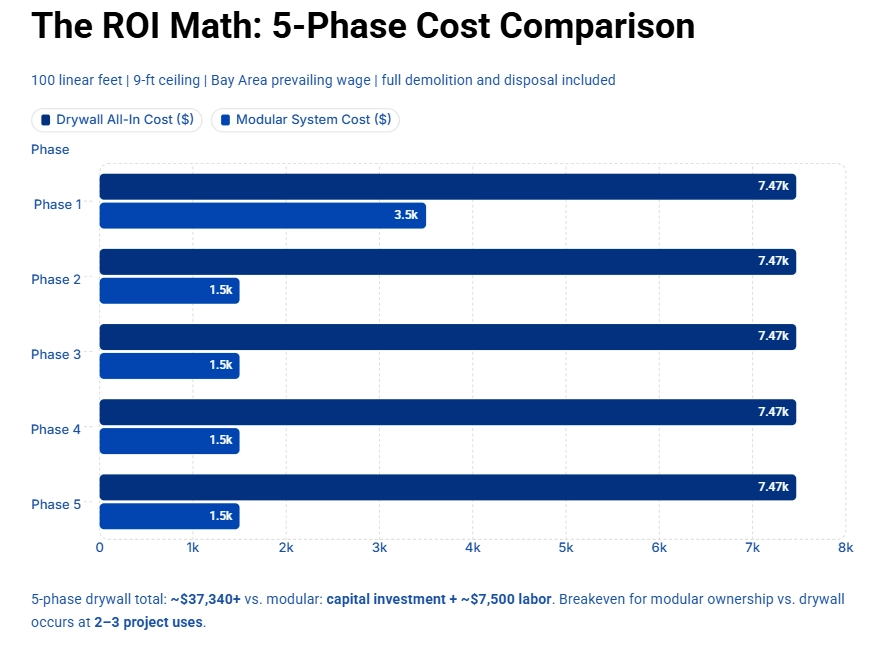
The most important thing to understand about drywall vs. modular containment is that the comparison is not one-time. Every project phase resets the drywall cost clock. Every phase with a modular system reduces it.
Phase-by-Phase Cost Comparison: 100 Linear Feet
Project Phase | Drywall All-In Cost | Modular System Cost |
Phase 1 | ~$7,468 | Capital investment + ~$1,500 labor |
Phase 2 | ~$7,468 | ~$1,500 (labor only) |
Phase 3 | ~$7,468 | ~$1,500 (labor only) |
Phase 4 | ~$7,468 | ~$1,500 (labor only) |
Phase 5 | ~$7,468 | ~$1,500 (labor only) |
5-Phase Total | ~$37,340+ | Capital + ~$7,500 labor |
Note: Drywall per-phase cost assumes 100 linear feet at 9-foot ceiling height, Bay Area prevailing wage rates, and full demolition and disposal. The modular system capital investment varies by system type and purchase or rental arrangement, but recurring per-phase costs are limited to labor for installation and removal.
When Does Modular Break Even?
Industry data from multiple containment system manufacturers and independent ROI analyses consistently places the breakeven point for modular wall ownership versus drywall at two to three project uses. For GCs with more than two containment phases per year, the financial case for modular is straightforward. For single-phase projects, renting modular walls sidesteps the capital question while still eliminating disposal fees, finish labor, and schedule risk.
Rent vs. Own for Bay Area GCs
Ownership of modular containment systems introduces storage costs that are not trivial in the Bay Area market. Industrial storage in San Jose and surrounding areas runs significantly above national averages. For GCs without dedicated storage capacity, renting full-service modular containment through a specialty subcontractor like 5DCCS eliminates both the capital outlay and the overhead of storage, maintenance, and logistics. The recurring per-phase cost is limited to the service fee, which still undercuts drywall on most projects of 50 linear feet or more.
Occupied Spaces: The Risk You Cannot Price After the Fact
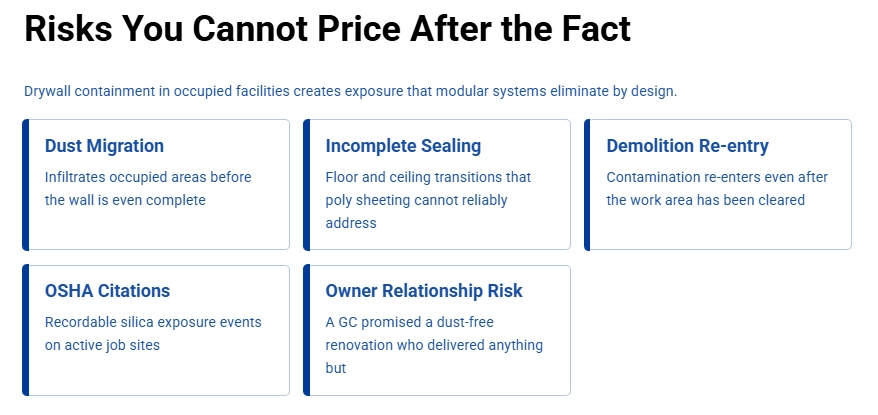
Cost analysis tells one part of the story. Risk tells the other. Drywall containment in occupied facilities creates several categories of exposure that modular systems eliminate by design.
- Dust migration into occupied areas before the wall is complete
- Noise transmission from cutting, nailing, and sanding during business hours
- Incomplete sealing at floor and ceiling transitions, which poly sheeting cannot address
- Re-entry of contamination during demolition, even after the work area has been cleared
- OSHA recordable events tied to silica exposure on active job sites
Each of these risks carries a financial consequence. Some are direct, like a silica citation or a hospital infection event tied to construction dust. Others are indirect, like a GC’s relationship with an owner who was promised a dust-free renovation and got anything but. Modular containment does not eliminate all risk, but it eliminates the risks that come from the containment system itself being a source of contamination.
Conclusion: The Wall That Costs You Less Is Not Always the One That Quotes Low
The true cost of containment is not a line item. It is a lifecycle. Drywall containment carries labor from five sequential trades, mandatory curing time that halts adjacent work, demolition debris that triggers California disposal compliance requirements, and real occupant safety risks that grow more serious in healthcare, data center, and occupied office environments.
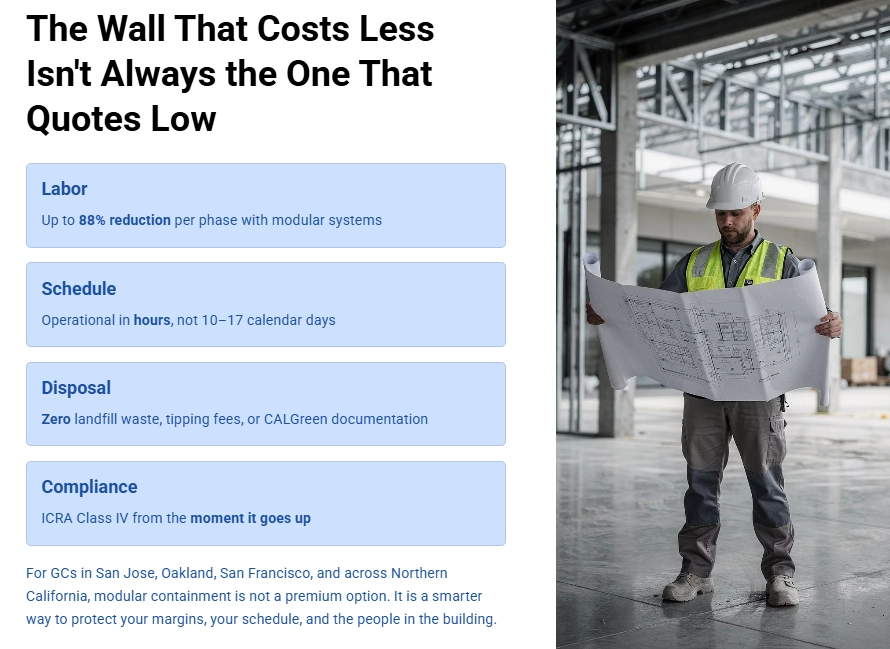
Modular temporary wall systems address every one of those costs. They install in hours rather than days, generate zero landfill waste, satisfy ICRA Class IV compliance requirements from the moment they go up, and reduce per-phase labor costs by as much as 88 percent. Across two or more project phases, the math consistently favors modular, even before you factor in schedule savings and risk reduction.
For GCs in San Jose, Oakland, San Francisco, and across Northern California, modular containment is not a premium option. It is a smarter way to protect your margins, your schedule, and the people in the building you are working in.
Ready to run the numbers for your next project? Contact 5DCCS for a free cost-comparison analysis for your specific linear footage and project type. We serve GCs across the Bay Area, Northern California, and nationally.