
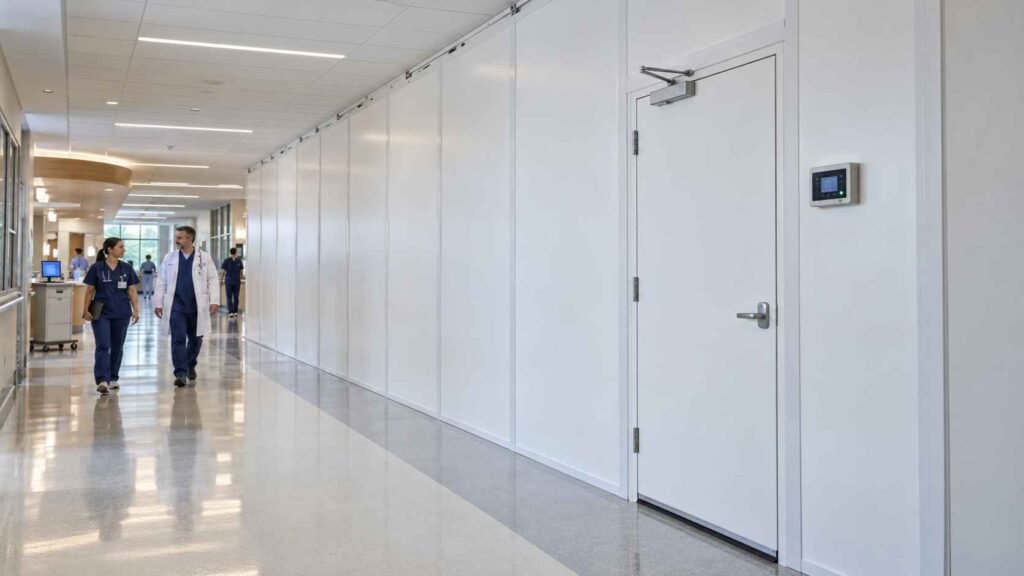
Why Plastic Sheeting Can Fall Short as Containment in Regulated Construction Environments
Plastic sheeting has a place on short, low-dust jobs, but guidance sets limits. See where poly barriers fail and when modular walls are the safer call.
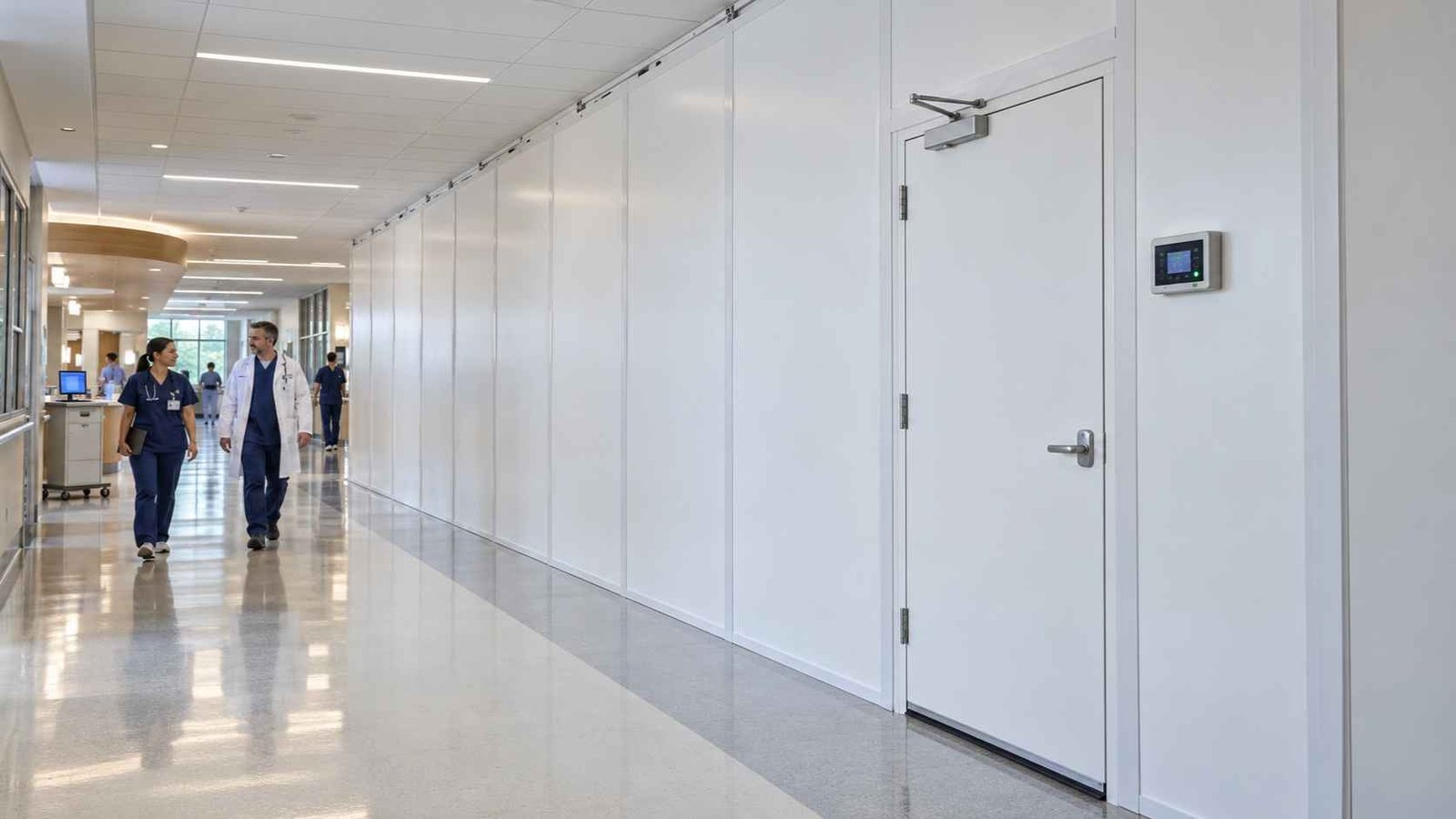
A dust barrier that looks fine at 7 a.m. can be a problem by Friday. Tape lifts at the ceiling line, a sheet sags where a cart caught it, a zipper door gets propped open for a material run, and dust that was supposed to stay in the work zone is now in a corridor, an office suite, or next to live equipment. In a regulated or occupied building, that is the point where a quiet renovation turns into a stop-work conversation with the owner.
Plastic sheeting is not banned, and it is not always the wrong call. CDC guidance allows it for short-term, minimal-dust projects. But the same guidance recommends durable rigid barriers for ongoing, long-term work, and how a poly enclosure is attached, sealed, monitored, and protected from damage decides whether it holds. This post covers what the guidance actually says, where plastic sheeting containment tends to fall short, and how modular temporary walls compare when the stakes are higher.
What the guidance actually says about plastic sheeting
A common claim in the trade is that infection control rules require hard walls for high-risk work. The published guidance is more specific than that, and getting it right protects your credibility with infection preventionists.
- CDC: The CDC Environmental Infection Control Guidelines say to use prefabricated plastic units or plastic sheeting for short-term projects that generate minimal dust, and to use durable rigid barriers for ongoing, long-term projects. They also call for barriers that are impermeable to fungal spores and compliant with local fire codes, and for monitoring barrier integrity and repairing gaps (see the CDC recommendations).
- ASHE ICRA 2.0: The 2022 ASHE matrix lists polyethylene containment among the ways to control minimal dust in Class III. For Class IV and Class V, it refers to "plastic or hard" barriers, requires barriers that meet NFPA 241, calls for negative pressure with an exterior device that monitors it continuously, and includes anteroom provisions at the higher classes. It does not say plastic is categorically prohibited in those classes.
- Peer-reviewed field data: A 2008 hospital study measured airborne Aspergillus during construction and found no elevated levels in patient areas. The authors concluded that containment using polyethylene film and negative pressure was effective.
That is the honest starting point. Plastic sheeting can work when it is installed well, kept intact, and paired with the right airflow controls. A hospital, a project specification, or the authority having jurisdiction (AHJ) may still require something stricter, so confirm the requirement with your infection prevention team and AHJ rather than assuming either way. The real question is whether a poly enclosure will keep working for the full duration of your project, under pressure, with traffic, in your specific environment.
Where plastic sheeting containment breaks down
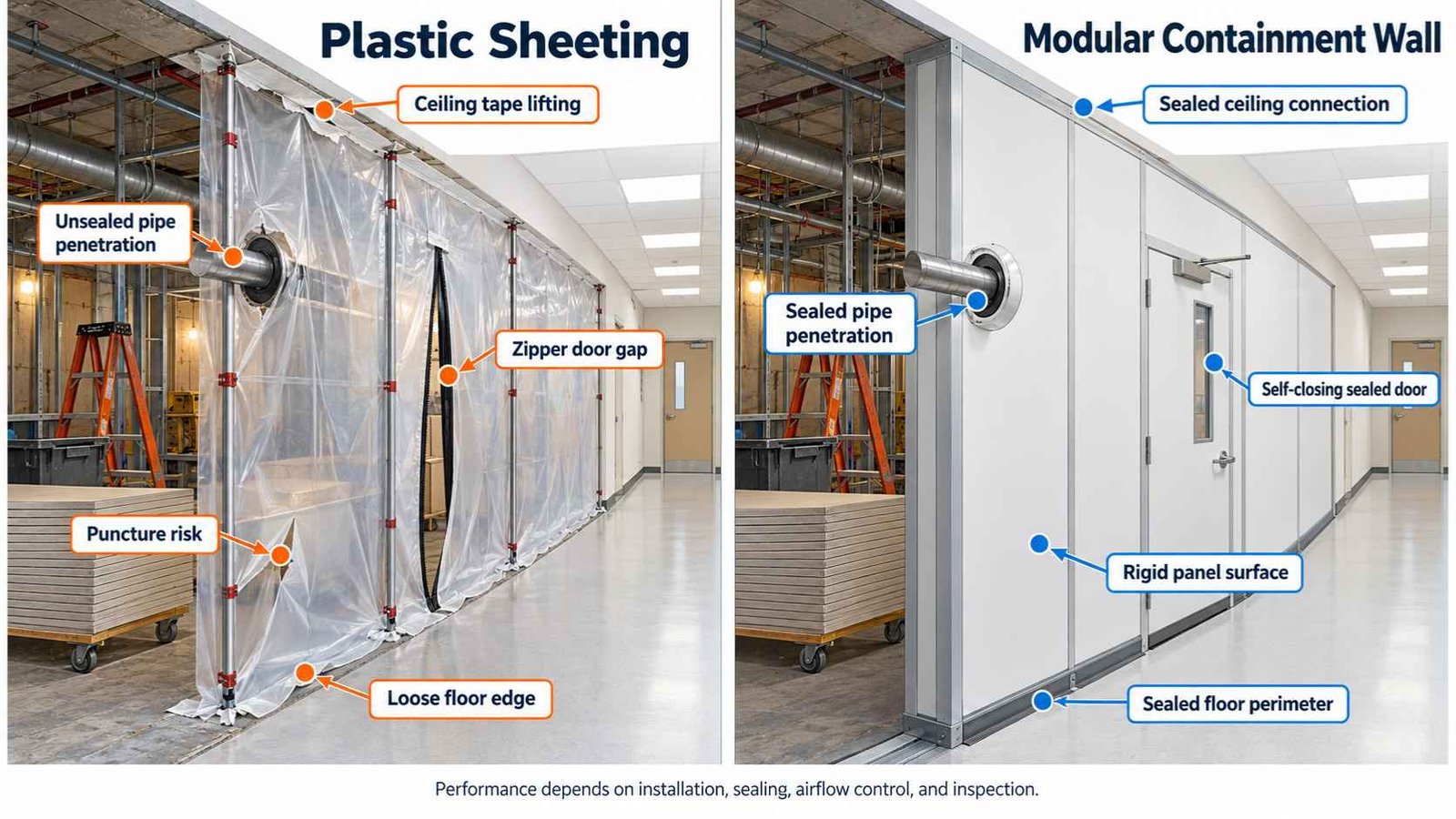
ASHE requires plastic barriers to be "effectively affixed to ground and ceiling and secure from movement or damage," with gaps and penetrations sealed. Each phrase in that sentence is a place where a flexible film enclosure can fail. To be clear about the evidence, we did not find a published study that puts a number on how often sheeting tears or how many days it lasts. What follows are the recognized control points, not statistics.
Edges and the floor line
A taped perimeter on finished walls, floors, and ceiling grids depends on adhesive holding for the whole job. Floor-level gaps matter most because that is where heavy debris collects. Foot traffic and rolling carts can push settled dust past a loose edge and into the clean side.
Movement and pressure
Flexible film moves. Under negative air it is pulled inward, and over days of work it can sag or billow, which stresses the tape and poles holding it. Because Class IV and V work relies on maintaining negative pressure, a perimeter that lets go can take the pressure differential with it.
Doors and penetrations
Zipper doors are cycled all day by workers and material carts, and they are easy to leave open. Conduit, pipe, and duct penetrations are another frequent leak path, and ASHE specifically calls for sealing them. These are the details that get skipped when the schedule tightens.
Damage from normal jobsite activity
Ladders, boards, scaffolding, and tools puncture film. A tear in a sheet is a hole through the entire barrier, and it may not be noticed until someone sees dust on the other side.
Removal
Pulling down a dust-covered sheet is a handling step that needs its own controls, because the film holds what it caught. Plan removal before the barrier goes up, not after the work is done.
Monitoring and repair
CDC calls for monitoring barrier integrity and repairing gaps or breaks. A barrier that is inspected and logged can be corrected quickly. One that is not inspected can fail quietly. We will cover monitoring devices and inspection routines in a follow-up post.
What failed containment has looked like in healthcare
Construction-associated fungal outbreaks are well documented. The reports below show what happens when containment and air management break down as a system. They do not prove that a particular film tore, and we are not presenting them that way.
- Thailand, 2021: A peer-reviewed report describes four of 25 COVID-19 ICU patients developing probable invasive pulmonary aspergillosis while demolition and renovation took place on the same floor. After the hospital added site containment, critical barriers, negative pressure, and portable HEPA filtration, measured airborne fungal levels dropped from 235 to 290 CFU/m³ to 30 to 50 CFU/m³, and no new cases occurred during six months of surveillance. Several controls changed at once.
- Australia, 2008: A report from a regional hematology unit described six cases of invasive aspergillosis during major hospital construction. The response combined relocating the unit, impermeable construction barriers, masks, and prophylaxis.
- Canada, 2001: Health Canada summarized an outbreak in which defective ventilation let unfiltered air from an adjacent construction zone circulate into patient areas, and listed improperly closed vents, poor pressure relationships, and poorly maintained HEPA filters as documented pathways.
A 2023 review of construction-related fungal infection reports points to the same lesson: dust control works as a combined, planned effort, and the barrier is one part of it.
Fire and life safety: three different questions
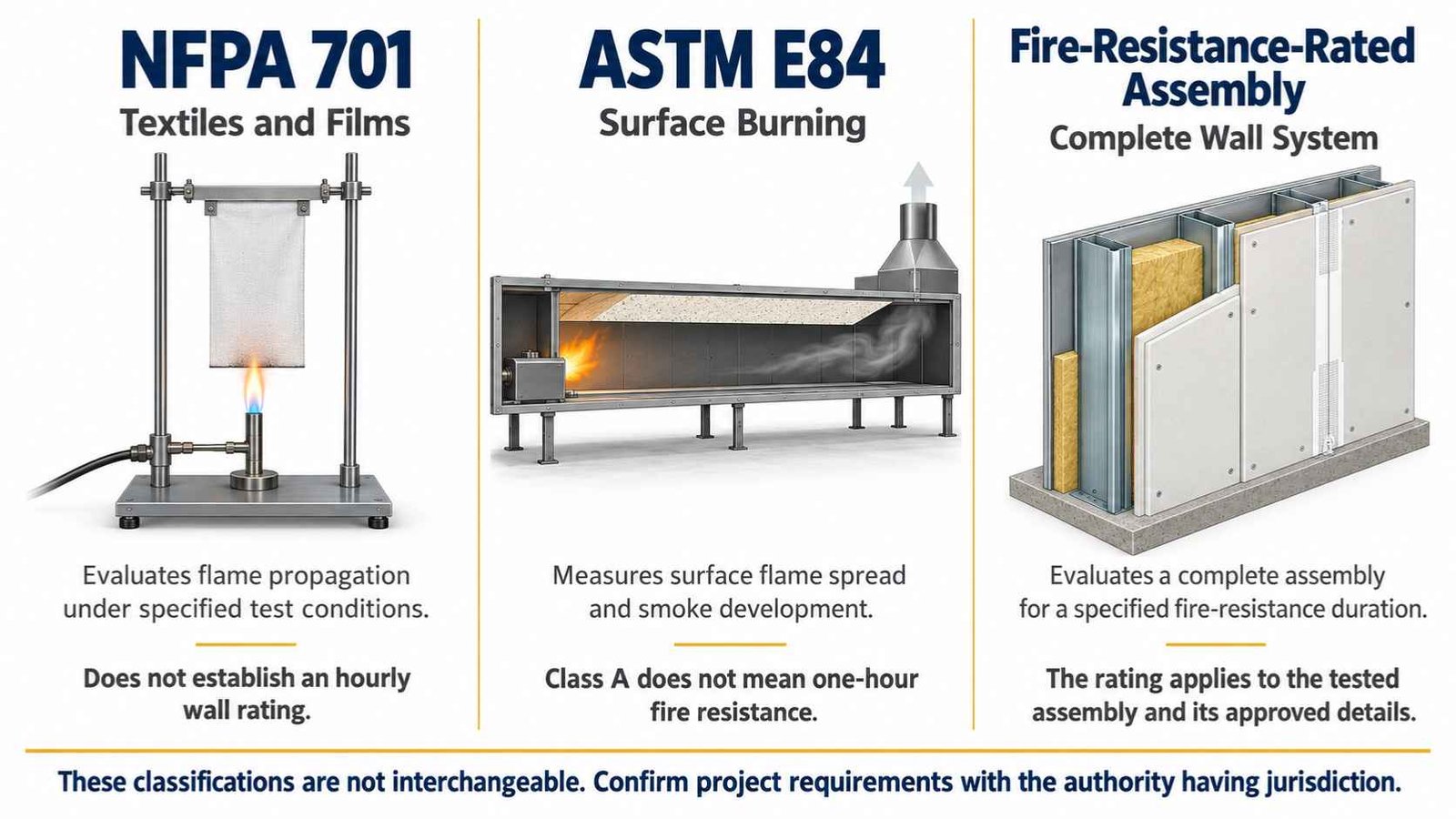
One of the most common mix-ups on submittals is treating a film that passes a flammability test as if it were a fire-rated wall. They are different things, and an infection-control approval is not automatically a life-safety approval.
| Standard | What it addresses | What not to infer |
|---|---|---|
| NFPA 241 | Fire safeguards during construction, alteration, and demolition. | A passing film test does not show the installed enclosure meets required construction separation. |
| NFPA 701 | Flame propagation of textiles and films under specified test conditions. | It does not establish performance under every fire exposure or installation. |
| ASTM E84 | Comparative surface flame spread and smoke development. | It is not an hourly fire-resistance test. "Class A" does not mean "one-hour rated." |
| Fire-resistance-rated assembly | A tested wall assembly with an hourly rating, where a rated separation is required. | Film classifications are not evidence of an equivalent rated wall. |
Acceptance depends on the barrier's function, the code edition in force, sprinkler conditions, the occupancy, and AHJ approval. Institutional policies can be stricter than people expect. One example, a University of Michigan-Dearborn policy that cites the 2000 edition of NFPA 241, treats construction tarps as inappropriate barriers where a rated separation is required. For California hospitals, HCAI directs temporary-barrier questions to CAN 9-3301. Because requirements vary by project, get written acceptance from the responsible AHJ before you build. Our guide on fire-rated temporary walls explains when a rated assembly is and is not needed.
Beyond hospitals: life sciences, data centers, and occupied offices
Outside healthcare, regulators generally care about contamination outcomes rather than naming a barrier material. The question becomes whether the temporary arrangement preserves the controls the space depends on.
- Life sciences: Under 21 CFR Part 211, facilities must have appropriate control over air pressure, micro-organisms, dust, humidity, and temperature, and sanitation procedures apply to contractors. EU GMP Annex 1 expects planned maintenance not to introduce additional contamination risk. Neither expressly bans polyethylene, but a loose film next to classified space has to be defended against those expectations. See our guide to biotech cleanroom construction containment.
- Data centers: IBM equipment documentation notes that aluminum, copper, and steel filings from construction are conductive contaminants that can affect reliability, with consequences that include errors, component damage, and outages. That is manufacturer guidance, but it shows why visible housekeeping is not proof of control. More in why data centers need modular containment.
- Occupied offices and courthouses: EPA and NIOSH guidance, Building Air Quality, recommends isolating renovation work and installing temporary barriers to confine dust and noise. A thin film has almost no mass, so it offers little noise reduction. If sound matters in your space, read what STC ratings actually mean for temporary walls.
Silica and Cal/OSHA
California's Title 8 section 1532.3 covers respirable crystalline silica in construction. Among other things, it calls for exhaust where needed to minimize accumulation of visible airborne dust for indoor tasks addressed by its Table 1, restricts dry sweeping and compressed-air cleaning in many situations, and requires a written exposure control plan. This is a worker-exposure standard. A polyethylene enclosure does not replace task-specific controls, and it is not a complete answer for tenants or patients on the other side. Our post on dust control for occupied commercial spaces covers the broader picture.
Where modular walls hold up better
Modular temporary walls are not magic, but their design addresses several of the failure points above. These are general characteristics of rigid modular systems, and specifics vary by system, so ask for documentation on the exact product and configuration.
- Rigid panels stay put. They do not sag or billow under negative air, so the enclosure does not depend on adhesive holding a flexible sheet in place.
- Joints and doors are designed for sealing. Panel joints, perimeter gasketing, and self-closing doors with sweeps replace zipper doors that wear out or get left open.
- No cutting or finishing to put them up. Prefabricated panels go up without cutting, sanding, or joint compound, so building the barrier does not generate its own dust.
- Cleanable surfaces. Smooth, non-porous faces can be wiped down, which matters where facility cleaning protocols apply to barrier surfaces.
- A stable base for the controls around them. Rigid walls give you a place to mount signage and exterior pressure monitors that are visible to facility staff.
- Documented fire and sound performance on some systems. Some systems carry ASTM E84 classifications and some assemblies are tested for hourly ratings. Acoustic performance varies widely by system.
- Reuse across phases. Panels can be cleaned, moved, and reconfigured as the work progresses, which suits multi-phase occupied projects.
A rigid wall with an unsealed penetration still leaks, and a poorly managed negative air setup still fails. Modular containment works best as part of a plan that includes sealing, pressure control, and inspection. For a look at how it compares with the other common option, see our temporary walls vs drywall cost comparison and our guide to ICRA-compliant containment walls.
What a containment failure really costs
We looked for a defensible industry average for the cost of a polyethylene containment failure and did not find one, so we are not going to invent one. What can be supported is the shape of the exposure. For a specific project, a simple framework works better than a generic number:
Failure exposure = cleanup and testing + damaged materials or equipment + rework + schedule impacts + investigation and restart costs + documented operational losses.
This is an estimating framework, not a published statistic. One consultant-reported example shows how the pieces add up: EH&E described construction dust moving through an unexpected pressure pathway into a chemotherapy pharmacy, followed by a shutdown lasting several weeks and cost overruns. The client is not named and no dollar figure is given, so treat it as one consultant's account rather than proof of a general rule. The point is that the savings on a roll of film look small next to the failure terms in the formula above.
Waste and California requirements
EPA estimates the United States generated about 600 million tons of construction and demolition debris in 2018, with more than 90 percent coming from demolition. About 455 million tons went to a next use and about 145 million tons went to landfill (EPA). That total covers buildings, roads, and bridges, so it says nothing specific about plastic film.
In California, CalRecycle states that applicable projects must meet at least a 65 percent construction and demolition waste diversion requirement under CALGreen. The 2025 code took effect January 1, 2026, and local applicability varies, so confirm requirements with your jurisdiction. Film, tape, and zipper kits are single-use items, while reusable panels reduce the amount of single-use barrier material each phase generates. We did not find an independent life-cycle study comparing the two, so we are not quoting a percentage.
When plastic sheeting is a reasonable choice
Being fair about this is part of being useful. Plastic sheeting is a reasonable option when:
- The work is short-duration and generates minimal dust.
- The adjacent space is lower risk, such as work within the ICRA class where the matrix names polyethylene (Class III).
- Infection prevention, the owner, and the AHJ have approved it for that location.
- The enclosure will stay sealed, inspected, and supported by the right airflow, filtration, fire-safety, and monitoring controls.
Move toward a rigid system when the work is long-term or multi-phase, when the adjacent space is sensitive, when noise matters, when fire separation is in question, or when the cost of a failure is high.
Questions to ask before you accept plastic sheeting as the barrier
- How long will this barrier stay up, and across how many phases?
- What is the ICRA class or contamination sensitivity of the adjacent space, and who approved polyethylene for it?
- Is the film flame-retardant, and does the AHJ accept the documentation for this location and sprinkler condition?
- How are the perimeter and floor line attached and sealed, and who inspects them?
- How are doors and penetrations handled?
- How is pressure verified and recorded, and what happens when it drops?
- How will the barrier be removed without releasing dust?
- Who repairs a tear, how fast, and who is accountable for it?
- Does the project involve silica-generating tasks or noise limits that a film cannot address?
If the answers are vague, that tells you something before the work starts.
Frequently asked questions
Is plastic sheeting allowed for ICRA Class IV or V?
The 2022 ASHE ICRA 2.0 matrix refers to "plastic or hard" barriers for both classes, subject to NFPA 241 and installation requirements, along with negative pressure monitored by an exterior device. A facility policy, project specification, or AHJ can be stricter, so confirm with infection prevention and the AHJ.
Does CDC recommend plastic sheeting for hospital construction?
CDC guidance supports plastic sheeting or prefabricated plastic units for short-term projects that generate minimal dust, and recommends durable rigid barriers for ongoing, long-term projects.
Is flame-retardant plastic the same as a fire-rated wall?
No. A flame-retardant film classification and an hourly fire-resistance-rated assembly measure different things. Where a rated separation is required, confirm what the AHJ will accept.
Does a plastic barrier satisfy California silica requirements?
No barrier replaces task-specific controls. Cal/OSHA Title 8 section 1532.3 addresses worker exposure through measures such as exhaust, housekeeping limits, and a written exposure control plan.
How often should a containment barrier be inspected?
CDC calls for monitoring barrier integrity and repairing gaps. The inspection frequency is set by the project's ICRA plan and infection prevention team, and many projects log inspections daily. Follow your permit and project documents.