What STC Ratings Actually Mean for Temporary Walls in Occupied Offices and Courtrooms
What does a temporary wall STC rating really mean? Learn what you'll hear through the wall in offices and courtrooms, and how to pick the right system.
Picture the call. The temporary wall went up on schedule and passed inspection, and on Tuesday morning a court clerk phones the project manager because the jury could hear the saw. Nothing was built wrong. The wall was simply never specified for the room next to it.
That is the risk hiding behind a temporary wall STC rating. It is a single number on a data sheet, it comes from a laboratory test, and it was built to describe speech and office noise, not a rotary hammer working a few feet from a courtroom. Most rentable temporary walls rate between about STC 16 and STC 24. In that range, a normal conversation on one side of the wall can still be understood on the other.
Whether the concern is occupied office renovation noise or construction noise reaching a courtroom, the fix starts at the spec stage, well before the first panel goes up.
This guide explains what an STC rating for temporary walls measures, what you will actually hear at each level, and what it leaves out. It also covers how to choose a wall, and plan around it, when the space next door is an occupied office or a courtroom.
What Is a Temporary Wall STC Rating?
Sound Transmission Class (STC) is a single-number rating of how well a wall blocks airborne sound. It is calculated under ASTM E413 from laboratory transmission-loss data measured under ASTM E90. A higher temporary wall STC rating means less sound gets through.
How the ASTM E90 Lab Test Works
Technicians mount the wall between two calibrated rooms, play broadband sound in one room, and measure the sound level in both. The lab records how much sound the wall blocks at 16 frequencies from 125 to 4,000 Hz. Those results are fitted to a standard reference curve, and the STC is the value of that curve at 500 Hz.
The test is rigorous, but it describes a perfect wall in a controlled chamber. It does not describe your corridor, your ceiling, or your equipment.
Why One Number Can Mislead You
ASTM's own standard is clear about the limits. It says STC ratings "correlate in a general way with subjective impressions of sound transmission for speech, radio, television, and similar sources." It also states that the method is not appropriate for sources with very different sound spectra, including machinery and industrial processes.
That matters on a renovation site. STC tells you how a wall handles voices. It does not tell you how the same wall handles a concrete saw.
What You Will Actually Hear at Each Temporary Wall STC Level
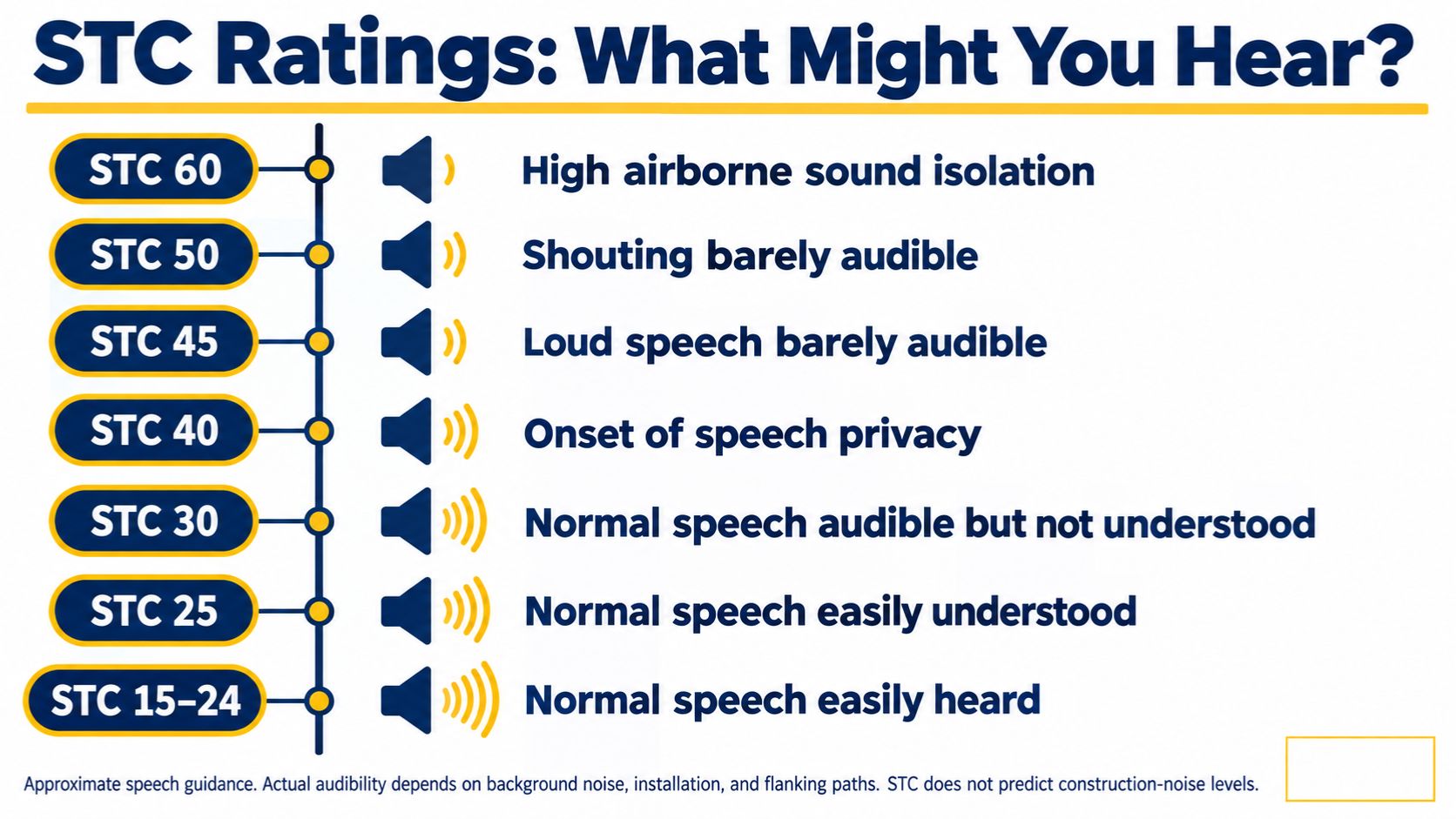
The table below translates STC numbers into what a person on the quiet side of the wall can make out. It draws on the National Bureau of Standards guidance and the GSA P100 Facilities Standards. The two sources differ slightly around STC 35, so treat STC 35 to 40 as a transition zone.
STC rating
What you hear on the other side
25
Normal speech is easily understood
30
Normal speech is audible but not understood
40
Loud speech is audible but not understood; GSA calls this the onset of privacy
45
Loud speech is barely audible
50
Shouting is barely audible; GSA says loud speech is not audible
Where Most Temporary Wall STC Ratings Land
Most rentable temporary walls fall between STC 16 and STC 24, which sits below the first row of that table. Only a small group of heavier, fire-rated modular assemblies reaches about STC 40. Even those fall roughly 20 points short of what a federal courtroom partition is designed to deliver.
It helps to put the noise itself in numbers. Normal conversation runs about 60 dB. Measured at 50 feet, a jackhammer reaches about 89 dBA, a concrete saw about 90 dBA, and pneumatic tools about 85 dBA, according to the FHWA Roadway Construction Noise Model. Indoors the work is usually much closer than 50 feet, so levels at the wall are higher.
Manufacturer testing shows how this plays out. In one test of two modular wall systems, a 90 dB air compressor placed 8 feet from the wall dropped by 20 dB and 17 dB. The walls worked, and the quiet side still heard 70 to 73 dB, which is louder than normal conversation. A tenant can be right that the wall is performing as tested and still be right that they can hear the work.
Three Things STC Does Not Tell You
Low-Frequency Rumble From Equipment
STC ignores everything below 125 Hz. Compressors, generators, and heavy machinery put out a lot of energy in that range, so a wall can post a respectable STC and still pass a low drone through to the other side. A separate low-frequency rating, OITC (ASTM E1332), reaches down to 80 Hz and usually comes in 4 to 8 points lower than STC for the same assembly. OITC is a facade rating, so it is not something to request for an interior temporary wall. It simply shows how much the single STC number leaves out.
Vibration Through the Slab
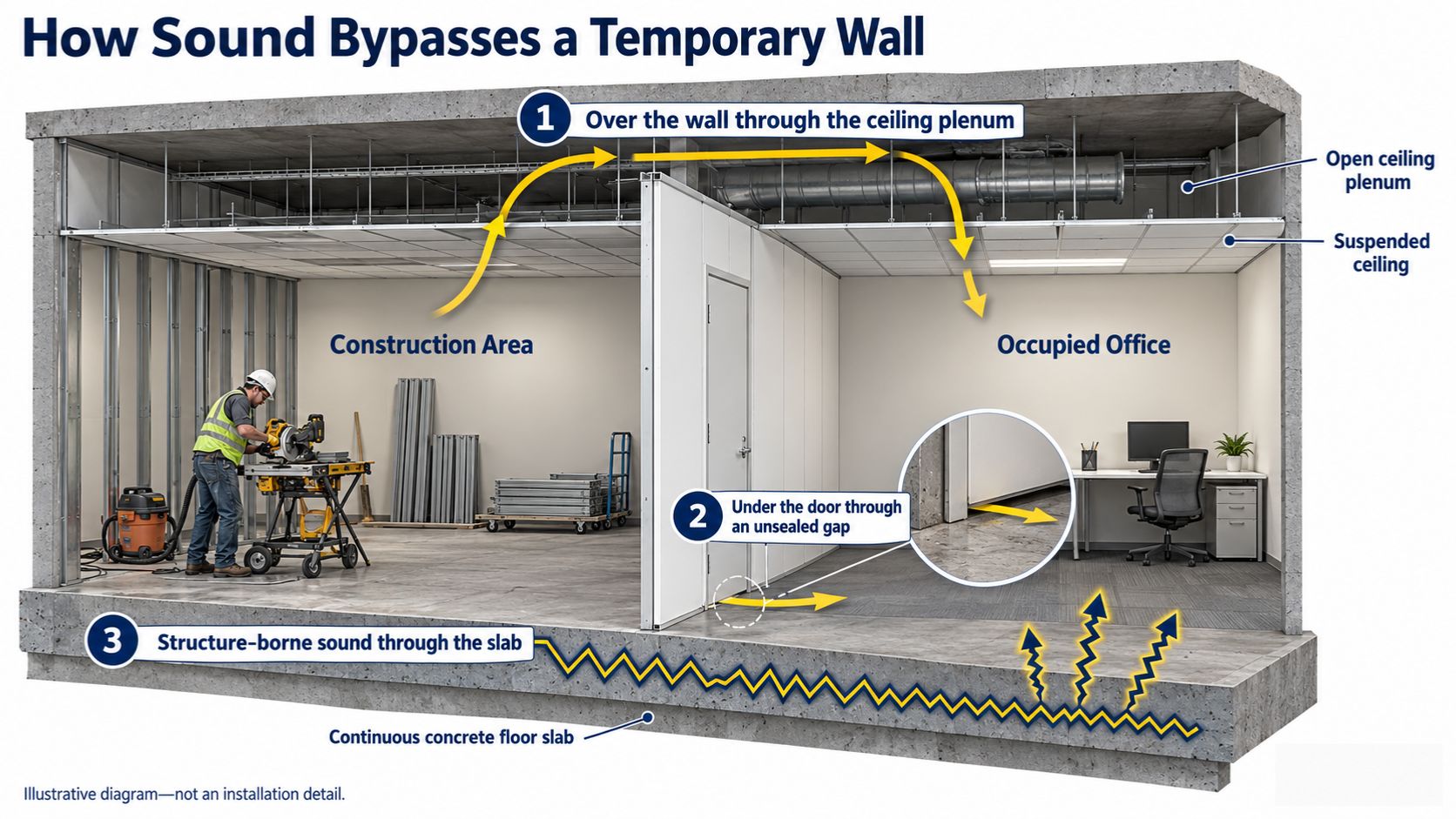
STC covers airborne sound only. Vibration that travels through the slab, columns, and framing is a separate path, called structure-borne sound, and occupants often feel it as a drone or a hum. Jackhammering and impact breaking produce major noise and vibration, while diamond core drilling is much quieter and causes no vibration damage. A temporary wall cannot stop sound that arrives through the floor, so the method of demolition matters as much as the wall.
Gaps, Ceilings, and the Lab-vs-Field Drop
The lab number is a best case. ASTM E413 itself warns that a partition built and tested in a real building "may be lower than that obtained for a partition tested in a laboratory because of flanking transmission or construction errors."
Field tests under ASTM E336 typically come in 2 to 5 points below the lab STC.
A 1/8-inch gap at the top or bottom of a wall can cost 3 to 5 points.
The U.S. Courts Design Guide (2021) notes that STC applies only to full-height partitions. A temporary wall that stops at the ceiling grid, with an open plenum above, is not performing at its rating.
Building codes already account for this gap. For dwelling-unit walls, the International Building Code allows STC 50 in the lab or NNIC 45 in the field. Your temporary wall deserves the same discipline.
Courtrooms vs. Occupied Offices: Different Noise Isolation Targets
Designers of finished spaces work to Noise Isolation Class (NIC), a field measure of the whole room-to-room path, not just the wall. The targets below come from federal standards. They are useful benchmarks for how quiet these rooms are meant to be, even where a specific building was designed to a different standard.
Space
Design target (NIC)
Source
Courtroom
55 to 60
U.S. Courts Design Guide, 2021
Jury suite, grand jury room, attorney and witness rooms
55
U.S. Courts Design Guide, 2021
Judge's chambers
50
U.S. Courts Design Guide, 2021
Teleconference room
53
GSA P100, 2018
Meeting room
48
GSA P100, 2018
Private office, confidential privacy
45
GSA P100, 2018
Private office, normal speech privacy
40
GSA P100, 2018
Courtrooms
The U.S. Courts Design Guide sets courtroom targets at NIC 55 to 60 with "Confidential" privacy and background noise of RC/NC 25 to 30. Its worked example says a space with an NIC goal of 55 should use STC 60 partitions. A temporary wall at STC 16 to 24, or even STC 40, was never going to meet that intent, and that is fine as long as everyone knows it before the job starts.
Background noise makes the problem worse. The guide notes that privacy depends on how loud the room already is: NIC 50 in a room at RC/NC 35 gives the same privacy as NIC 45 in a room at RC/NC 40. A courtroom at RC/NC 25 to 30 has almost nothing to cover construction sound, so intrusions stand out.
California state courts follow the Judicial Council's California Trial Court Facilities Standards (2023 edition, adopted September 2024), and Chapter 19 covers acoustical criteria. Since most Bay Area courtroom work is state court, confirm the chapter 19 requirements with the court's facilities team before you set a containment spec.
Private Offices and Conference Rooms
GSA sets NIC 40 for normal speech privacy in private offices and NIC 45 for confidential privacy, with higher targets for meeting and teleconference rooms. Offices are noisier than courtrooms, and GSA notes that HVAC background sound helps mask speech in enclosed offices. That is why the same temporary wall can feel fine along an open-office floor and fail next to a conference room.
How to Pick a Temporary Wall for a Noise-Sensitive Space
Use this checklist before you submit a containment plan for a space next to an occupied office, conference room, or courtroom.
Ask for the ASTM E90 test report, not a percentage. Claims like "up to 50% noise reduction" or "blocks up to 40 dB" are not STC values. A tested STC comes with a report you can read.
Run the wall full height, or plan the plenum. If the ceiling is a suspended grid with an open plenum above, sound will go over the top. Extend the wall to the deck or seal the plenum.
Seal the perimeter and the penetrations. Floor tracks, ceiling connections, column terminations, and cable or duct openings are where lab ratings are lost.
Use sealed doors and limit how many you need. A door is the weakest point in any wall. Fewer doors, with proper perimeter seals, protect the rating.
Schedule loud and impact work around the occupants. Plan it around court sessions or business hours. Municipal hours rules, such as San José's 7 a.m. to 7 p.m. weekday window near residences, protect neighbors. They do not protect a courtroom down the hall.
Choose lower-vibration methods where you can. Core drilling instead of breaking, for example, cuts the vibration that no wall can stop.
Bring in an acoustical consultant for the most sensitive rooms. Courtrooms, jury rooms, and chambers justify a professional's review before the plan is final.