
What Happens When Construction Dust Escapes the Work Zone in Occupied Spaces
Construction dust control in occupied spaces can fail fast. See the health, insurance, and project consequences when dust escapes the work zone.
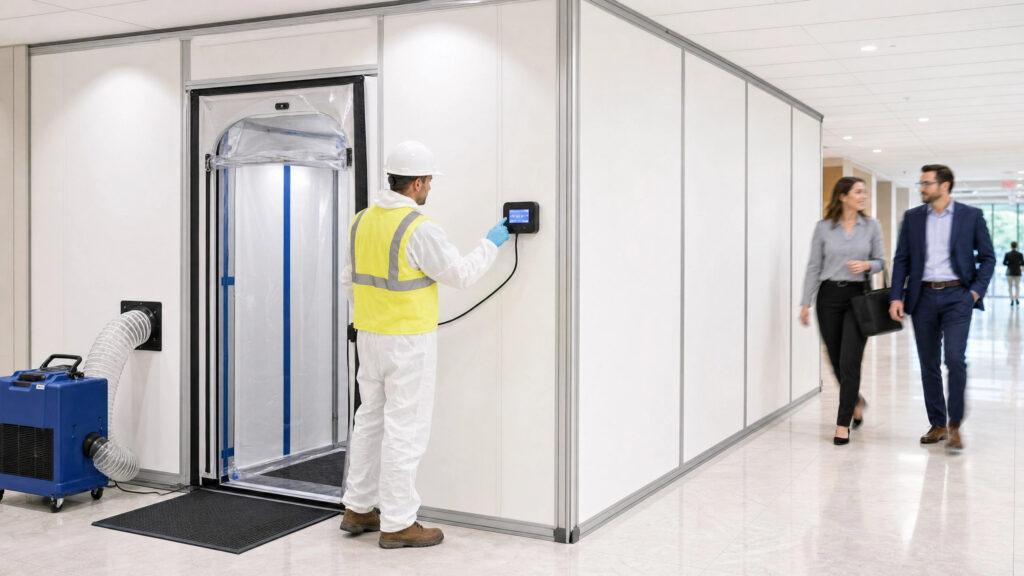
Between October and December 2025, six patients at Royal Prince Alfred Hospital in Sydney developed serious fungal infections, and two of them died. The hospital was in the middle of a major redevelopment. When New South Wales health authorities reported on the outbreak in March 2026, they said the balance of evidence pointed to the balcony and nearby construction activities as the greatest exposure risk, while stating they could not identify a single conclusive cause.
That careful wording is worth noticing. Construction dust is rarely traced to one failed seal on one afternoon. It travels through ceiling plenums, ductwork, doorways, and the soles of work boots, and by the time anyone connects it to a complaint, the damage is already spread through the building.
This article looks at what happens when construction dust control in occupied spaces breaks down, from the first headache in the office next door to the insurance dispute that follows.
This is Part 1 of a two-part series on construction dust control in occupied spaces. It covers the consequences: how dust escapes, who it harms, what it costs, and why some facilities are far less forgiving than others. Part 2, How to Prevent Construction Dust in Occupied Spaces: Barriers and Protocols, covers the barriers, negative air, and monitoring that prevent these outcomes.
How Construction Dust Escapes the Work Zone
Construction dust is not one substance. It is a mixture of particles released by cutting, drilling, demolition, grinding, and sanding of concrete, brick, drywall, wood, and finishes. Depending on the building, it can also carry respirable crystalline silica, lead from old paint, asbestos fibers in older construction, and mold spores disturbed inside ceiling and wall cavities.
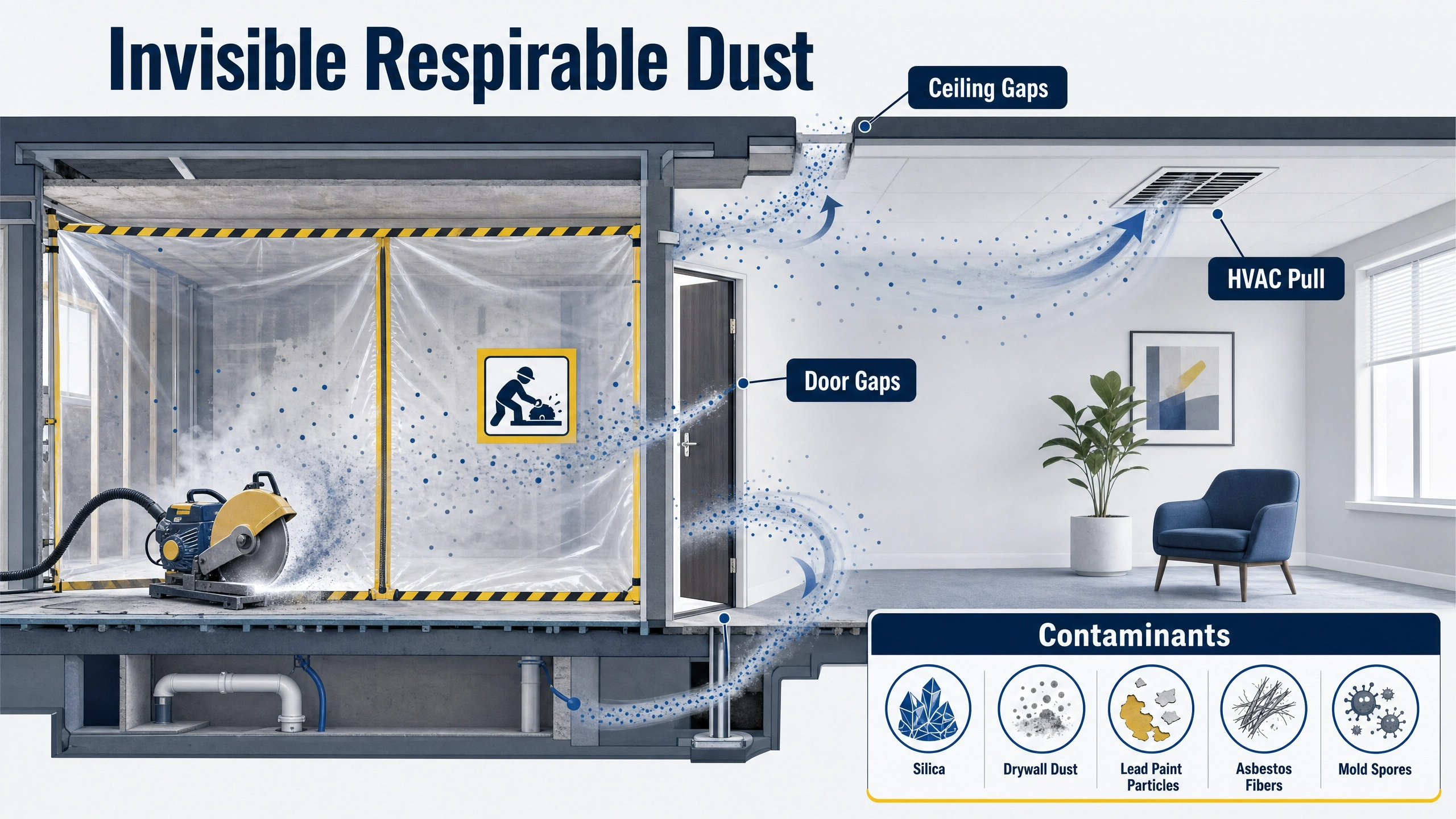
The particles that matter most are the ones you cannot see. Fine dust stays airborne for long periods and moves with whatever air is moving, which in a commercial building means the HVAC system and every pressure difference between rooms.
Measurements from real jobs show how much of it workers breathe. A 2025 study in the Annals of Work Exposures and Health took 407 personal samples from 92 workers at 14 indoor renovation sites in Oslo. Respirable dust averaged 0.88 mg/m³ (geometric mean) and peaked at 29 mg/m³. Respirable crystalline silica averaged 40 µg/m³ and peaked at 3.2 mg/m³, roughly 64 times the 50 µg/m³ permissible exposure limit used by federal OSHA and Cal/OSHA. Those are exposures at the source, and without good containment, some of that dust does not stay there. Strong construction dust control in occupied spaces starts with keeping it where it is made.
Six Points Where Construction Dust Control in Occupied Spaces Fails
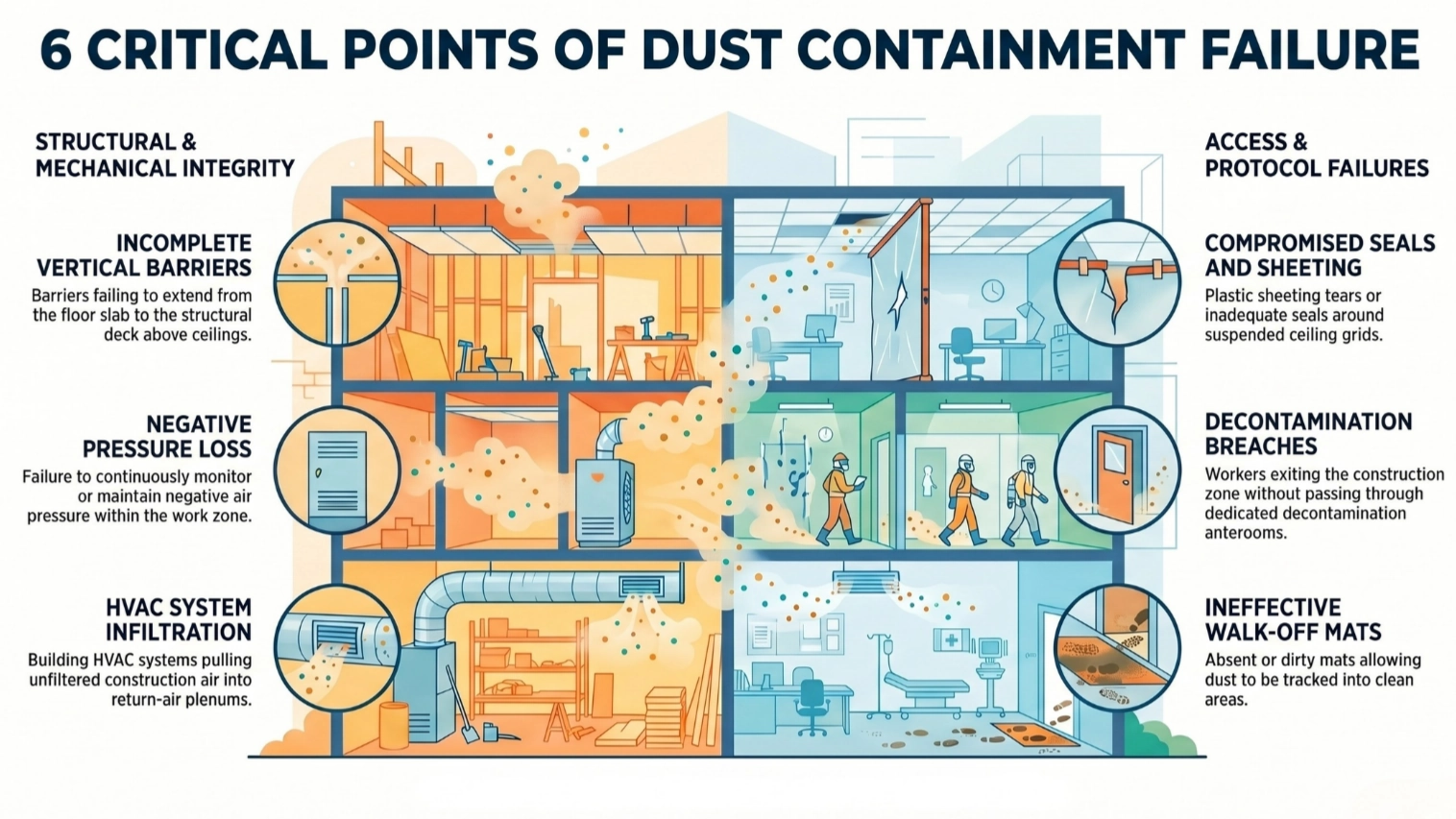
Dust follows the path of least resistance, and the same weak points undermine construction dust control in occupied spaces from project to project:
- Plastic sheeting tears, or does not seal tightly around a suspended ceiling grid.
- Barriers stop at the ceiling tile instead of running from the floor slab to the structural deck.
- Negative air pressure is not maintained, or nobody checks it once the shift starts.
- The building's HVAC returns pull unfiltered construction air out of the work zone.
- Workers and materials move in and out without an anteroom or other transition space.
- Walk-off mats are missing or full, so dust rides out on foot traffic and carts.
Part 2 explains how to close each of these gaps. For now, the point is that none of them is exotic. They are ordinary lapses, and each one is enough to move dust into a space people are using.
How HVAC Systems Spread Dust Through a Building
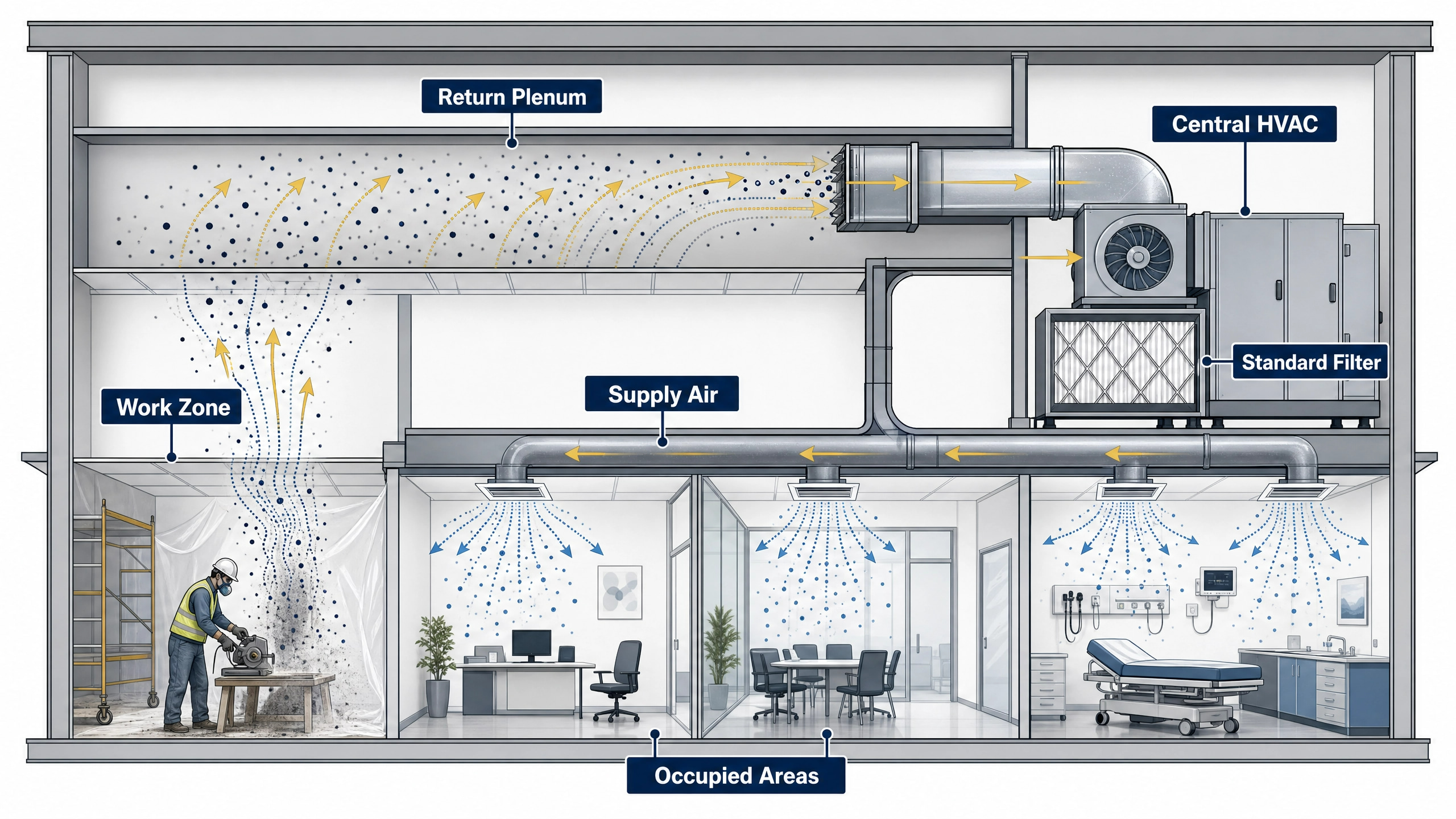
In many commercial buildings, the space above a drop ceiling serves as a shared return-air plenum. When a ceiling tile is removed or a wall is cut open inside a poorly isolated work zone, dust can rise directly into that plenum. The return fans then draw it into the ductwork, and the supply side delivers it to other rooms and floors.
The damage can outlast the project. Fine particles can coat coils and fan components and settle inside ducts, where they may keep shedding into the airstream each time the system cycles. Property managers who see this once tend to budget for containment up front, and our guide to temporary wall costs in California shows what those budgets involve.
Health Consequences When Construction Dust Control in Occupied Spaces Fails
Weak construction dust control in occupied spaces puts people at risk who never agreed to be near the work: office staff, patients, visitors, and neighboring tenants.
Irritation, Complaints, and Sick Building Symptoms
Most occupants will never see the dust. What they notice is how they feel. The U.S. EPA describes sick building syndrome as a situation in which building occupants experience acute health effects that appear linked to time spent in a building, without a specific illness or cause identified. Typical complaints include:
- Headaches that ease after leaving the building
- Eye, nose, and throat irritation
- Congestion and sinus pressure
- Fatigue and trouble concentrating
- Coughing, wheezing, or chest tightness
- Dry or irritated skin
The EPA also notes that Americans spend about 90 percent of their time indoors, and that concentrations of some pollutants are often 2 to 5 times higher indoors than outdoors. A dust release during renovation lands on top of that baseline. Each complaint is easy to dismiss alone, but a cluster of them from one floor, right after demolition starts, is hard for a facility manager to ignore. In many workplaces it ends up as a formal complaint, a request for air testing, or a lease conversation.
Silica and Lead Dust in Occupied Areas
Respirable crystalline silica is released when concrete, masonry, and stone are cut, drilled, or ground. Cal/OSHA's standard in Title 8, section 1532.3 sets a permissible exposure limit of 50 µg/m³ as an eight-hour average, with an action level of 25 µg/m³. Federal OSHA uses the same limits. OSHA estimates that about 2.3 million workers are exposed to respirable crystalline silica, most of them in construction. Long-term exposure is linked to silicosis, lung cancer, chronic obstructive pulmonary disease, and kidney disease.
Those limits are written to protect workers who do the cutting. The same dust matters differently when it drifts into a corridor, a break room, or a patient room, because the people there did not choose the exposure and may not know it is happening.
Lead is the other dust that deserves attention in older buildings. Since January 1, 2025, Cal/OSHA's lead-in-construction standard, section 1532.1, has used a permissible exposure limit of 10 µg/m³ and an action level of 2 µg/m³, down from 50 and 30. Disturbing old paint in an occupied building without proper containment can spread lead dust well beyond the work area.
Mold and Fungal Infection Risk in Healthcare
For immunocompromised patients, escaped dust can be a clinical threat. Aspergillus spores are common in soil, old building materials, and ceiling cavities, and demolition can release them into the air. Patients receiving chemotherapy, organ transplant recipients, and others with severely weakened immune systems can develop invasive infections that are difficult to treat.
The strongest summary evidence comes from a 2006 systematic review by Vonberg and Gastmeier. It examined 53 studies covering 458 patients and found construction or demolition to be a probable or possible source in 49.1 percent of the hospital outbreaks reviewed. Mortality among severely immunodeficient patients in those outbreaks was 57.6 percent.
The Sydney outbreak shows how these cases play out in practice. NSW Health's March 2026 report did not name a single cause. It did conclude that the balance of evidence pointed to the balcony and nearby construction activities as the greatest exposure risk, and it recommended better infection control planning, pre-construction documentation, and a clear response process when infection rates rise.
The CDC's environmental infection control guidance for healthcare facilities addresses the same ground: barriers around construction areas, negative pressure relative to adjacent spaces, and HEPA filtration where exhaust air is a concern. We cover the full framework in our guide to ICRA-compliant containment walls.
Financial and Legal Exposure
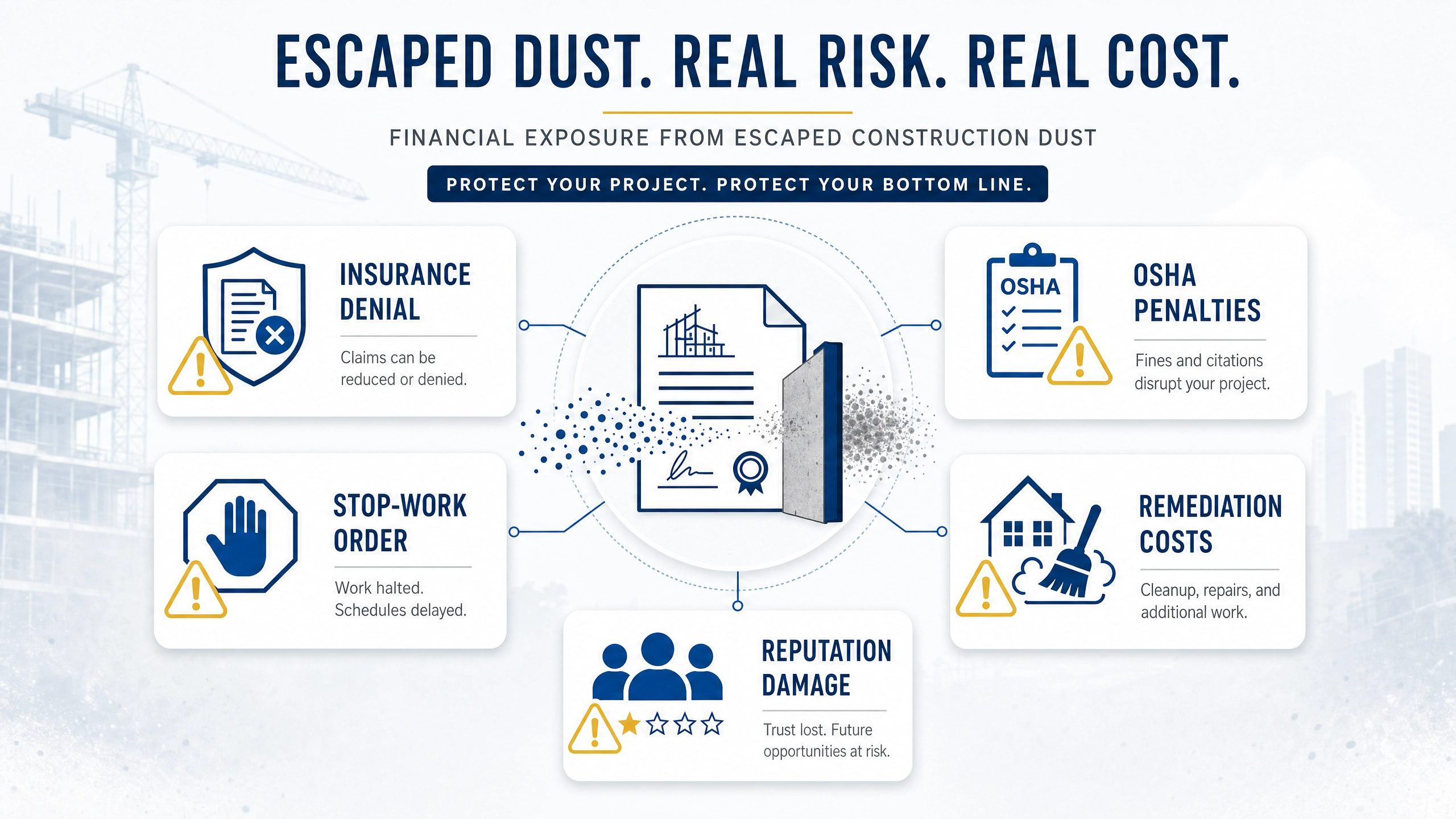
Insurance and the Pollution Exclusion
Many contractors and owners assume their policies will absorb a dust incident. That assumption deserves a second look. Most commercial property and liability policies carry a pollution exclusion, and courts have not treated construction dust consistently.
In Broome County v. Travelers Indemnity Co. (N.Y. App. Div., 3d Dept., 2015), silica dust from garage construction traveled up an elevator shaft into a county building. The court held that the policy's pollution exclusion barred coverage, reasoning that silica dust fits the policy's definition of a pollutant. California courts have read these exclusions more narrowly. In MacKinnon v. Truck Insurance Exchange (Cal. 2003), the California Supreme Court held that a standard pollution exclusion applies to conventional environmental pollution, not to every substance that can irritate or harm.
The takeaway is not that coverage will fail or succeed. It is that the outcome depends on the policy wording, the facts, and the jurisdiction. Owners and contractors should review exclusions with their broker or counsel before the project starts. This article is general information, not legal advice.
OSHA and Cal/OSHA Penalties
When construction dust control in occupied spaces fails and a worker or occupant complaint draws an inspector, penalties can be significant. The table below shows current maximum amounts. California operates its own state plan, so Cal/OSHA's schedule is the one that applies to most California employers, and both agencies adjust their figures annually.
| Violation type | Federal OSHA (2026 maximum) | Cal/OSHA (2025 maximum) |
|---|---|---|
| Serious | $16,550 per violation | $25,000 per violation |
| Other-than-serious or general | $16,550 per violation | $16,285 per violation |
| Willful or repeat | $165,514 per violation | $162,851 per violation |
| Failure to abate | $16,550 per day | Not covered in this table |
Sources: OSHA's 2026 annual civil penalty adjustments memo and the California Department of Industrial Relations' 2025 penalty announcement. Confirm current figures with each agency, since amounts change each year.
Stop-Work Orders, Delays, and Rework
The largest cost of a dust breach is often time. An owner, building official, or infection prevention team can halt work while air quality is tested and affected areas are cleaned. Depending on the contract, the consequences can include:
- Work stoppage while remediation and testing are completed
- Liquidated damages or delay claims if the schedule slips
- Professional cleaning of adjacent spaces, including HEPA vacuuming and surface wipe-downs
- Indoor air quality testing before areas can be reoccupied
- Strained relationships with the facility team and the general contractor, which can affect future work
These costs usually dwarf the price of the containment that would have prevented them. Our post on common contractor mistakes with temporary wall systems shows how a few small shortcuts turn into expensive rework.
Facility-Specific Vulnerabilities

Healthcare Facilities
Construction dust control in occupied spaces matters most in a hospital, where a containment failure can become a patient safety event. Possible consequences include closing a clinical area, rescheduling procedures, delays to the project, and findings from accreditation surveyors. The Joint Commission's environment of care standards address infection control risk during construction, and facilities typically manage it through an Infection Control Risk Assessment (ICRA) before work begins.
High-risk work generally calls for rigid barriers from slab to deck, continuous negative air with HEPA filtration, and a controlled entry. See our healthcare containment services page for how we support these projects, and Part 2 for the ICRA class requirements.
Data Centers and Server Rooms
Construction dust control in occupied spaces is just as critical around data halls, which are designed around clean air. Many are held to ISO 14644-1 Class 8, which limits air to 3,520,000 particles of 0.5 µm or larger per cubic meter. Oracle's data center environmental guidance notes that construction activity can push local particle levels beyond that class and that drywall and gypsum dust is especially damaging to equipment.
Fine dust can settle on circuit boards and heat sinks, interfere with cooling, and contribute to component failure. Equipment warranties often specify environmental conditions, so owners should check their own terms before any work near live equipment. For more detail, read about data center containment and server room mistakes during HVAC upgrades.
Commercial Offices and Tenant Improvements
When construction dust control in occupied spaces slips in an office, dust shows up on desks, conference tables, and monitors, and it shows up in complaints. Depending on the lease, a tenant may have grounds to ask for remedies when a landlord's contractor disrupts the premises, and landlords sometimes look to the general contractor to recover those costs. The details turn on the lease and the contract, so each project is different.
Occupied tenant improvements are some of the most common jobs for modular containment. See our overview of tenant improvement containment and our look at how modular temporary walls transform California offices.
Why This Matters in the Bay Area
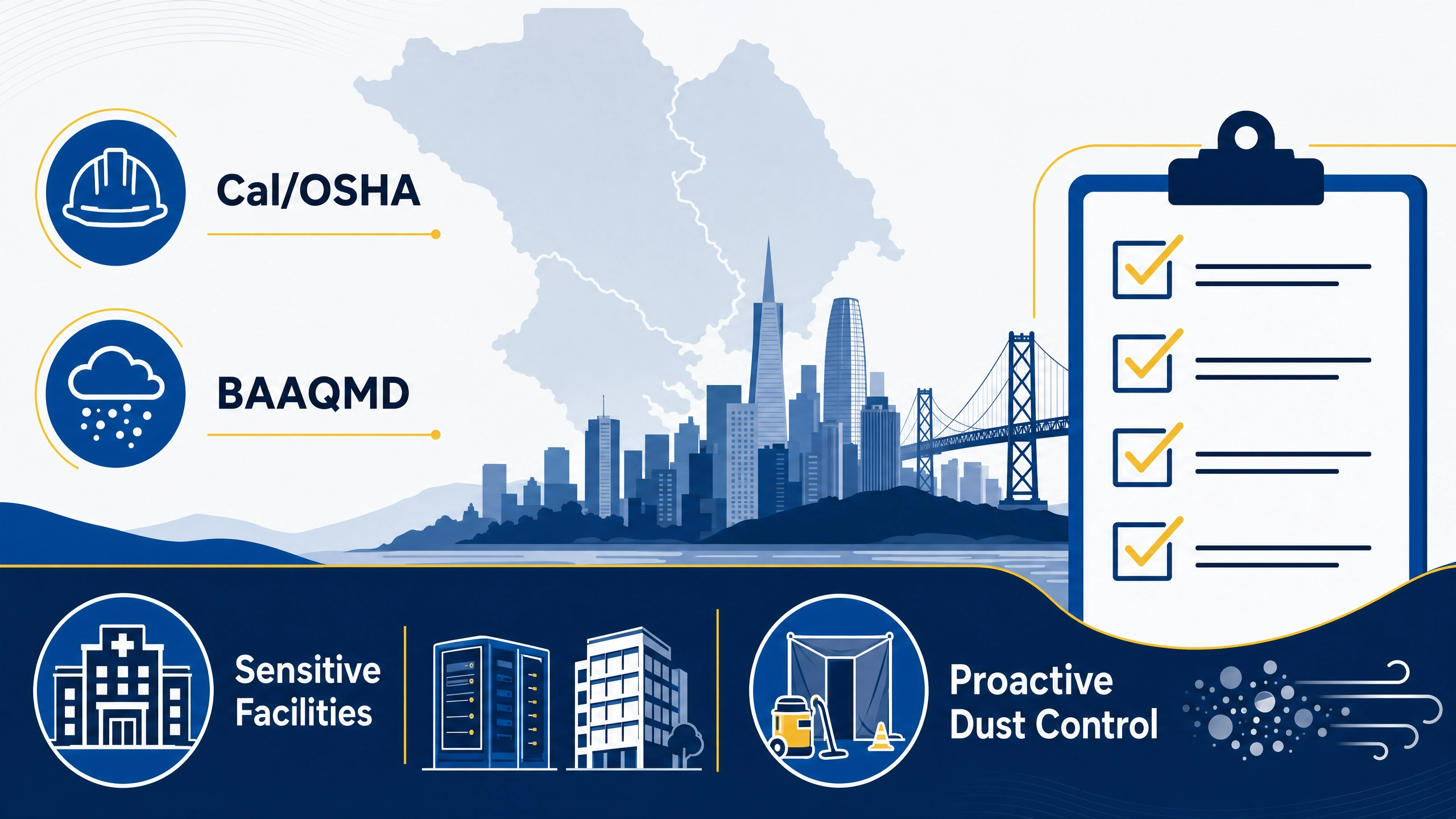
California's rules on silica and lead are among the most protective in the country, and the lead limits changed again in 2025. Locally, the Bay Area Air Quality Management District has said its staff are developing amendments to Regulation 6, Rules 1 and 6, covering particulate matter and fugitive dust, and construction is within the scope of that work. The details may change as the rulemaking continues, so check with the district on current requirements before a project starts.
The Bay Area also has a dense mix of hospitals, labs, data centers, offices, and public buildings that stay open during renovation. That mix is why construction dust control in occupied spaces gets so much attention here. Our guide to California temporary wall regulations explains which codes and agencies typically come into play, and as always, final requirements come from the authority having jurisdiction on your project.