
Modular Temporary Wall Solutions vs. Permanent Structures: What General Contractors Need to Know
Most general contractors pricing a tenant improvement or hospital renovation in Northern California run the same mental calculation: drywall is cheap, drywall is familiar, drywall works. And on paper, that math holds up, until you actually run the full numbers.
The raw material cost for metal studs and gypsum board is hard to argue with. The problem is that those materials represent maybe 30 percent of what you will actually spend. The rest goes to finishing labor, disposal fees, schedule delays, and the regulatory exposure that comes with generating silica dust in an occupied building. When you add all of that up, permanent drywall containment is rarely the economical choice it appears to be on the bid sheet.
This post breaks down exactly how modular temporary wall solutions compare to permanent structures across every dimension that matters on a California job site: cost, speed, compliance, safety, and environmental impact.
The Real Cost of Temporary Containment in California
At first glance, permanent drywall looks like the budget-friendly option. But the comparison only holds if you ignore most of what containment actually costs.
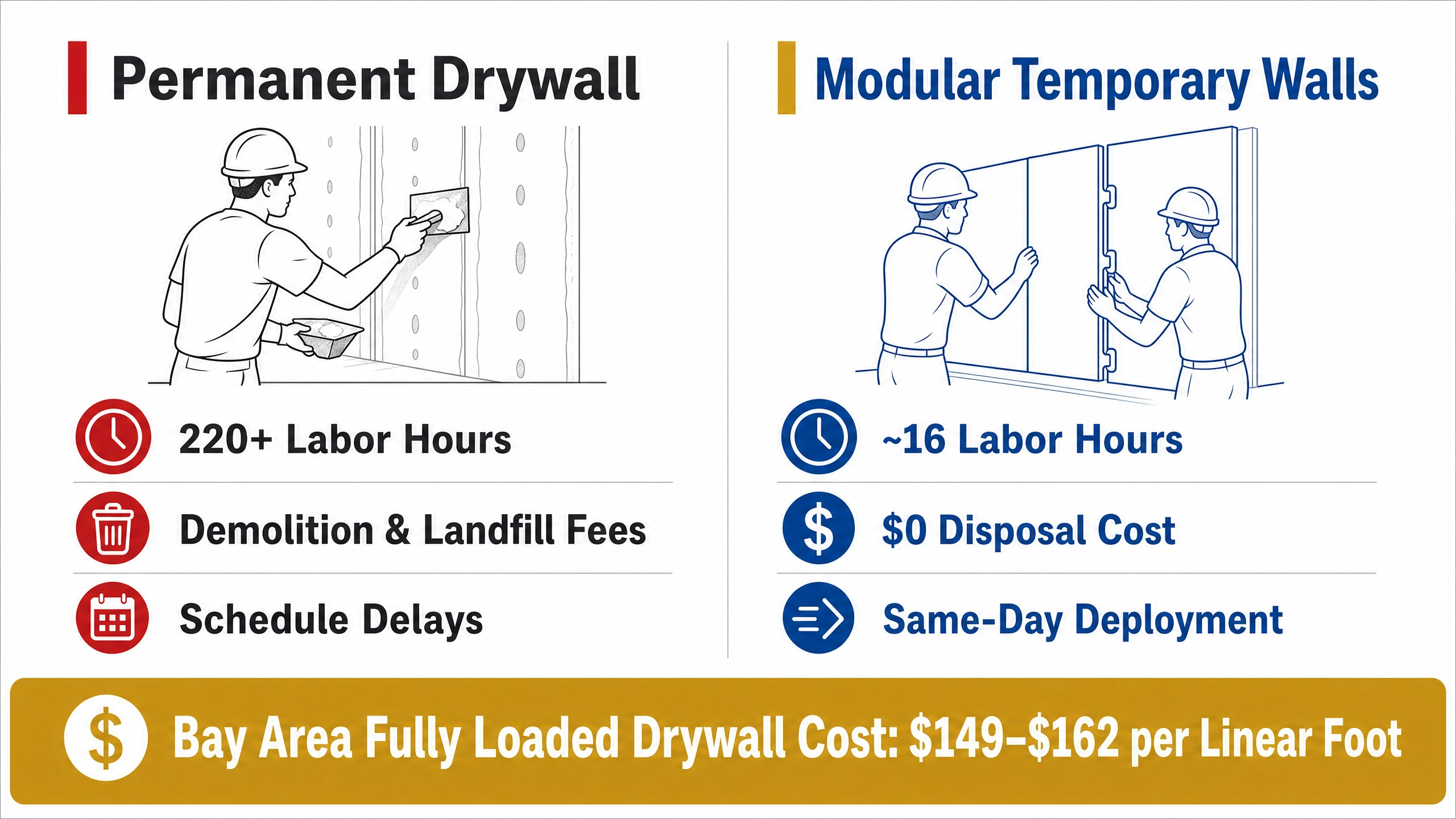
In the San Francisco Bay Area, the fully loaded cost to install and later remove a standard drywall containment partition runs between $149 and $162 per linear foot. That figure includes framing labor, materials, the taping and finishing trades, and eventual demolition and disposal. In a high-cost labor market like California, the installation phase alone for 400 linear feet of 10-foot drywall can require over 220 labor hours, with several sequential steps that cannot overlap.
A two-person crew can install the equivalent footage in modular panels in roughly 16 hours. No mud, no sanding, no drying time, no painter. The panels arrive pre-finished and interlock on-site. You pay for one trade, one mobilization, one day.
That speed difference is not just about money. Every additional day your containment takes to install is a day your primary construction crew is standing by, and a day the occupied space next door is absorbing construction risk.
For projects where the containment line needs to move, the math gets even worse for drywall. Moving a permanent partition means tear-down, debris hauling, and rebuilding from scratch. With modular systems, a two-person crew unlocks the panels, repositions them, and resets in a few hours without generating a single cup of dust. This kind of flexibility is especially important when you’re planning temporary containment for multi-phase renovations.
For contractors who prefer not to carry the capital cost of purchasing a system, renting from a provider like Construction Containment Services converts a capital expenditure into an operating expense. You get access to premium equipment on day one without the overhead of storage and maintenance. That’s a large part of why renting temporary wall panels has become the smart choice for many Bay Area general contractors.
Containment Method | Labor Hours (400 LF) | Disposal Cost | Reusability |
|---|---|---|---|
Permanent Drywall | ~220 hours | High (demolition + landfill fees) | Single use only |
Modular Temporary Walls | ~16 hours | $0 | 20-100+ uses |
California Code Compliance: Where Drywall Gets Complicated
California has some of the most demanding construction regulations in the country, and occupied-space renovations sit squarely in the crosshairs.
The California Building Code (CBC) Chapter 33 governs safeguards during construction in occupied buildings. The California Fire Code requires that temporary barriers not interfere with sprinkler coverage, egress paths, or existing fire separation assemblies. And NFPA 241 requires fire-rated separation between construction zones and occupied areas in certain project types.
Building permanent drywall partitions to meet a 1-hour fire rating requires specific screw patterns, approved assemblies, and often an open-wall inspection before the partition can be enclosed. That adds steps to an already-congested schedule.
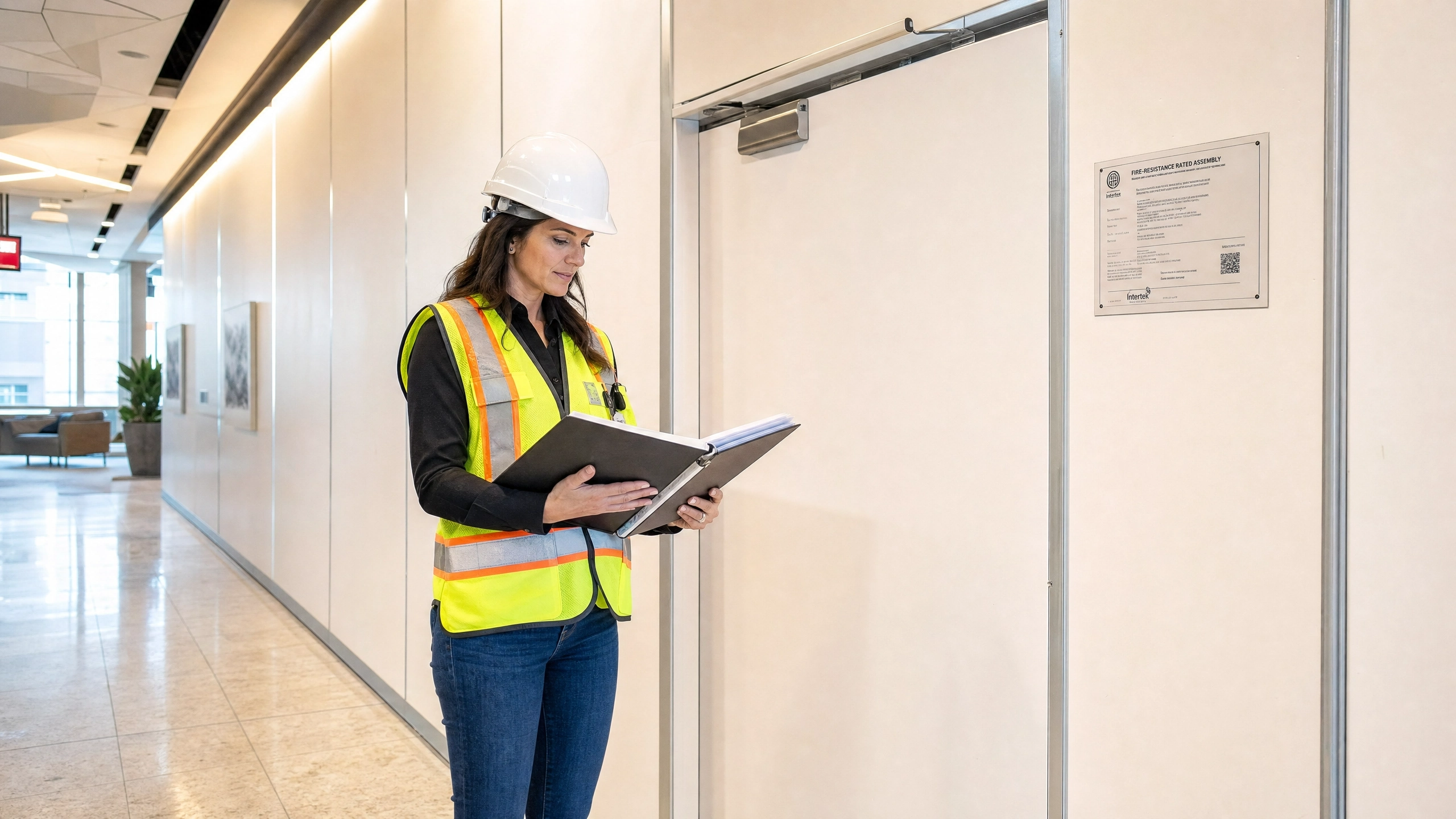
High-quality modular systems can achieve ASTM E119 1-hour fire ratings right out of the box, with pre-tested and documented assemblies you can hand directly to the Authority Having Jurisdiction. The compliance documentation is already done. For more on fire-rated temporary wall requirements on California job sites, we have covered this in detail separately.
Permit exposure is another consideration. Permanent partitions typically trigger formal permit review, architectural sign-off, and municipal inspection. Modular systems are generally classified as temporary equipment rather than permanent construction, which can allow faster deployment and avoid the weeks-long wait for permit approvals. You can review the specifics in our post on California modular temporary wall regulations.
One nuance worth noting: all 5DCCS modular systems start at 7 feet in height, which technically can implicate CBC permit requirements in some jurisdictions. In practice, most healthcare, data center, and active construction environments already have a broader project permit in place that covers the containment installation. The key is understanding your local AHJ’s position before the project starts. We assign permit responsibility contractually to the building owner in every project.
Cal/OSHA Silica Rules and the Dust You Cannot See
This is where the compliance risk for drywall containment often gets underestimated.
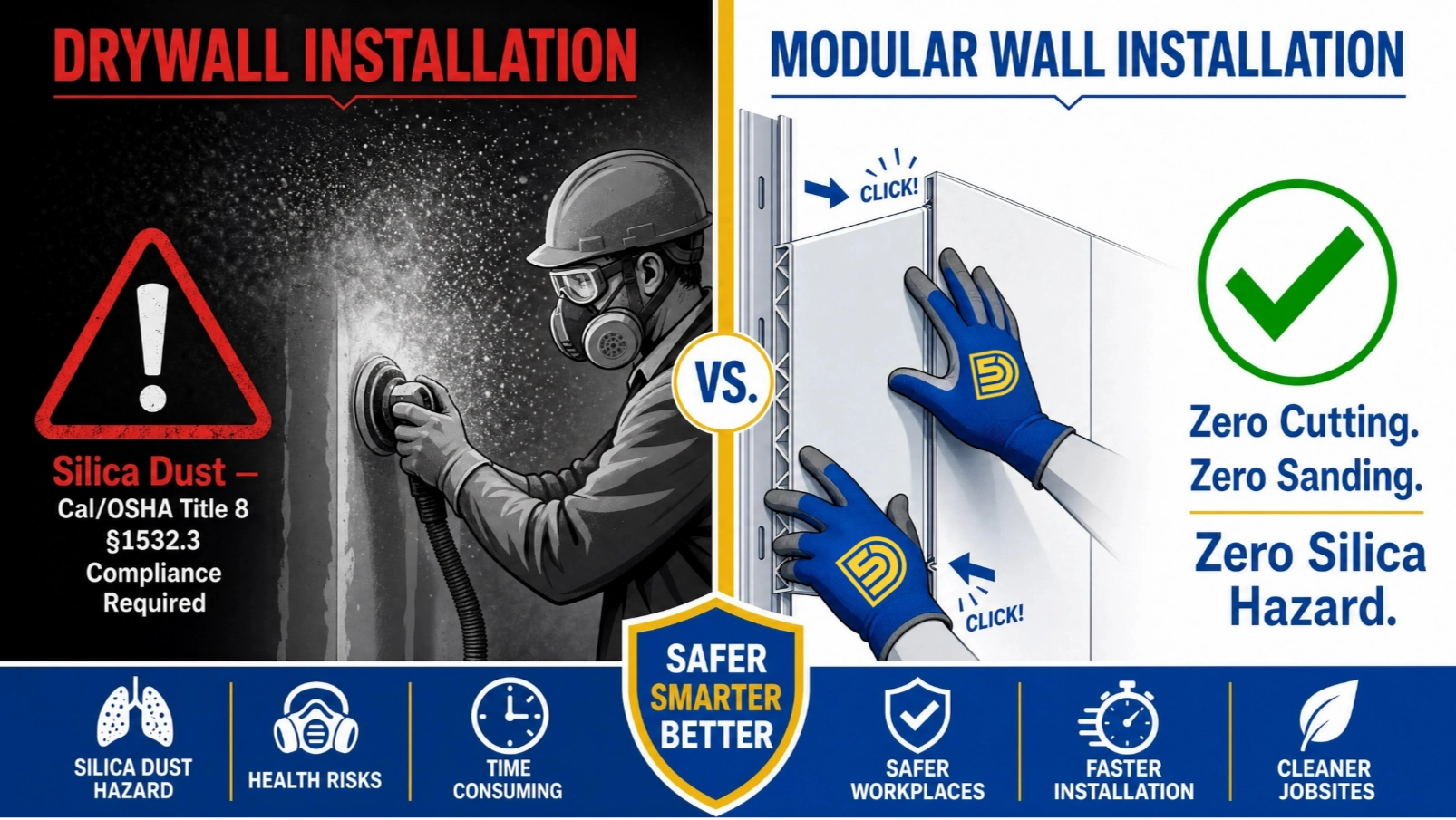
Cal/OSHA Title 8 Section 1532.3 regulates worker exposure to respirable crystalline silica, a byproduct of cutting, sanding, or drilling into gypsum, concrete, and masonry products. Silica exposure is a documented cause of silicosis, COPD, and lung cancer. The standard is not aspirational and it carries significant financial penalties for documented violations.
Every time you run a chop saw through metal stud track anchored in concrete, or sand a drywall seam, you are generating silica particulate that must be controlled through engineering controls, wet methods, or respiratory protection programs. In an occupied building, that exposure is not just a worker safety issue. It is an occupant safety issue.
Modular panels arrive on-site pre-finished. There is no cutting, no sanding, and no drilling during installation. The dust hazard at the installation phase is essentially zero. That alone removes a significant layer of regulatory exposure from your job site.
The 5 Ds of Construction: How Modular Systems Perform
At 5DCCS, we frame every containment project around what we call the 5 Ds: Dust, Debris, Decibels, Demolition, and Disruption. Drywall has real weaknesses in most of these categories.
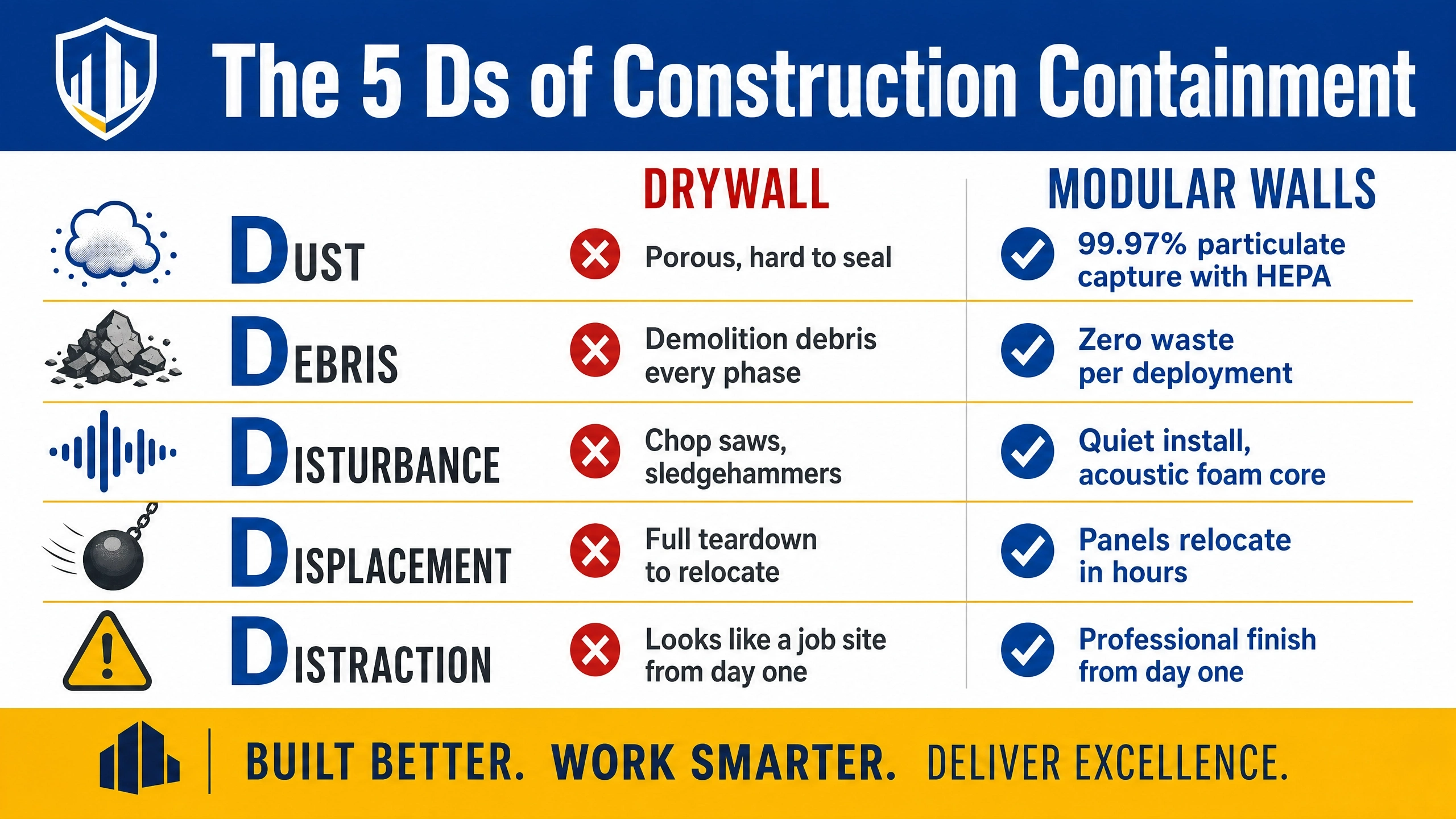
Dust
Dust is the most critical failure mode in occupied renovations. Drywall is porous and difficult to seal completely, which means even a well-built partition can allow fine particulate to migrate into adjacent spaces. Modular systems use engineered gasketed seals that close off the construction zone tightly. When integrated with a negative air machine and HEPA filtration, the containment zone maintains negative pressure, meaning any air movement flows into the construction zone, not out of it. This is the configuration required for ICRA Class IV and Class V work in healthcare environments.
Decibels
Decibels are a significant problem with permanent drywall, especially during the installation itself. Chop saws cutting metal studs, impact drivers, and eventually sledgehammers at teardown generate noise levels that are genuinely disruptive to adjacent occupied spaces. Modular panels install quietly and many systems incorporate sound-attenuating foam cores that provide meaningful acoustic separation once in place. For environments where noise control matters, we cover this in detail in our post on temporary wall panels that reduce construction noise.
Disruption
Disruption to building operations is the metric that facility managers care most about, and modular walls win here by a wide margin. The installation is faster, cleaner, and quieter. The finished appearance from day one is professional rather than looking like a job site in progress. For hospitals, corporate offices, and other professional environments where brand image matters during a renovation, that difference is real. We have seen it be the deciding factor on more than one project.
ICRA Compliance in Healthcare: Why Drywall Falls Short
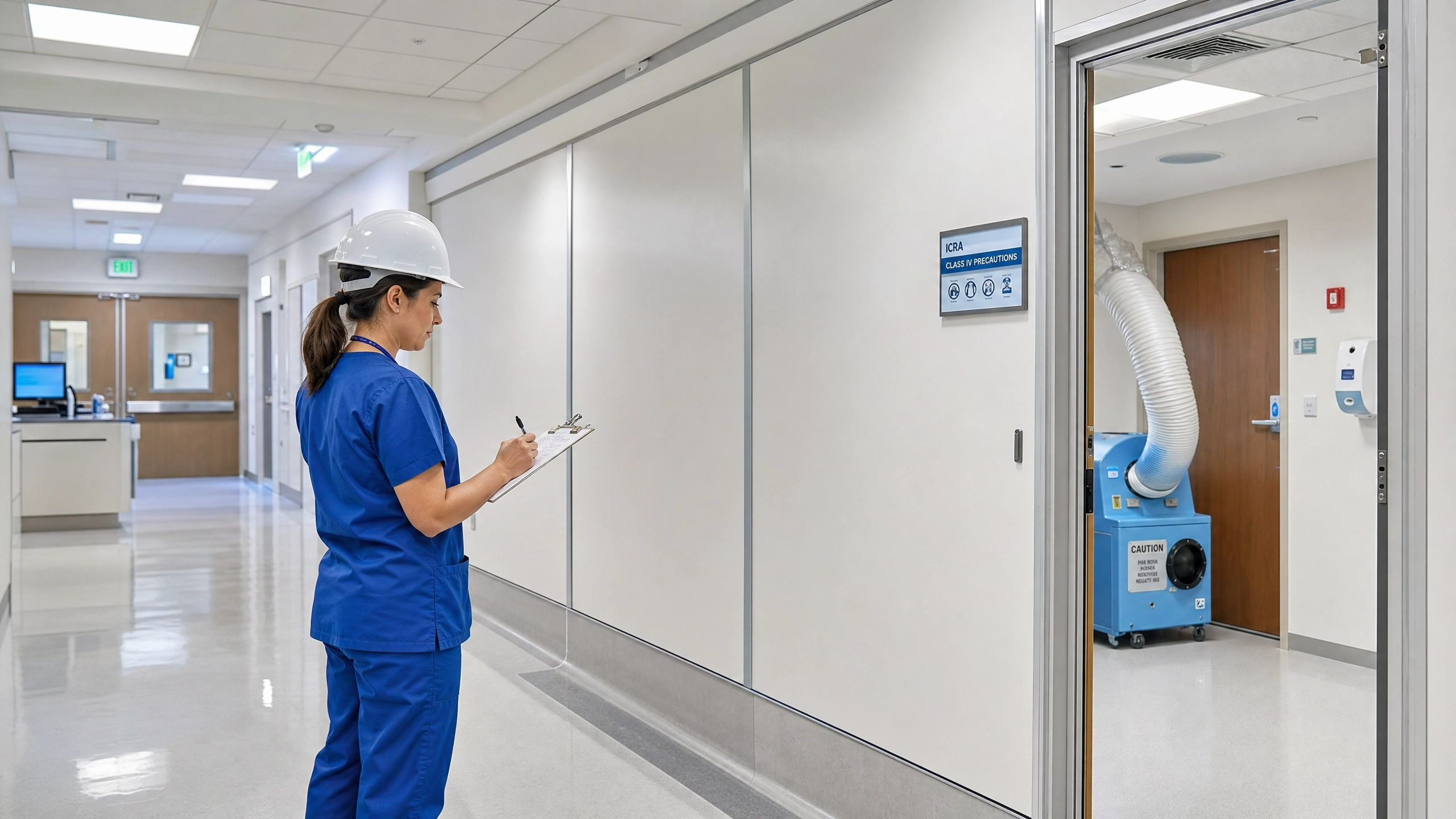
In healthcare construction, the performance gap between drywall and modular systems is widest.
The American Society for Healthcare Engineering (ASHE) ICRA 2.0 framework classifies construction activities by risk level and specifies the containment requirements for each. Class IV work, which covers the highest-risk activities adjacent to immunocompromised patients, requires containment that seals completely, integrates with negative pressure systems, and can be cleaned and disinfected using hospital-grade protocols.
Drywall fails on the last two counts. Gypsum board is porous, absorbs moisture, and cannot be reliably disinfected. It is also vulnerable to mold growth in humid environments. The Facility Guidelines Institute (FGI) guidelines for hospital construction reflect these limitations, and infection control professionals at most major California health systems have moved away from drywall for temporary containment as a result.
Non-porous modular panel materials, by contrast, wipe down cleanly, do not harbor microbial growth, and maintain their seal integrity across the duration of a project. For a detailed breakdown of what ICRA compliant containment walls actually require, we have a full post on that topic.
The stakes in healthcare construction are not abstract. Fungal infections like aspergillosis can be fatal to immunocompromised patients. There is documented evidence in the clinical literature connecting construction-related environmental disturbances to patient infections. Proper containment is not a cost line item to optimize; it is a clinical safety measure.
CALGreen, Waste Diversion, and the Drywall Problem
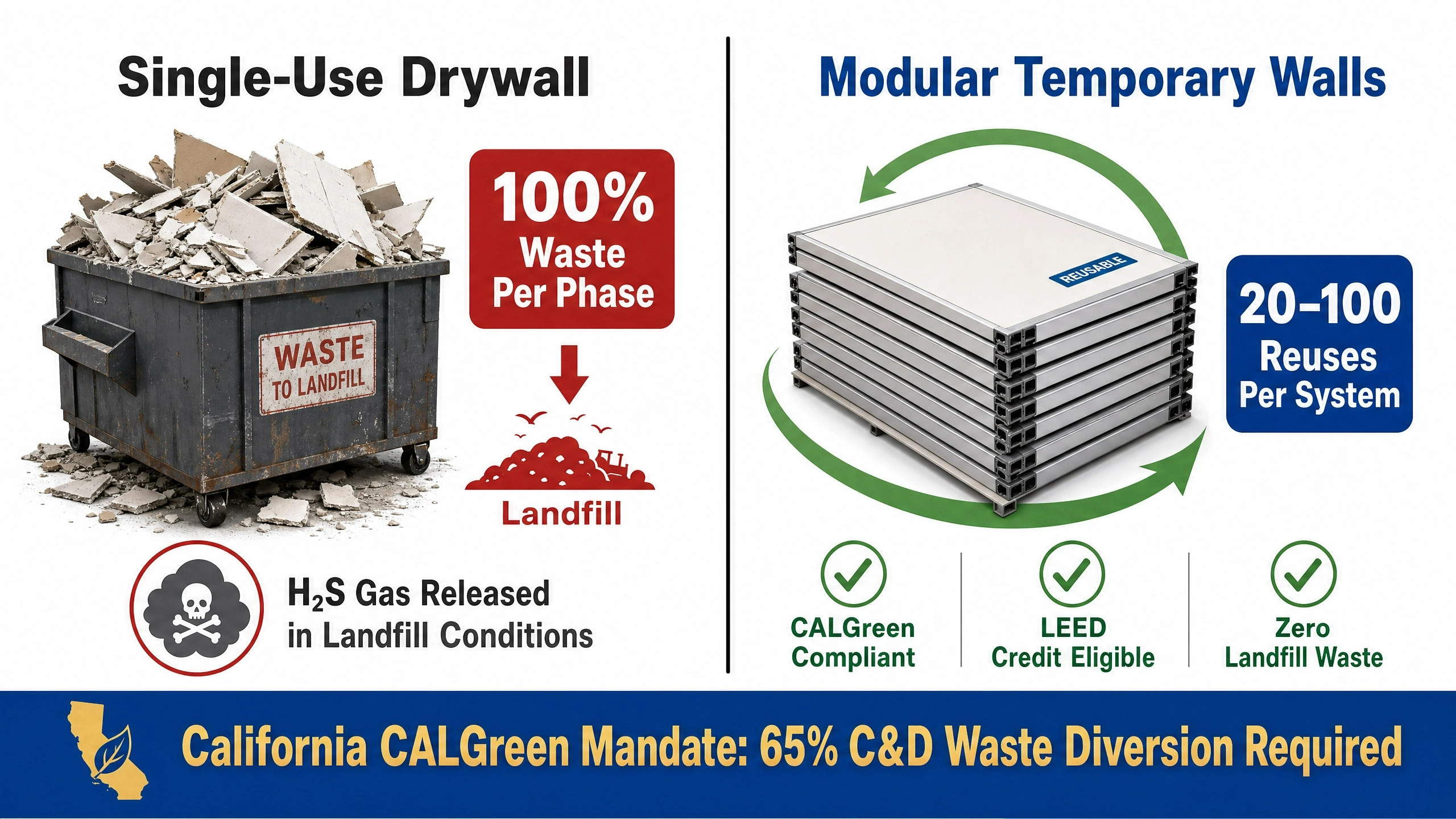
California’s CALGreen building standards require commercial construction projects to divert at least 65 percent of construction and demolition debris from landfills. Construction and demolition waste accounts for a disproportionately large share of California’s total waste stream, and gypsum drywall is a consistent contributor.
Permanent drywall containment is inherently single-use. Once a project phase is complete, the wall gets demolished and hauled to a landfill. Wet gypsum in landfill conditions decomposes and releases hydrogen sulfide, a toxic gas. The disposal fees for C&D debris in the Bay Area have increased substantially over the past several years as landfill capacity has tightened.
Modular panels are engineered for repeated use, typically 20 to 100 project cycles depending on the system. When you use modular containment, the waste generation from that phase of your project drops to essentially zero. This is a genuine advantage for projects pursuing LEED credits for materials and resources, and it supports the ESG reporting requirements that many corporate facility owners now place on their GC partners.
The US Green Building Council and organizations like AIA Los Angeles have increasingly emphasized circular economy principles in construction, which favor material reuse over disposal. Modular wall systems are a straightforward application of that principle.
Flexibility Across Project Types and Industries
One area where modular systems often get underestimated is adaptability. Contractors tend to evaluate containment based on their most recent project type, but modular systems serve a much wider range of applications than most people initially recognize.
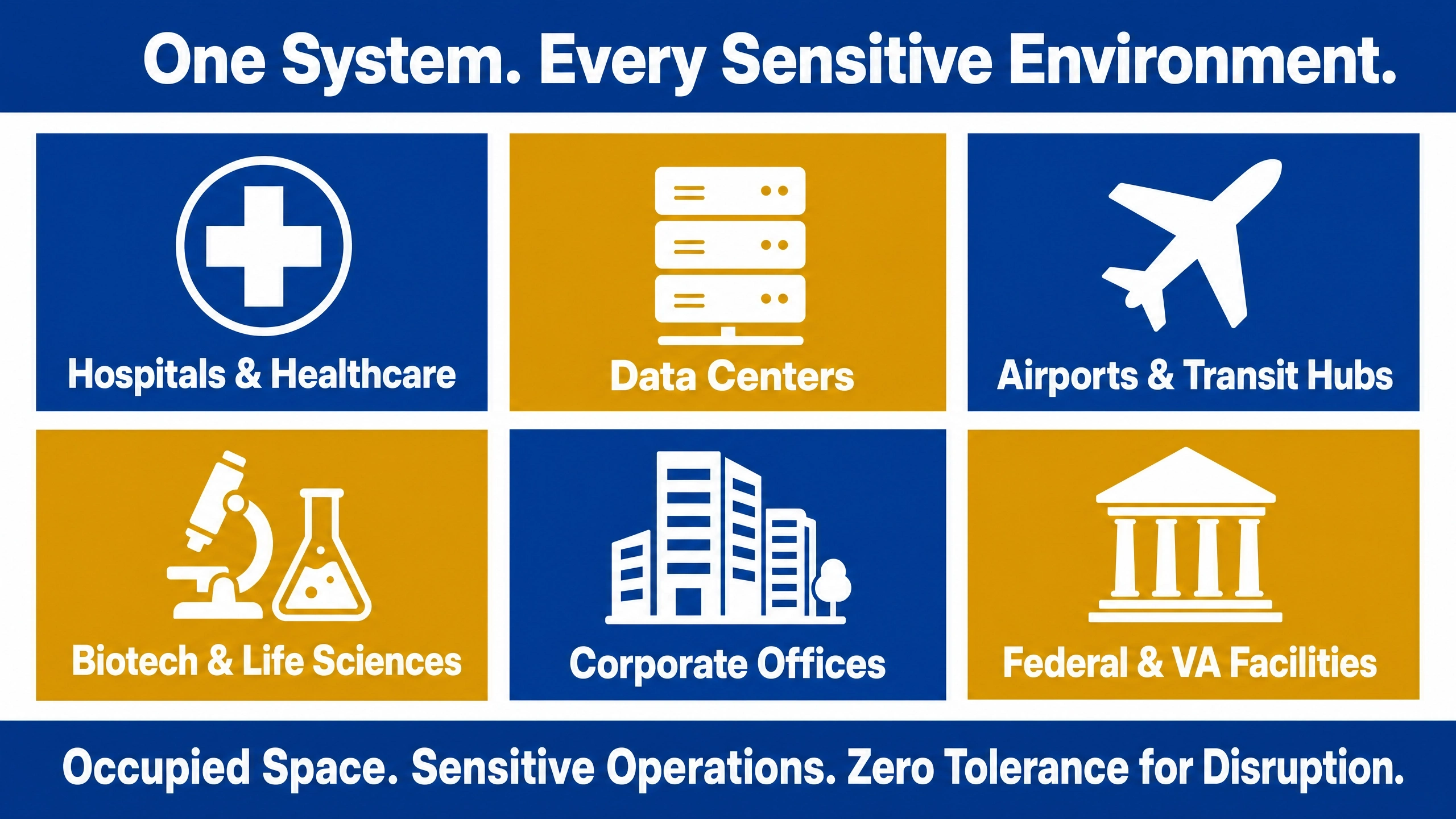
The same core capability that makes these systems effective in a hospital wing also works in a data center where server uptime cannot be interrupted, an airport terminal renovation where public circulation cannot stop, or a biotech laboratory where contamination control is regulatory rather than just operational. For a broader look at the industries where modular containment has proven its value, we covered this in our post on industries beyond healthcare that benefit from temporary wall solutions.
The common thread across all of these environments is the combination of occupied space, sensitive operations, and zero tolerance for the dust, noise, and disruption that uncontrolled construction generates.
Making the Call on Your Next Project
Permanent drywall is the right choice for some things. New construction, walls that need to stay, finishes that need to match existing architecture permanently. No one is arguing with any of that.
For temporary containment in occupied spaces, the argument for drywall is much harder to sustain once you account for the full scope of costs and risks. The labor is expensive, the schedule is slow, the dust is a regulatory hazard, the disposal creates waste that California actively penalizes, and the end result is a wall you are going to tear down anyway.
Modular systems install faster, perform better on dust and noise control, meet fire and ICRA requirements with documented assemblies, generate zero waste, and can move as your project phases shift.
Construction Containment Services is a veteran-owned specialty subcontractor based in San Jose, holding SDVOSB, DVBE, DBE, and Micro SBE certifications. We provide modular temporary wall rentals, sales, and containment consulting across the Bay Area and Northern California. If you’re evaluating containment options for an upcoming occupied-space renovation, we’re straightforward to work with.
Contact 5DCCS to discuss your project or request a quote. If you’re a general contractor interested in how we can support your team on occupied building work, you can also learn more about why contractors partner with 5DCCS.
Quick Reference: Modular vs. Drywall Containment
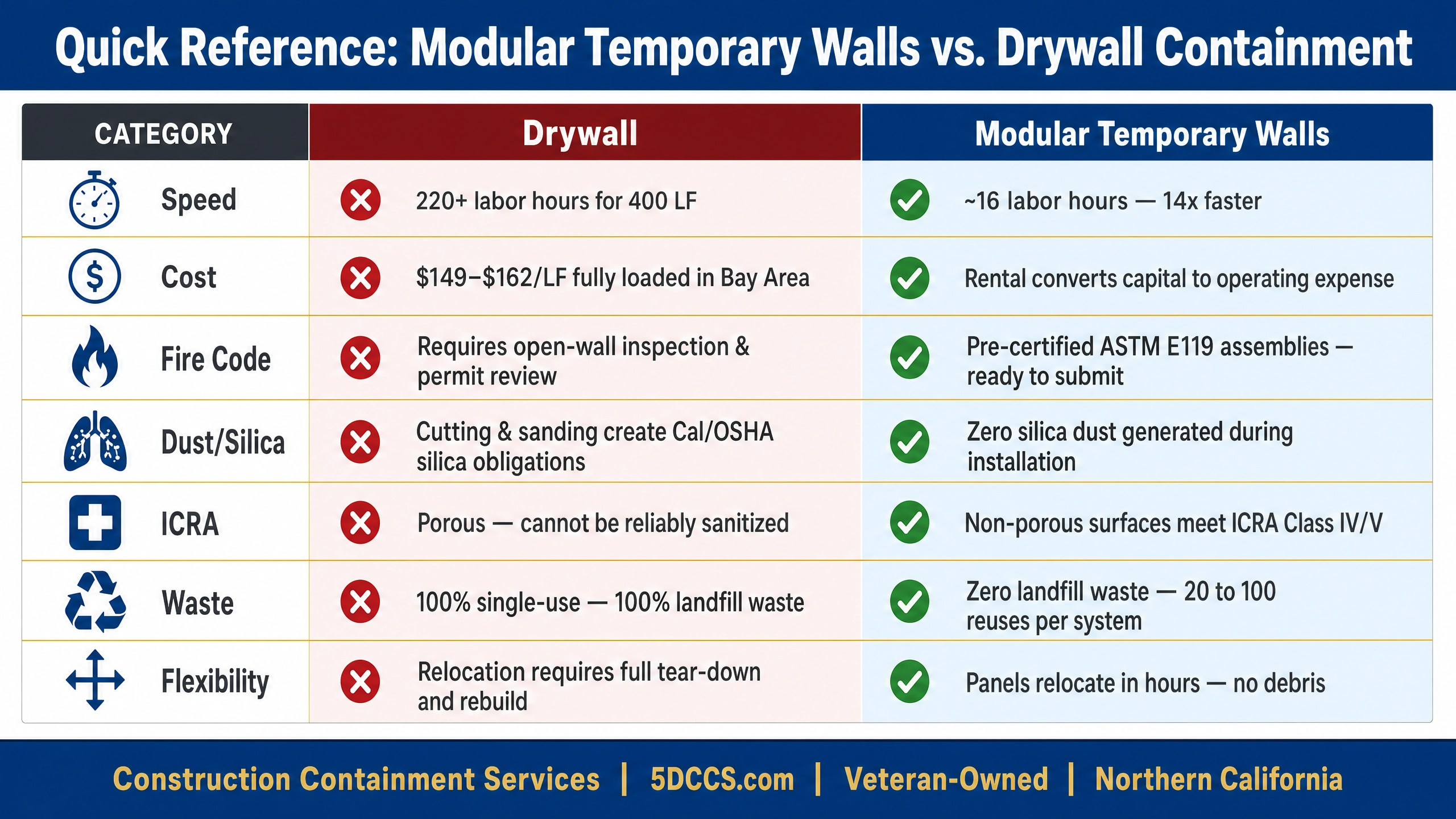
- Speed: Modular installs in roughly 14 times fewer labor hours for equivalent coverage
- Cost: Drywall runs $149-$162/LF fully loaded in the Bay Area; modular converts capital to operating expense with rental
- Fire code: Modular systems offer pre-certified ASTM E119 assemblies; drywall requires open-wall inspection
- Dust/silica: Modular installation generates no silica dust; drywall sanding and cutting create Cal/OSHA compliance obligations
- ICRA: Modular non-porous surfaces meet Class IV/V requirements; drywall is porous and cannot be reliably sanitized
- Waste: Modular generates zero landfill waste per deployment; drywall is 100% single-use
- Flexibility: Modular panels can relocate in hours without debris; drywall relocation requires full tear-down and rebuild
External References
Cal/OSHA Respirable Crystalline Silica Standard (DIR)
NFPA 241: Safeguarding Construction, Alteration, and Demolition Operations
California Building Standards Commission (CBSC)
US EPA: Sustainable Management of Construction and Demolition Materials
CalRecycle: Construction and Demolition Debris