
Fire-Rated Temporary Walls: When You Need Them (And When You Don’t)
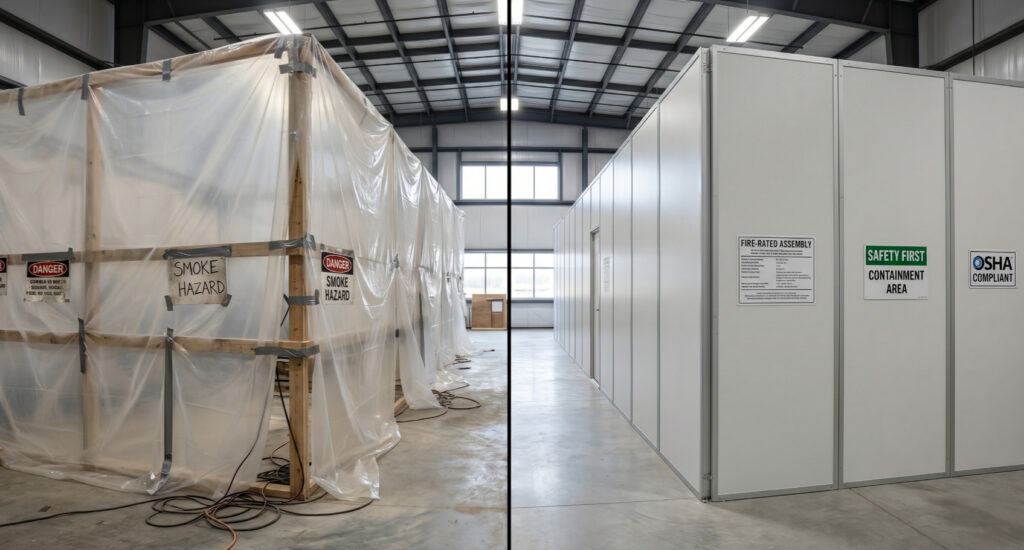
Construction and renovation within occupied commercial environments present a unique set of safety challenges that go far beyond simple dust management. For project managers and general contractors in the San Francisco Bay Area, the decision of which containment barrier to use is often dictated by the most critical factor of all: fire safety. While keeping a workspace clean is important, ensuring that a temporary barrier can withstand a fire event or prevent the spread of smoke is a matter of legal compliance and life safety.
At Construction Containment Services (5DCCS), we specialize in helping our clients manage the five Ds of construction: dust, debris, decibels, demolition, and disruption. The silent sixth D that can derail any project is danger. Understanding the nuances of fire-rated temporary walls is essential for any professional operating in high-occupancy or high-risk environments.
The Foundation of Fire Safety: Understanding the Containment Spectrum
The term fire-rated is used loosely in the construction industry, which can lead to dangerous misunderstandings. To a fire marshal, a fire-rated wall is a specifically engineered assembly that has been tested to survive extreme heat for a set period, usually one or two hours. To a contractor, fire-rated might simply mean the material won’t catch fire easily.
Why Containment Matters Beyond Dust Control
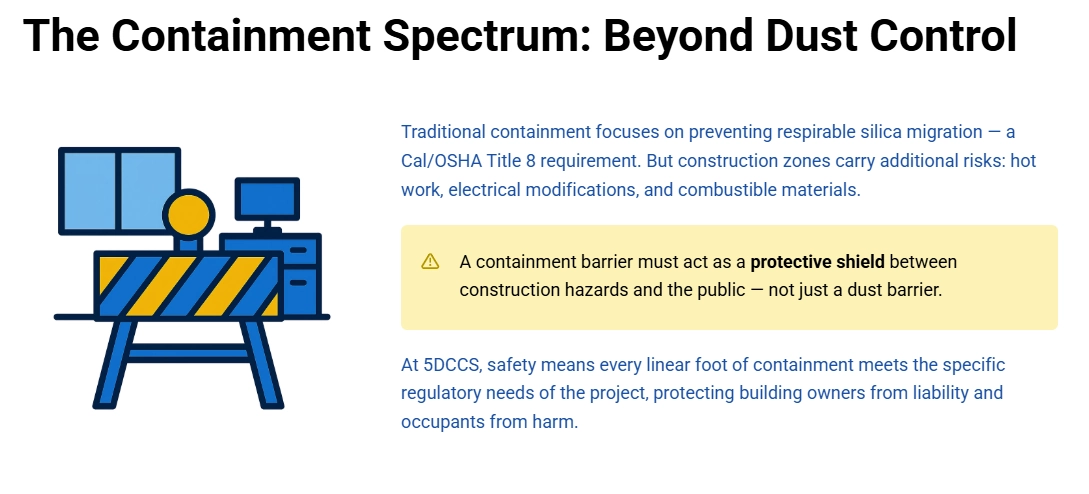
Traditional containment often focuses on preventing the migration of respirable crystalline silica and other particulates. While this is a requirement under Cal/OSHA Title 8, it does not address the volatility of a live construction site. Construction zones are inherently higher risk due to hot work, electrical modifications, and the presence of combustible materials. A containment barrier must act as a protective shield between these risks and the public.
If you are planning a commercial renovation and want to understand how containment requirements fit into your broader project scope, our guide to planning for temporary containment during renovation is a useful starting point.
The 5DCCS Approach to Life Safety and Compliance
As a veteran-owned business based in San Jose, 5DCCS operates under the PACTS framework: professional, accountable, customer-first, trustworthy, and safe. For us, safety means ensuring that every linear foot of containment we install meets the specific regulatory needs of the project. We don’t just sell or rent walls; we provide a compliance strategy that protects building owners from liability and occupants from harm.
Cracking the Code: ASTM E84 vs. ASTM E119
One of the most frequent points of confusion in the containment industry is the difference between flame spread ratings and fire resistance ratings. These are two different benchmarks tested under different conditions for different purposes.
ASTM E84: Surface Burning and Flame Spread
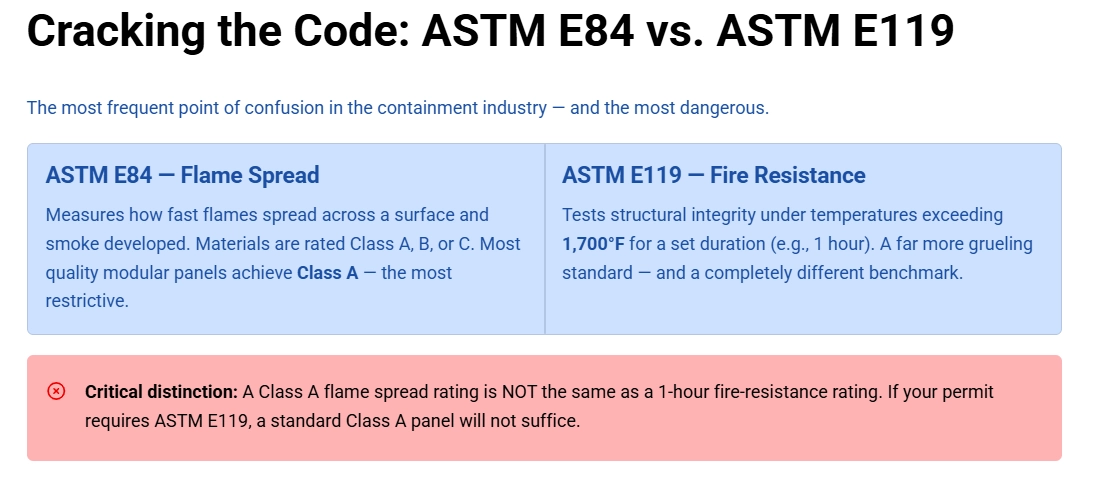
ASTM E84 is the standard test method for surface burning characteristics of building materials. It measures two primary things: how fast a flame spreads across a surface and how much smoke is developed. Materials that pass this test are categorized into Class A, B, or C, with Class A being the most restrictive.
Most high-quality modular wall panels are Class A rated under ASTM E84. This means that if a fire starts, the wall itself will not contribute significantly to the spread of the flames or the production of toxic smoke.
ASTM E119: Real Fire Resistance and Hourly Ratings
In contrast, ASTM E119 is a far more grueling test. It measures the ability of a wall assembly to maintain its structural integrity and prevent the passage of heat and flame for a specific duration, such as one hour. During an ASTM E119 test, the barrier is subjected to temperatures exceeding 1,700 degrees Fahrenheit.
Why Class A Flame Spread Is Not Always a Fire Rating
A common mistake is assuming that a Class A material is the same as a 1-hour fire-rated barrier. It is not. A Class A panel prevents flames from racing across its surface, but it may not prevent heat from transferring through the panel or the barrier from collapsing under intense fire conditions. If your permit or fire marshal specifically requires a 1-hour fire-resistance rating, a standard Class A modular panel will not suffice without additional engineering or a purpose-built fire-rated system.
This is also a key consideration in the broader debate between modular systems and drywall. For a full cost and compliance breakdown, see our analysis of temporary walls vs. drywall for general contractors.
The Regulatory Landscape for California Construction
California has some of the most stringent fire and building codes in the nation. Contractors must balance local municipal rules with state-level mandates.
California Fire Code (CFC) Chapter 33 Requirements
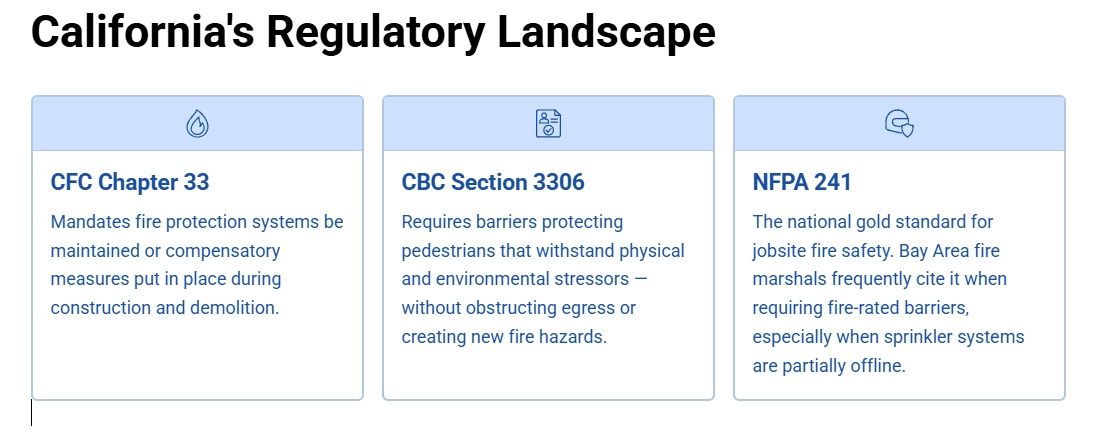
The California Fire Code (CFC) Chapter 33 focuses on fire safety during construction and demolition. It mandates that fire protection systems be maintained or that compensatory measures be put in place if they are impaired. This often triggers the need for more robust containment barriers that can contain a fire within the construction zone.
California Building Code (CBC) and Section 3306 Compliance
The California Building Code (CBC) Section 3306 requires protection for pedestrians and the public during construction. This includes the use of barriers that can withstand specific physical impacts and, in many cases, environmental stressors like fire. For occupied buildings, these barriers must not obstruct egress routes or create new fire hazards.
The Role of NFPA 241 in Safeguarding Jobsites
The NFPA 241 standard is the national gold standard for safeguarding construction, alteration, and demolition operations. It requires that a fire safety program be established for every project. Fire marshals in the Bay Area frequently cite NFPA 241 when requiring fire-rated barriers, especially in complex renovations where the building’s main fire alarm or sprinkler system may be partially offline.
When Fire-Rated Temporary Walls Are Mandatory
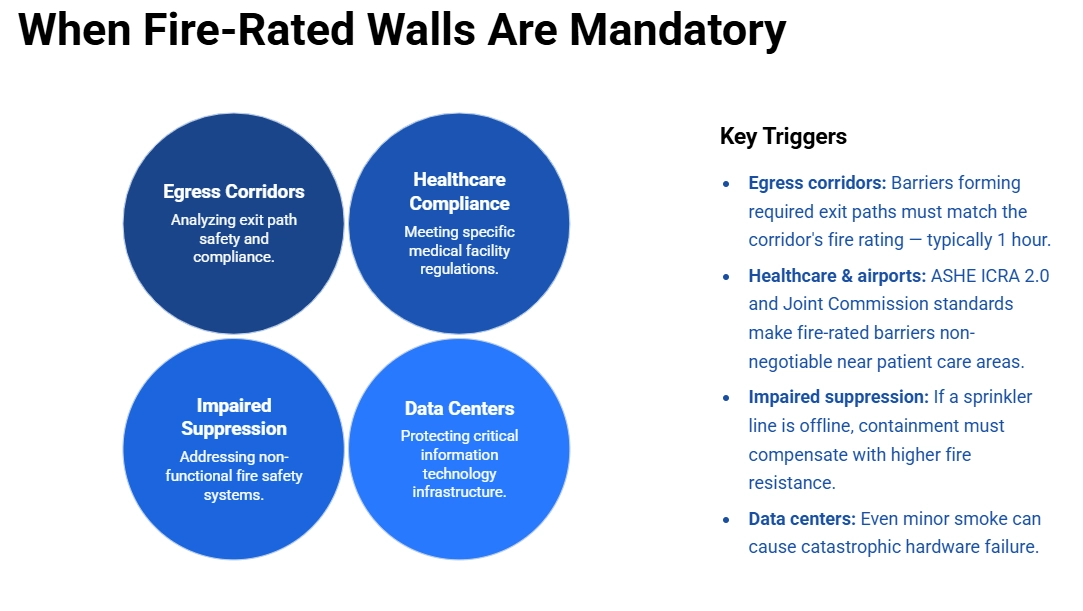
Legal requirements for fire-rated containment are usually triggered by the proximity of the construction to the public and the potential impact on evacuation routes.
Protecting Required Means of Egress and Corridors
If your construction barrier forms part of a required egress corridor, it must typically match the fire rating of the original corridor. In many commercial buildings, this means a 1-hour fire-resistance rating is required to ensure that tenants can safely exit the building during an emergency without the construction zone compromising their path.
High-Risk Occupancies: Healthcare, Airports, and Malls
In healthcare environments, the stakes are even higher. The ASHE ICRA 2.0 framework and Joint Commission standards require rigorous infection control combined with fire safety. If a renovation takes place near patient care areas where occupants cannot easily be moved, fire-rated barriers are often a non-negotiable requirement of the Interim Life Safety Measures (ILSM).
Similarly, in high-traffic areas like San Francisco International Airport or major retail centers, fire marshals often demand fire-rated containment to prevent a small construction fire from becoming a mass casualty event. For a deeper look at ICRA requirements specifically, see our post on
what ICRA-compliant containment walls actually require.
Renovations in Buildings with Impaired Fire Suppression
If your project requires shutting down a sprinkler line or a fire alarm zone for more than a few hours, the building’s overall fire safety is compromised. In these cases, the temporary containment walls must often compensate by providing a higher level of fire resistance to contain potential incidents within the work zone.
Containment in Critical Infrastructure and Data Centers
Data centers are a growing sector in the Bay Area. These facilities house sensitive hardware where even a small amount of smoke can cause catastrophic failure. Using fire-rated containment in these environments is often a standard operational requirement to protect both the building and the critical data it houses. Our post on why data centers need modular containment during live operations covers this in detail.
When You Don’t Need a Fire-Rated Wall
While safety is paramount, over-engineering a project can lead to unnecessary costs and delays. Not every barrier needs to be a 1-hour fire-rated assembly.
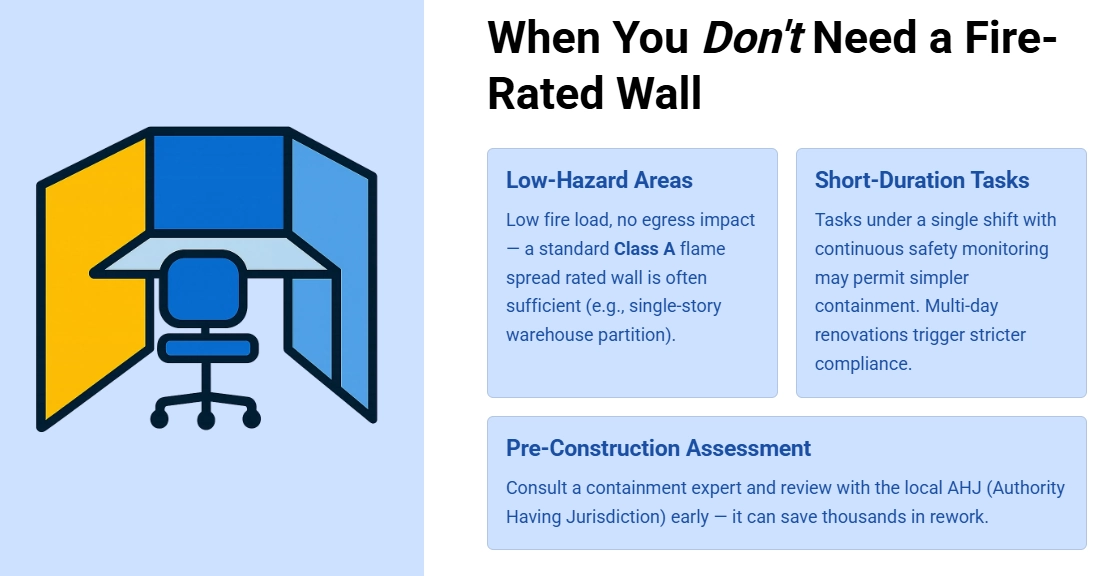
Low-Hazard Areas and Non-Combustible Zones
If construction is occurring in an area with low fire load and where the barrier does not infringe on egress paths, a standard Class A flame spread rated wall is often sufficient. For example, a small office partition change in a single-story warehouse may not trigger the same requirements as a high-rise corridor.
Short-Duration Maintenance Tasks
For tasks that last less than a single shift and are constantly monitored by safety personnel, simpler containment methods may be permitted. However, as soon as the project becomes a multi-day renovation, the permanence of the barrier triggers stricter code compliance.
Determining the Scope with a Pre-Construction Risk Assessment
The only way to know for sure is to conduct a risk assessment. Consulting with a containment expert and reviewing the project with the local Fire Marshal or Authority Having Jurisdiction (AHJ) early in the planning phase can save thousands in rework. 5DCCS offers containment consultations as part of our full-service containment process.
The Hazards of Traditional Methods: Poly Sheeting and Drywall
Historically, contractors relied on plastic sheeting or temporary drywall. Both have significant drawbacks when fire safety is considered.
The Hidden Fire Risk of Plastic Sheeting
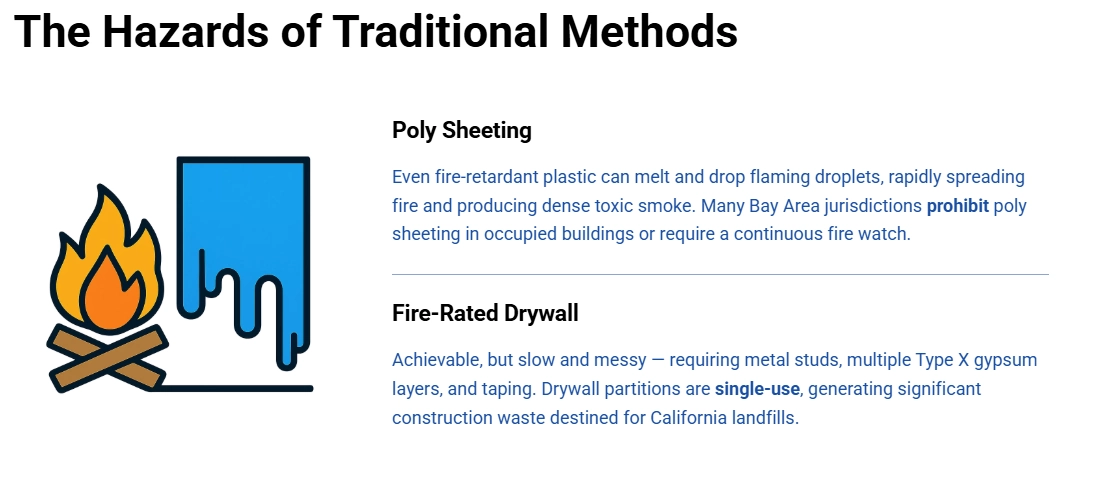
Plastic sheeting, often called poly, is a major fire hazard. Even fire-retardant plastic can melt and drop flaming droplets, which can rapidly spread a fire and create dense, toxic smoke. In many Bay Area jurisdictions, the use of plastic sheeting for anything more than very short-term dust protection in occupied buildings is strictly prohibited or requires a continuous fire watch.
The Labor-Intensive Reality of Fire-Rated Drywall Barriers
Drywall can be fire-rated, but building a fire-rated drywall partition is a slow, messy process. It requires metal stud framing, multiple layers of Type X gypsum board, and taping/mudding to achieve the rating. This process creates a significant amount of dust and requires substantial labor hours for both installation and teardown. Drywall partitions are also single-use and end up in California landfills, contributing to construction waste. To understand just how significant those costs are, see our cost savings analysis for temporary walls in California.
Modern Solutions: Modular Systems for Superior Protection
Modular containment systems have changed how the industry approaches fire safety on the jobsite. These systems offer the protection of traditional methods with the speed of modern logistics.
Speed and Efficiency in Fire-Rated Installations
Modern modular systems can be installed up to ten times faster than drywall. For projects that require 1-hour fire ratings, purpose-built fire-rated systems provide a tested, code-compliant assembly that can be deployed in a fraction of the time. This allows projects to stay on schedule while maintaining the highest safety standards. To explore the full range of options available, visit our services and solutions page.
Sustainability and Reusability in Containment
At 5DCCS, our vision is to make the world greener by providing reusable alternatives to drywall. Modular panels can be used on dozens of projects, preventing thousands of tons of waste from entering landfills. For a business in Northern California, this is both a financial advantage and an environmental responsibility. Learn more about our approach in our piece on sustainable modular temporary walls in California.
Bay Area Fire Marshal Expectations: What We See in the Field
In cities like San Francisco and San Jose, fire marshals are increasingly looking for professional, engineered containment solutions. They expect to see clear labeling on panels indicating flame spread and smoke developed ratings. If a project involves a high-rise building or a healthcare facility, they will often ask for the specific testing data (ASTM E84 or E119) for the containment system.
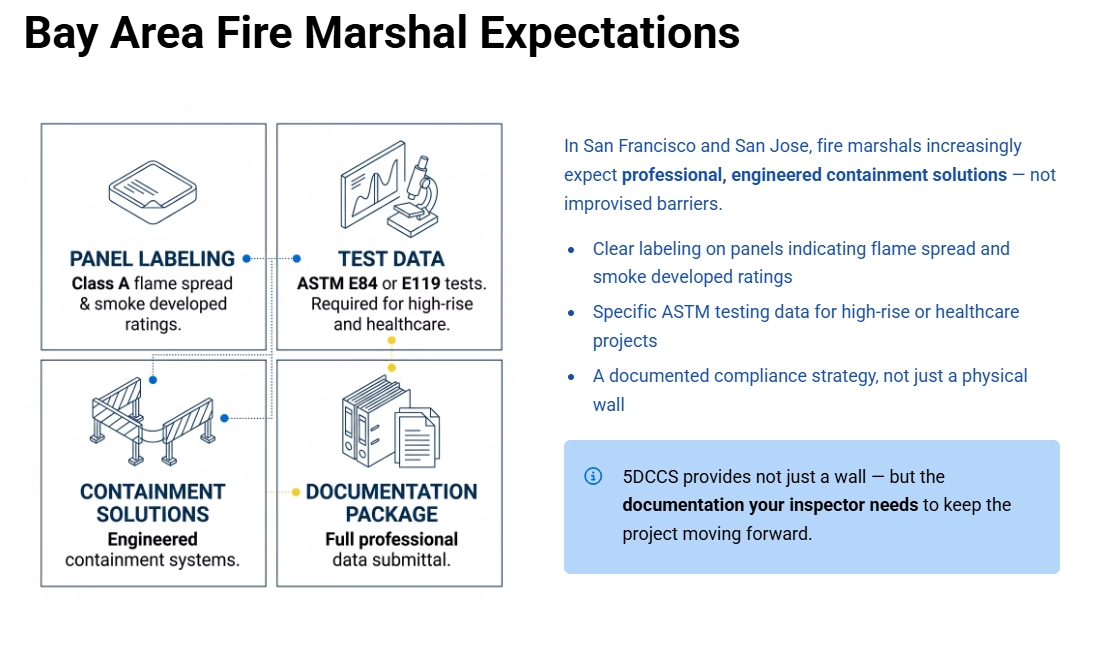
Using 5DCCS provides not just a wall, but the documentation your inspector needs to keep the project moving. We ensure that our panels meet the required standards and can supply the supporting data on request.
Conclusion: Making the Safe Choice for Your Next Renovation
Choosing between fire-rated and standard containment is not just a budget decision. It is a critical safety choice. By understanding the difference between flame spread and fire resistance, and knowing when the California Building Code requires a higher standard, you can protect your project, your reputation, and the people in your building.
Whether you need a simple Class A barrier for an office remodel or a fully rated system for a hospital corridor, 5DCCS is your partner in the Bay Area. We combine technical expertise with a commitment to excellence to ensure your containment is always compliant and always safe.
Ready to get started? Contact Construction Containment Services to discuss code-compliant fire-rated containment for your next Bay Area project.