
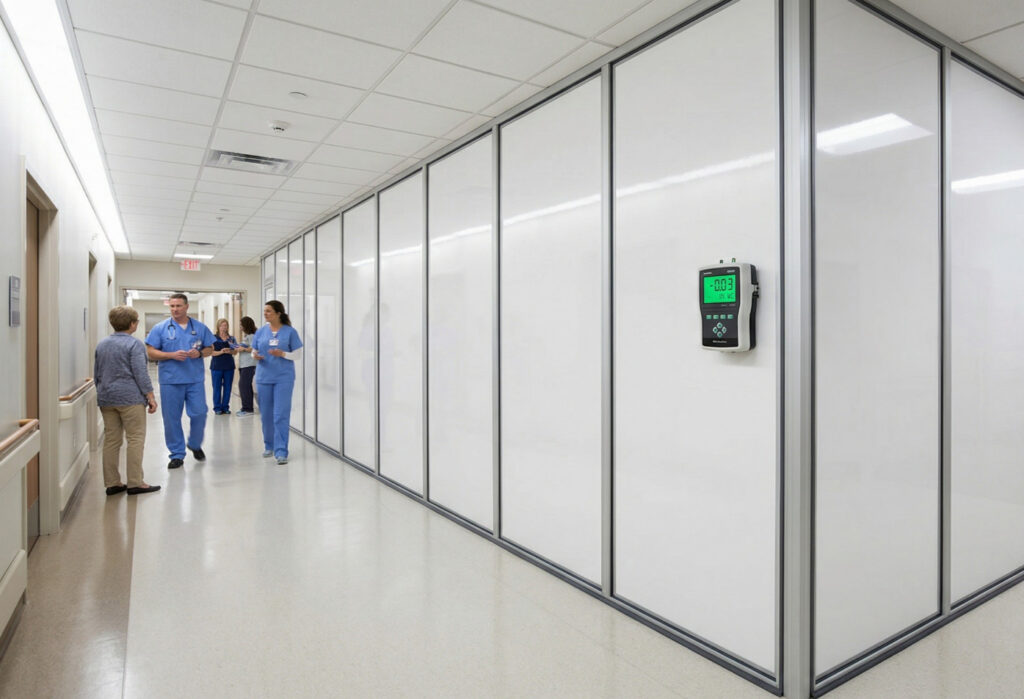
Clean Construction: Dust Control for Occupied Commercial Spaces
Performing a major renovation within an occupied commercial building is one of the most complex logistical challenges a general contractor or facility manager will face. In these “live” environments, construction dust is not just a cleaning nuisance — it is a significant health hazard, a regulatory liability, and a direct threat to your business continuity. This guide explores how advanced modular containment and strategic air management create a “clean construction” environment that protects your occupants while keeping your project on schedule.
Construction and renovation within active commercial, institutional, and healthcare facilities represent a fundamental departure from standard vacant-site work. In an occupied space, the contractor must simultaneously manage industrial-level safety hazards while protecting building occupants — employees, patients, customers, and students — who did not consent to the risks of a job site.
At Construction Containment Services (5DCCS), we understand that the cornerstone of a successful occupied renovation is a “Clean Construction” strategy. As a veteran-owned and service-disabled veteran-owned small business (SDVOSB) based in San Jose, we bring military-grade discipline and precision to the management of the “5 Ds” of construction: Dust, Debris, Decibels, Demolition, and Disruption.
The High Stakes of Dust Control in Occupied Environments
In an occupied building, construction dust is far more than an aesthetic issue. Fine particulates generated during demolition, cutting, and grinding are classified as “respirable,” meaning they are small enough to be inhaled deep into the lungs.
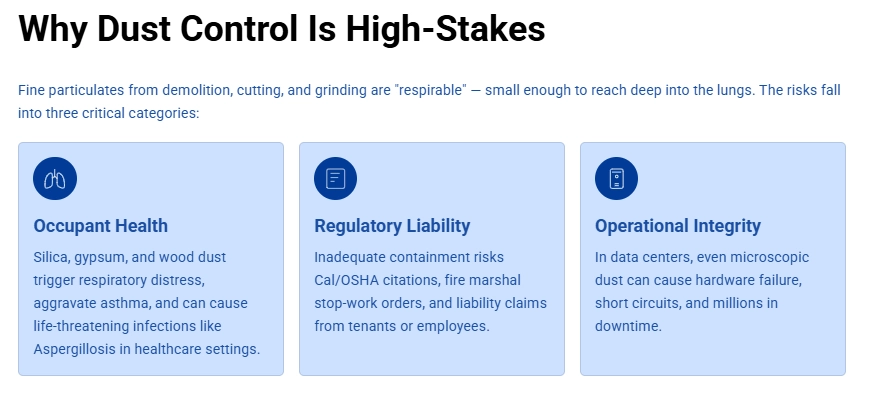
Why Construction Dust is a Multi-Dimensional Risk
The risks associated with inadequate dust control fall into three critical categories:
- Occupant Health: Exposure to silica, gypsum, and wood dust can trigger acute respiratory distress, aggravate asthma, and — in healthcare settings — lead to life-threatening infections such as Aspergillosis.
- Regulatory Liability: Failure to contain dust can result in significant Cal/OSHA citations, fire marshal stop-work orders, and liability claims from tenants or employees.
- Operational Integrity: In mission-critical environments like data centers, even microscopic dust can cause hardware failure, short circuits, and millions of dollars in downtime.
The Hidden Vector: HVAC System Contamination
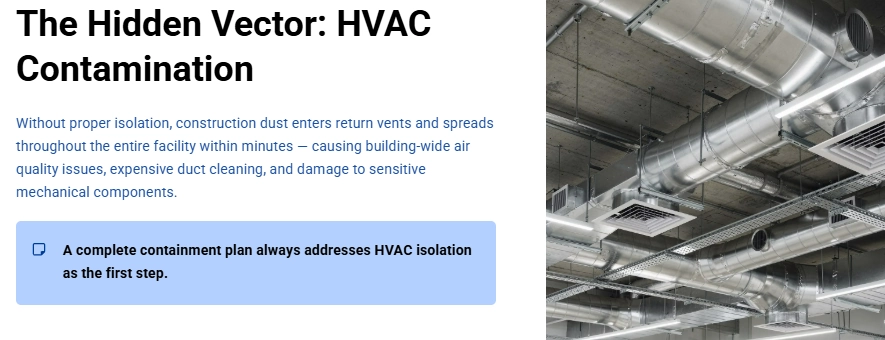
One of the most overlooked hazards is the building’s own HVAC system. Without proper isolation, construction dust enters return vents and is distributed throughout the entire facility within minutes. This can lead to building-wide air quality issues, expensive duct cleaning requirements, and damage to sensitive mechanical components. A complete containment plan always accounts for HVAC isolation as a first step.
The Regulatory Framework: Cal/OSHA and Federal Standards
Navigating the legal landscape of construction in Northern California requires a deep understanding of both federal and state-level standards.
OSHA 29 CFR 1926.1153: The Silica Standard
The federal OSHA Respirable Crystalline Silica Standard (29 CFR 1926.1153) is the primary regulation governing dust from concrete, masonry, and tile. It establishes a Permissible Exposure Limit (PEL) of 50 µg/m³ and an Action Level (AL) of 25 µg/m³. Any task that exceeds these levels — such as drilling for wall anchors or demolishing old masonry — requires stringent engineering controls.
Cal/OSHA Title 8, Section 1530.1 and 1532.3
California operates under some of the nation’s strictest safety laws. Cal/OSHA Title 8, Section 1530.1 specifically mandates the use of dust reduction systems — such as HEPA-filtered vacuums or water suppression — whenever power tools are used on concrete or masonry. Section 1532.3 addresses lead exposure, adding another layer of compliance for work in older buildings. Our team at 5DCCS holds federal and California OSHA 30-hour certifications, ensuring that every containment plan we design meets these rigorous state standards.
NFPA 241 and Fire Safety Compliance
NFPA 241 governs safeguarding construction operations. In occupied buildings, any temporary barrier used for dust control must also satisfy fire safety codes. For instance, barriers along egress paths often require an ASTM E119 one-hour fire-resistance rating. 5DCCS offers specialized systems like STARC FireblockWall™, which meet these critical fire safety requirements. For a deeper look at this topic, see our guide on fire-rated temporary walls on construction jobsites.
ICRA 2.0: The Gold Standard for Sensitive Occupancies
The Infection Control Risk Assessment (ICRA) framework, developed by the American Society for Health Care Engineering (ASHE), provides the industry benchmark for managing air quality in sensitive environments.
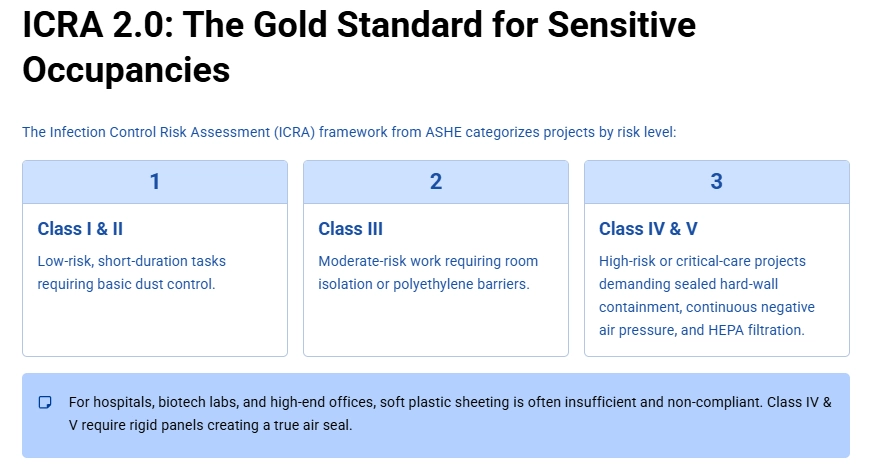
Understanding the Five Classes of Containment
The ICRA 2.0 matrix categorizes projects by risk level:
- Class I & II: Low-risk, short-duration tasks requiring basic dust control.
- Class III: Moderate-risk work requiring room isolation or polyethylene barriers.
- Class IV & V: High-risk or critical-care projects demanding sealed hard-wall containment, continuous negative air pressure, and HEPA filtration.
Why Class IV and V Demand Rigid Modular Barriers
For projects in hospitals, biotech labs, or high-end offices, soft plastic sheeting is often insufficient and non-compliant. Class IV and V standards require rigid panels that create a true air seal and can withstand the pressure differentials required for negative air management. Learn more about what ICRA-compliant containment walls require and how our systems meet that bar. For a detailed breakdown of Class IV versus Class V requirements, see our dedicated guide on ICRA Class IV vs. Class V for Bay Area hospital containment.
Engineering “Clean Construction” with Modular Containment
At 5DCCS, we leverage a hierarchy of controls to ensure a clean work zone.
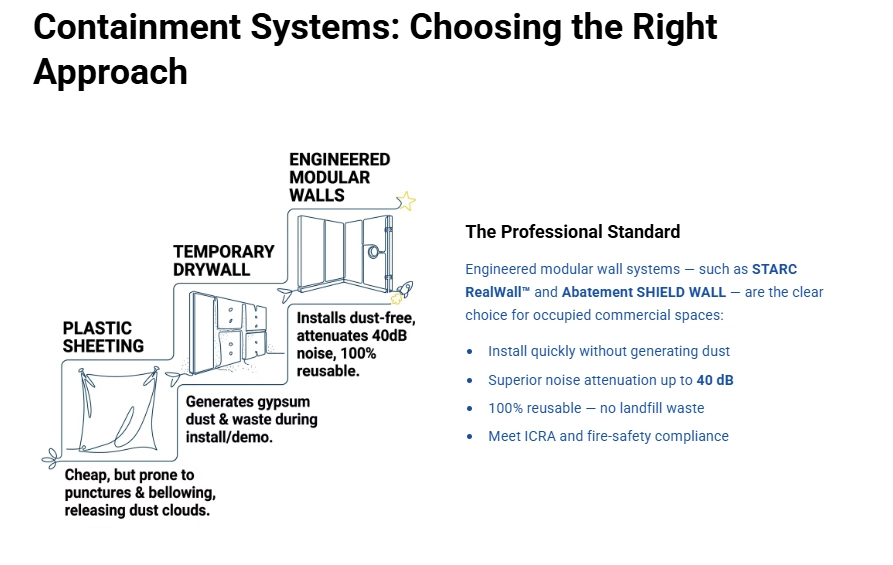
The Hierarchy of Control: Plastic vs. Drywall vs. Modular
- Plastic Sheeting: Cheap but prone to punctures and “bellowing,” which can release dust clouds into occupied hallways.
- Temporary Drywall: Better than plastic but creates a second mess during installation and demolition, generating significant gypsum dust and landfill waste.
- Engineered Modular Wall Systems: The professional standard. Systems like STARC RealWall™ and Abatement SHIELD WALL install quickly without generating dust, provide superior noise attenuation (up to 40 dB), and are 100% reusable.
For a detailed cost analysis of these three approaches, read our post on temporary walls vs. drywall: a true cost comparison for general contractors.
Negative Air Pressure and HEPA Filtration Protocols
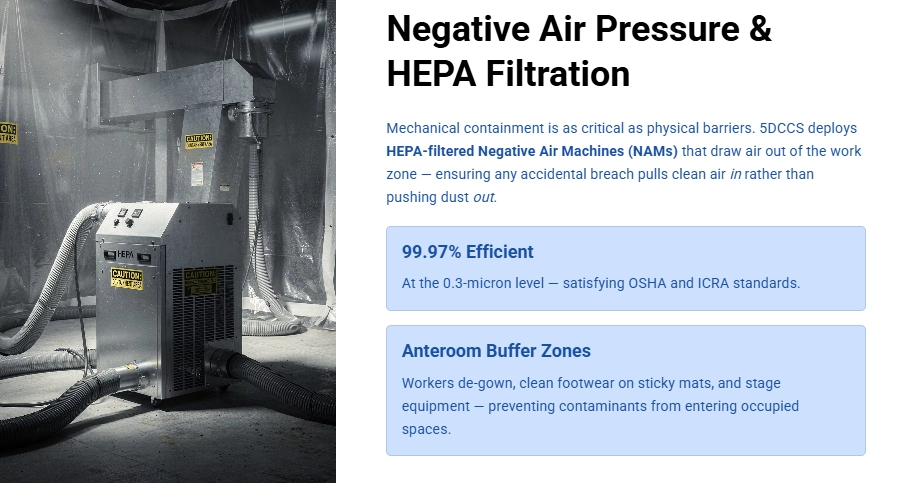
Mechanical containment is just as important as physical barriers. We deploy HEPA-filtered negative air machines (NAMs) that draw air out of the work zone, ensuring that any accidental breach in the wall pulls clean air in rather than pushing dust out. These units must be 99.97% efficient at the 0.3-micron level to satisfy OSHA and ICRA standards.
The Role of Anterooms and Decontamination Zones
For high-risk environments, an anteroom serves as a vital buffer zone. It provides a space for workers to de-gown, clean footwear on adhesive “sticky mats,” and stage equipment. This prevents the “airlock effect” failure, where opening a single door immediately releases contaminants into the occupied space.
Operational Strategies for Northern California Facilities
Successful “Clean Construction” begins long before the first panel is installed. Our team serves facilities across the entire Northern California Bay Area, from San Jose to Oakland and San Francisco.
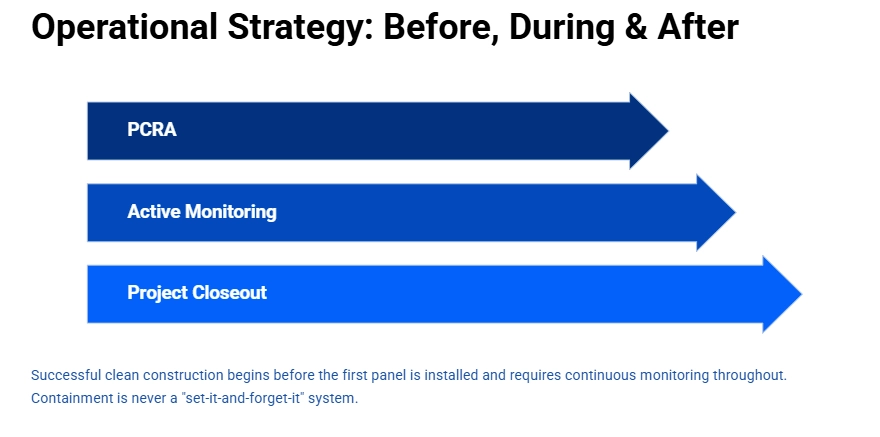
Pre-Construction Risk Assessment (PCRA)
Our 5-step process begins with a comprehensive site assessment. We collaborate with GCs and facility managers to identify sensitive occupants, map HVAC zones, and determine the appropriate ICRA or Cal/OSHA classification. This PCRA is a requirement under ASHE’s ICRA 2.0 guidelines for any work in or adjacent to healthcare occupancies.
Ongoing Monitoring and Inspection Requirements
Containment is not a “set-it-and-forget-it” system. A professional installation requires:
- Daily Visual Inspections: Checking for seal integrity and door function.
- Pressure Monitoring: Using manometers to log and document active negative pressure, in compliance with Cal/OSHA documentation requirements.
- Sticky Mat Maintenance: Replacing debris-loaded mats to ensure footwear cleaning remains effective.
Why 5DCCS is Your Partner in Clean Construction
Choosing the right containment partner is about more than just equipment — it’s about reliability and expertise.
Veteran-Owned Discipline in Site Containment
Our founder, Amir Jenkins, a service-disabled veteran, manages all aspects of the business with the discipline and accountability inherent in military service. Our PACTS framework (Professional, Accountable, Customer First, Timely, Sustainable) ensures that every project is executed to the highest quality standards. Learn more about our story and credentials.
Turnkey Solutions for Bay Area GCs and Facility Managers
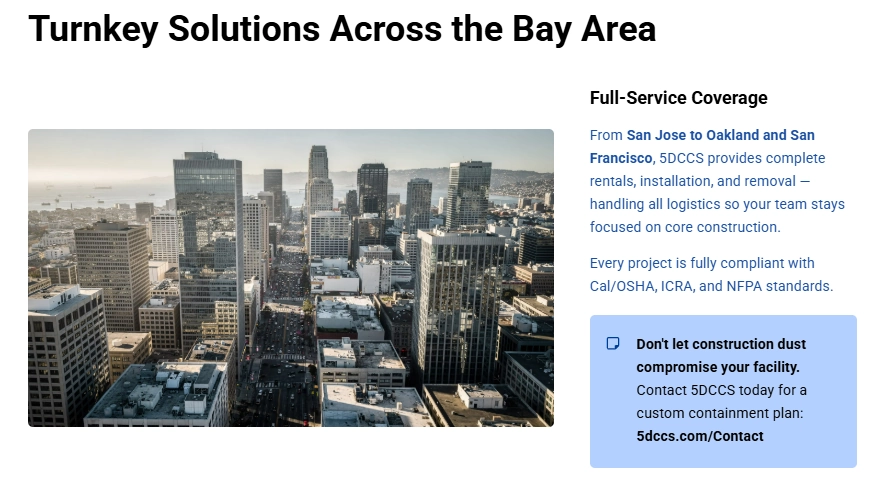
From San Jose to Oakland and San Francisco, 5DCCS provides full-service rentals, installation, and removal. We handle the logistics so your team can focus on the core construction tasks, knowing that the environment is protected and your project is fully compliant with all local regulations. Learn more about why contractors choose 5DCCS for their most critical containment work.
Don’t let construction dust compromise your facility’s safety or your project’s reputation. Partner with the Northern California containment specialists who prioritize clean construction.
Contact Construction Containment Services (5DCCS) today for a custom containment plan.